Wes Cecil argues that a single word—Cheerios—holds the key to understanding late capitalism. And no, he's not joking.
The author's core claim is striking: our economic dysfunction isn't accidental. It's designed. Late capitalism actively disorients us to prevent clear thinking about what we're really facing.
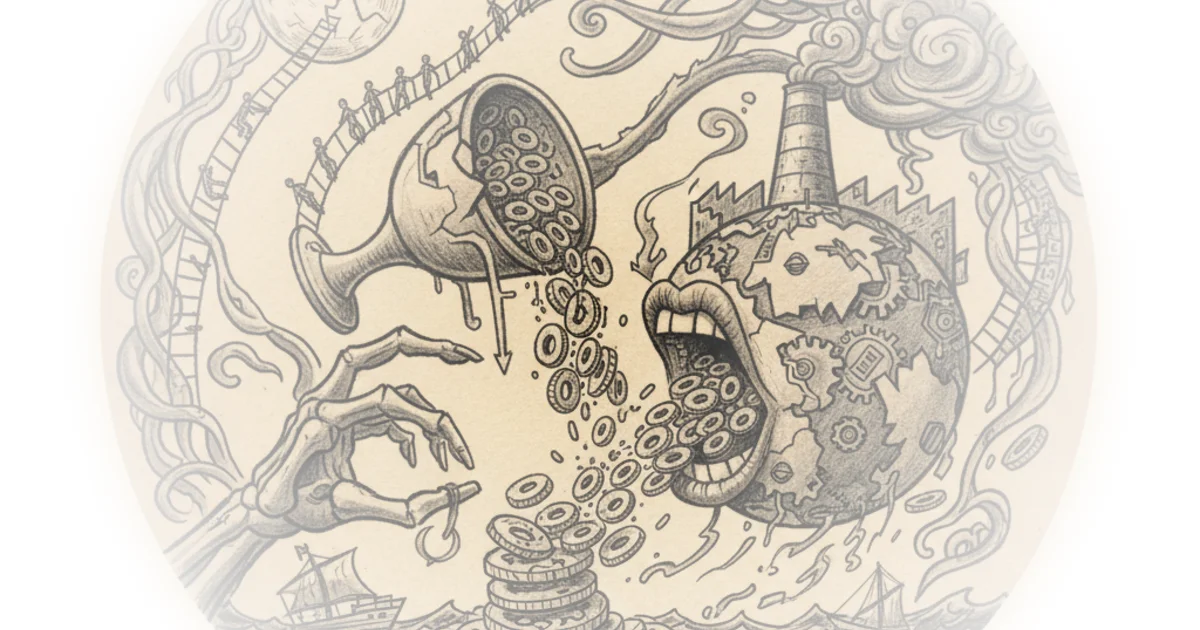
The Unaskable Question
Cecil identifies the "unaskable question" as where wealth actually comes from. Our society tells us the answer is simple—get money. But asking why questions threatens the fundamental assumptions that underpin our economic system. You must assume wealth means money, just as in fundamentalist cultures where certain religious questions are forbidden.
The Unanswerable Questions
When examined closely, our economy raises more questions than answers. Why did higher education transform from free or affordable to costing $50-80,000 per year? How can GDP growth and technological efficiency coexist with increasingly exclusionary costs for essential services?
The same paradox applies to housing—why have normal jobs stopped enabling home ownership when everything supposedly improved? The standard response suggests making more money solves all problems. Yet wages haven't risen proportionally to these escalating costs.
Everything's getting better, everything's growing, we're all getting rich. Don't worry about that.
The Cheerios Principle
Cecil introduces "Cheerios" as the crucial insight for understanding this puzzle. A box of Cheerios from 1950 adjusted for inflation should cost around 30 cents per ounce, but today costs about 60 cents—doubled in price despite efficiency improvements in logistics, crop subsidies, and manufacturing.
The actual ingredients represent only a fraction of the total cost: a $6 box contains roughly $1.50 worth of cereal, with the rest absorbed by financial extraction at every supply chain step.
This pattern extends beyond cereal to all essential goods—a systematic outcome where everyone—from producers to stores to packaging to marketing—extracts maximum profit margin, driving prices upward rather than downward.
Financialization and Housing
The same dynamic appears in housing through a complex process: Goldman Sachs obtains capital at 3%, loans it to entities like Blue Owl at roughly 6% interest. These intermediaries then lend to builders at 12-18%, who pass those costs onto property buyers, creating titanic price increases that make home ownership increasingly impossible.
Critics might note that the Cheerios example focuses on a single US brand while European equivalents show different pricing structures—but Cecil would argue that's precisely what proves his point: the extraction model is uniquely American.
Bottom Line
Cecil's strongest argument is that rising costs despite efficiency gains isn't a bug in the system—it's the feature. Every step in the supply chain extracts value, and financialization compounds this at each intermediary level. His vulnerability lies in whether this analysis offers any actionable path forward beyond understanding the problem. That question remains for part two.