Scott Alexander delivers a rare masterclass in the mechanics of thought, arguing that the most common writing failures are not stylistic but moral. While most advice columns focus on grammar or flow, Alexander identifies a deeper rot: the writer's instinct to smuggle in unearned conclusions or hide behind safe, hollow structures. This is not just about better prose; it is about the integrity of the argument itself.
The Cost of Microdishonesty
Alexander opens with a provocative claim: the English language possesses a kind of moral compass that punishes even the slightest deviation from truth. He writes, "The English language hates the slightest whiff of dishonesty, even levels so small you wouldn't naturally notice them yourself. It punishes you by making your writing worse." This framing is striking because it shifts the blame from the reader's lack of attention to the writer's lack of courage. He illustrates this with a mentee who tried to "smuggle" their actual point into an essay about a different, more presentable topic, a tactic Alexander notes is a "clever plan, but your readers will notice."
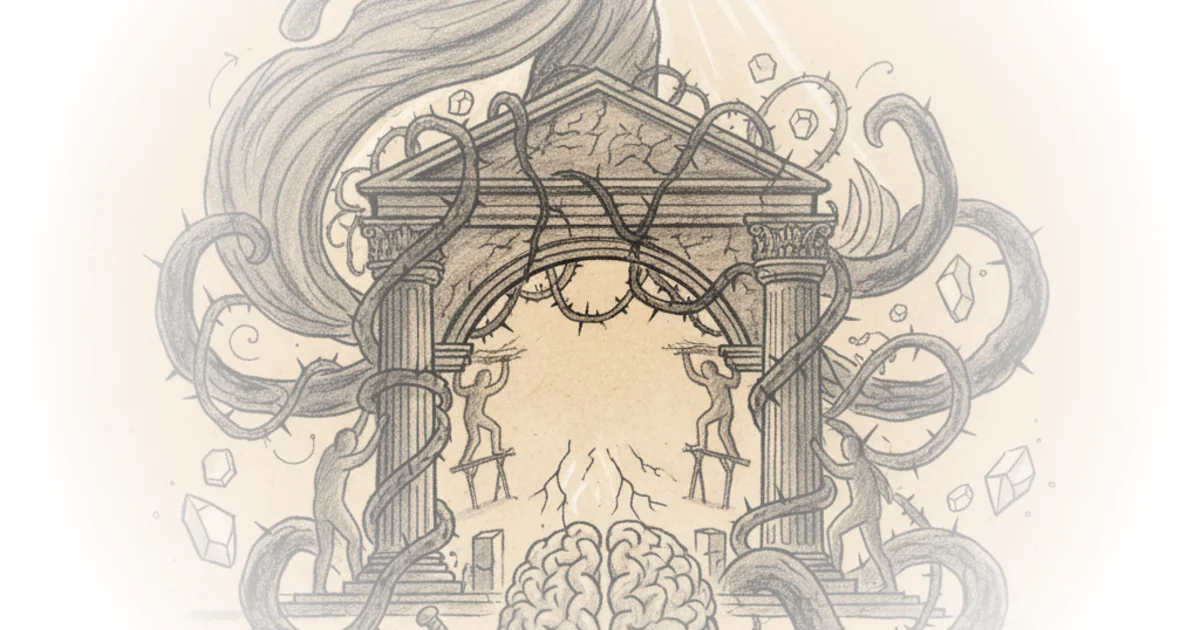
The core of his argument here is that structural dishonesty creates a friction that the reader feels but cannot name. When a writer forces a narrative arc that doesn't match their experience—such as fabricating a "recovery of faith" that is merely aspirational—the prose collapses under the weight of its own pretense. This resonates with the concept of Moore's paradox, where asserting a fact while simultaneously expressing disbelief in it creates a logical impossibility that feels deeply unsettling. Alexander suggests that writing is the same; you cannot assert a conclusion you do not genuinely hold without the sentence structure betraying you.
Critics might argue that all writing involves some degree of curation and that "honesty" is subjective. However, Alexander's point is not about raw, unfiltered confession, but about the alignment between the writer's intent and the text's structure. When that alignment breaks, the reader's trust evaporates.
The Trap of the Cliché and the Mountaintop
Moving to style, Alexander dismantles the obsession with eliminating clichés. He observes that trying to purge every common phrase leads to a "hypersensitivity" where a writer replaces "a good start" with "a beneficial beginning," creating prose that is "equally barbaric." Instead, he reframes clichés as "missed quest hooks," suggesting that phrases like "the arc of history" are signs that the writer has stopped thinking and started recycling. He proposes a radical solution for beginners: "go to a monastery on a distant mountaintop and submit to some discipline for thirty years."
This "mountaintop" metaphor serves as a pedagogical tool rather than a literal instruction. Alexander argues that one must first master the rules—no adverbs, no hedging, no passive voice—before one can effectively break them. He writes, "If you're just getting started, practice by avoiding passive voice until this effort gives you an ear for the indescribable bad thing, then avoid the indescribable bad thing directly." This echoes the rationalist principle of Coherent Extrapolated Volition, where the goal is not just to follow rules but to understand the underlying values they protect. By forcing a writer to strip away the crutches of passive voice and excessive hedging, they are forced to confront the clarity of their own thoughts.
Reject the cliches handed to you by past generations, and you will have to build every brick of your edifice from scratch as you go.
The danger here is that such rigid discipline could stifle creativity in the short term. Yet, Alexander's experience suggests that the "indescribable bad thing" that passive voice often masks is actually a lack of agency in the sentence. By enforcing active voice, the writer is forced to take responsibility for the action, which naturally leads to more precise and engaging prose.
The Hollow Explainer and the Five-Paragraph Trap
Perhaps the most incisive critique in the piece is directed at the "explainer" genre. Alexander argues that these articles often suffer from a lack of genuine purpose, becoming a form of "microdishonesty" where the writer feels they "should" write about a topic like AI without having a specific argument to make. He asks, "What do you put in your explainer? Prompt engineering advice? The reasons some people don't like data centers?" He concludes that without a constrained reason for writing, the content becomes hollow.
He extends this critique to the traditional five-paragraph essay, describing it as "lazy, cliched, [and] soulless." The structure, which demands a broad philosophical opening, three pieces of evidence, and a restatement of the thesis, often forces writers to manufacture arguments that fit the mold rather than letting the evidence dictate the structure. Alexander suggests that the solution is to frame writing as an answer to a genuine question, imagining a child asking, "What would satisfy their curiosity?" rather than filling a quota.
This approach challenges the institutional habit of treating writing as a performance of knowledge rather than an act of discovery. It aligns with the "Death of the Author" concept, not by removing the author's intent, but by forcing the author to serve the reader's curiosity rather than their own desire to appear authoritative. The writer must ask: "Do I actually have something to say, or am I just filling space?"
Bottom Line
Alexander's strongest contribution is the redefinition of good writing as a byproduct of intellectual honesty rather than stylistic flair. The piece's vulnerability lies in its assumption that all writers are capable of this level of self-scrutiny; for many, the "mountaintop" discipline may feel like an insurmountable barrier. However, the verdict is clear: if you want your writing to resonate, you must stop trying to sound smart and start trying to be clear about what you actually believe.
The English language hates the slightest whiff of dishonesty, even levels so small you wouldn't naturally notice them yourself. It punishes you by making your writing worse.