Most of us live our days in the messy, unedited raw footage of existence, yet we consume media that promises a clean, purposeful narrative arc. Tom van der Linden tackles the dissonance between the structured logic of storytelling and the chaotic randomness of reality, arguing that the very act of telling a story imposes a destiny that life rarely offers. This is not just a critique of plot devices; it is a profound inquiry into why we feel so inadequate when our own lives refuse to follow a script, and how the illusion of purpose is manufactured after the fact.
The Architecture of Destiny
Van der Linden begins by dissecting the ubiquity of the "hero's journey," a framework popularized by Joseph Campbell that dictates a hero leaves an ordinary world, faces a crisis, and returns transformed. He notes that while this structure is comforting, it creates a fundamental gap with our actual experiences. "Whereas the hero's journey is clearly structured, our own often feels messy and chaotic," he observes. In stories, every character and event serves a purpose; in life, we encounter the incidental and the meaningless. The author argues that this isn't just a difference in genre, but a difference in the nature of existence itself.
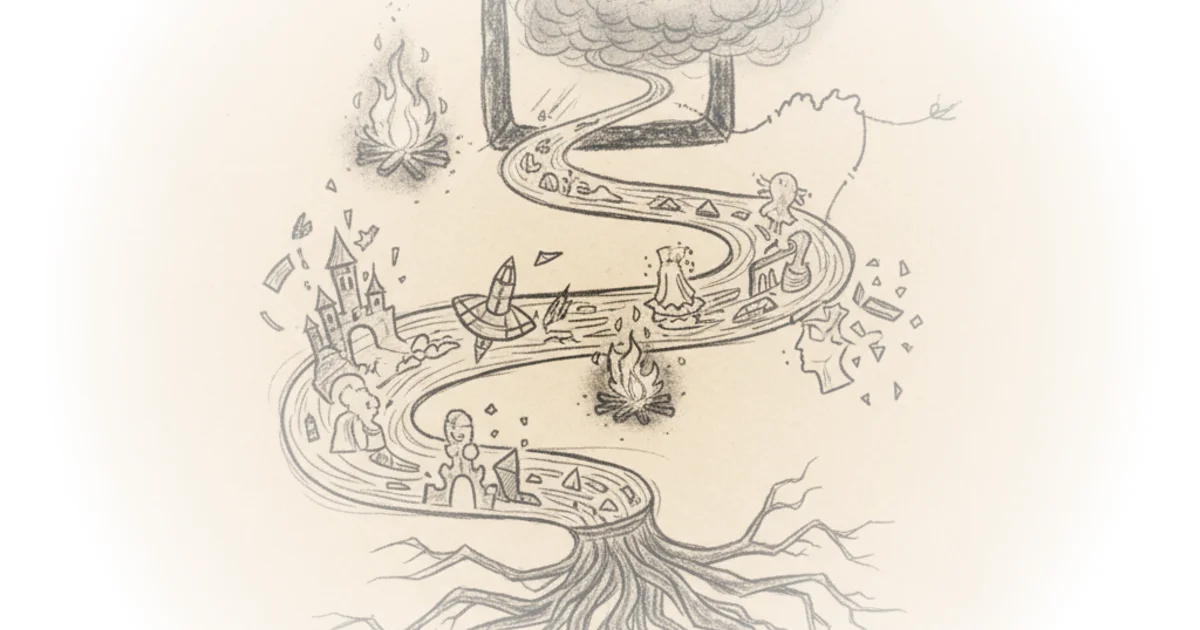
The commentary here is sharp because it identifies a specific psychological pain point: the feeling that our lives lack the "tangible meaning" found in fiction. Van der Linden writes, "Whereas the hero encounters events and characters that are purposeful to the larger adventure, our own experiences often feel incidental and lacking in tangible meaning." This framing is effective because it shifts the blame from the individual's lack of achievement to the structural differences between art and reality. We aren't failing to be heroes; we are living in a world that doesn't edit out the boring parts.
Whereas the hero's journey is clearly structured, our own often feels messy and chaotic.
The Illusion of the Ordinary
The piece then pivots to the most critical insight: the concept of "destiny" is a narrative tool, not a biological or historical fact. Van der Linden points out that in nearly every major story, the hero is never truly ordinary to begin with. Luke Skywalker is the son of a villain; Harry Potter is the boy who lived; Neo is the One. The author argues, "They were never truly ordinary but were already fated to become extraordinary heroes long before that first call to adventure." This determinism ensures that the journey feels inevitable, whereas in reality, most extraordinary outcomes are the result of random chance, not prophecy.
Even when stories feature "ordinary" people rising to greatness, Van der Linden suggests this is a retrospective illusion. He explains that "all stories are essentially told backwards by their very nature," meaning the end is built into the beginning. Because the storyteller knows the destination, they curate the journey to show only the moments that led there. "It is why everything we see the hero do is filled with promise and purpose and why we rarely see them spend a lot of time doing uninteresting ordinary things like eating folding laundry or filling out tax forms." This is a devastatingly accurate critique of how we consume biographies and news. We are fed a highlight reel and mistaken it for a life.
Critics might note that this view risks dismissing the genuine agency of individuals who overcome immense odds without a "destiny." However, Van der Linden's point is not that these people didn't succeed, but that the story of their success is a constructed narrative that smooths over the chaos and luck involved.
The Tragedy of Structure
The author also addresses tragedy, using examples like Ned Stark in Game of Thrones or Walter White in Breaking Bad. He argues that even tragedy follows a rigid structure, often an inversion of the hero's journey where a character's fundamental flaw leads to their downfall. "What makes a tragic hero tragic is that they meet their fate because they are acting with good intentions," he writes. The structure remains intact; only the outcome changes. This reinforces the central thesis: stories are about patterns, while reality is about the unpredictable.
Van der Linden highlights how modern media sometimes tries to subvert this, citing Blade Runner 2049 and Star Wars: The Last Jedi, where characters discover they are not special. "You imagined it was you and that he wasn't going on a hero's journey in the way he thought he did," he paraphrases the realization of the replicant hero. These moments are powerful precisely because they break the contract of destiny, forcing the audience to confront the possibility that they, too, might be ordinary. Yet, even these subversions are carefully plotted, proving that the desire for structure is so strong that even the denial of it becomes a plot point.
All stories are essentially told backwards by their very nature. The end is always built into the beginning.
Bottom Line
Tom van der Linden's analysis succeeds in exposing the "determinism" that underpins our favorite stories, offering a necessary corrective to the feeling that our own lives are failing to measure up. The strongest part of the argument is the realization that meaning is often a product of editing, not experience. The vulnerability lies in the potential for nihilism; if stories are just curated fictions, does that diminish the value of our messy, unedited lives? The reader should watch for how this insight changes their consumption of news and biography, recognizing that the "heroic arcs" presented to them are likely constructed narratives designed to hide the chaos of reality.
The Editor's Cut
The most striking realization is that the "hero's journey" is not a map of how to live, but a filter for how to remember. We are not the protagonists of a script; we are the editors of a chaotic archive, and the meaning we find is the only destiny we truly have.