Adam Tooze delivers a chilling diagnosis of a potential constitutional crisis in the U.S. financial system, arguing that the Treasury Department is attempting to weaponize market intervention against the Federal Reserve's mandate. This is not a standard policy dispute; it is a fundamental clash over who controls the price of money in the world's most critical asset class. Tooze suggests that the administration's clumsy attempt to suppress bond yields could unravel the very discipline that keeps the U.S. dollar stable, turning a technical adjustment into a global flashpoint.
The Clash of Mandates
The core of Tooze's argument rests on the dangerous friction between two pillars of American economic governance. He observes that when the Federal Reserve and the U.S. Treasury pull in opposite directions, it signals a "fundamental dissensus at the heart of government." In this scenario, the Treasury, led by Secretary Scott Bessent, is actively trying to drive up bond prices and lower yields, while the Fed, under new Chair Kevin Warsh, is trying to break the habit of massive bond buying to control inflation. Tooze writes, "For the US Treasury to be engaging in open manipulation of the bond market, is both a step in the opposite direction and a substantial expansion of government intervention."
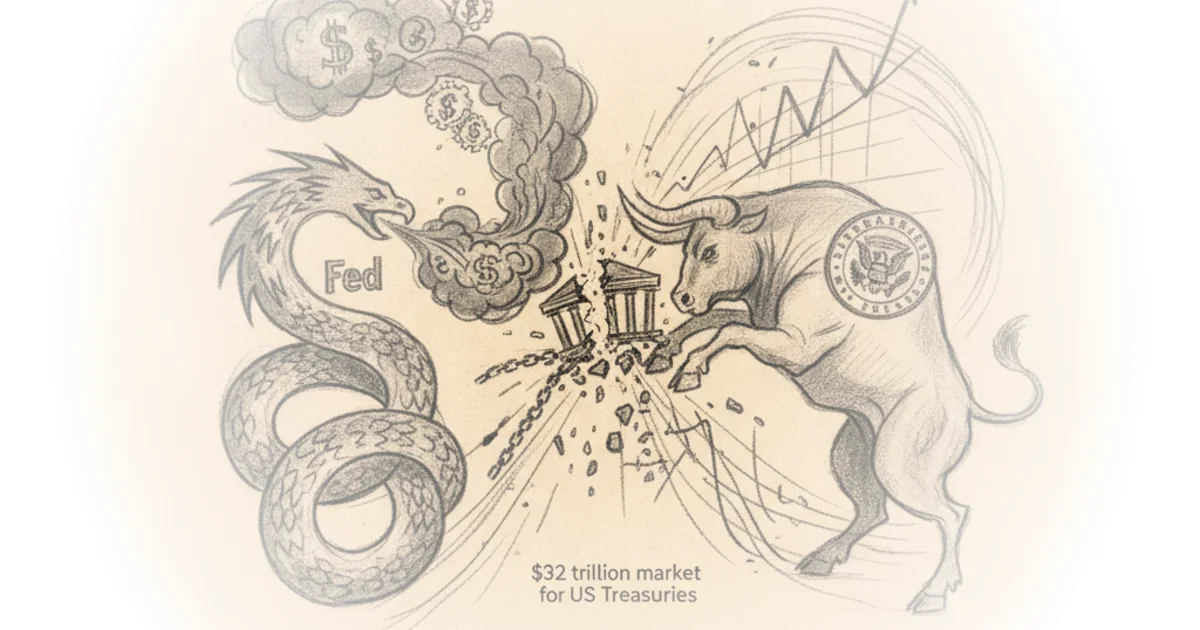
This framing is effective because it highlights the institutional absurdity of the situation. The Treasury is claiming an "asymmetrical informational advantage" to justify its actions, a move that directly contradicts the Fed's new philosophy of letting market forces speak. Tooze notes that Bessent's justification implies the market is out of line with "fundamentals," yet the market is simply pricing in a reality of 3.7% inflation and a 6% deficit at full employment. Critics might argue that in times of extreme volatility, executive intervention is sometimes necessary to prevent a panic, but Tooze convincingly points out that the current market is functioning orderly, not malfunctioning.
"Every basis point of artificial yield suppression is a subsidy to procrastination."
The Illusion of Power
Tooze's most biting critique targets the sheer inadequacy of the Treasury's proposed solution. He contrasts the Treasury's modest $4 billion buyback plan with the massive scale required to actually move a $32 trillion market. He draws a sharp parallel to the 2022 UK mini-budget crisis, noting that the current situation has the makings of a conflict that would make the "battle between Liz Truss and the Bank of England... look like a storm in a teacup." Yet, the Treasury's actions are so small they are almost comical. Tooze writes, "The doubling of bond buy backs that Bessent has announced is so tiny that it requires a special graphic to explain... this can have no significant impact on net issuance and has no prospect whatsoever of shifting the market."
This analysis cuts through the political theater to reveal a strategic vacuum. The Treasury is threatening to use its checking account, the Treasury General Account, to defend a price target, which Tooze argues would simply "shovel profits into the accounts of speculators who will eventually break the peg." The argument here is that the administration is blustering without the financial firepower to back it up, creating a "MAGA premium" that could actually raise borrowing costs. As Lisa Shalett of Morgan Stanley is quoted, intervening because you are "cranky" about rising yields "smacks of whimsy."
The Historical Stakes
The stakes, according to Tooze, are the integrity of the U.S. fiscal constitution. He reminds readers that the wall between debt management and price management was built for a reason, citing the 1951 Fed-Treasury Accord which ended the era of yield caps that fueled double-digit inflation. "U.S. policymakers built the wall between debt management and price management for a reason," Tooze writes. "This intervention starts dissolving it."
The danger is that this technical operation will evolve into a policy commitment that forces the Fed to compromise its independence. Tooze suggests that if the Fed under Warsh refuses to intervene, the Treasury's actions will look desperate; if the Fed does intervene, it abandons its anti-inflation mandate. The result, he predicts, is likely not a new regime of financial repression but a loss of credibility for the Treasury and a further escalation in yields. "The most likely outcome is that there is no regime shift, but that the Treasury loses credibility," Tooze concludes, noting that the market is looking for a principled stance from Warsh that may never come.
"The long-term Treasury yield is the most important price in the world. It is also the only fiscal disciplinarian the U.S. has left."
Bottom Line
Tooze's strongest contribution is exposing the disconnect between the administration's grandiose threats and their actual, tiny policy tools, revealing a strategy that risks destabilizing the bond market without solving the underlying fiscal deficits. The argument's greatest vulnerability is its reliance on the assumption that the Fed will hold the line; if Warsh caves to political pressure, the "dissensus" could quickly dissolve into a unified policy of financial repression. Readers should watch closely for Warsh's upcoming speech at Jackson Hole, as his response will determine whether this is a temporary blip or the start of a permanent erosion of central bank independence.