Robin James delivers a startling correction to the prevailing narrative about modern culture: the "immediacy" we crave in our streaming feeds isn't a deep connection to ourselves, but a hollow void designed for algorithmic efficiency. While critics often mourn the loss of deep engagement, James argues that in popular music, the dominant style of late capitalism is not "pure being" but "pure nothing"—a frictionless background noise that actively erases meaning to keep us scrolling. This is a vital intervention for anyone trying to understand why our cultural diet feels so increasingly weightless.
The Illusion of Immediacy
James begins by engaging with Anna Kornbluh's recent work, which posits that contemporary culture has shifted from a model of public, universal aesthetics to one of "immediacy." Kornbluh describes this new mode as "affective transfer" and "atomistic absorption," where the goal is to create an experience that feels like an unbroken whole with the self. James notes that Kornbluh sees this as a "permalingering mirror stage," a fortress of the imaginary that minimizes the possibility of encountering an "other." The author writes, "Immediacy's metaphysics of presence chafes against representation," suggesting that we are increasingly consuming media that refuses to show us anything outside our own reflection.
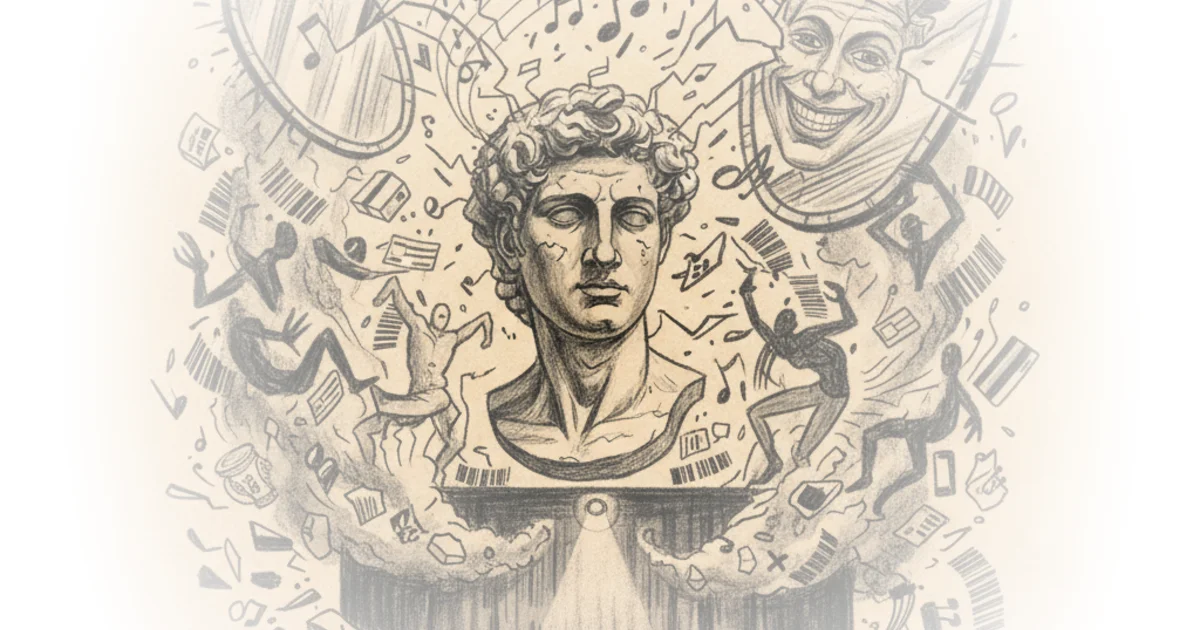
However, James pushes back against the idea that this is a psychoanalytic failure. Instead, they reframe the phenomenon through the lens of user experience (UX) design. In the tech world, "friction is any element that makes users stop and consider their options." When an interface forces a pause for reflection, it is seen as a bug. James argues that the current cultural shift is not a philosophical crisis but a business imperative. The goal of platforms like Spotify is not to create deep, immersive art, but to eliminate the friction that might cause a user to press pause. As Liz Pelly explains in her reporting, "the quest for a frictionless user experience resulted in a deluge of frictionless music."
This reframing is crucial. It moves the conversation from "why are we so narcissistic?" to "how are our tools designed to prevent us from thinking?" James observes that this has led to a specific type of music: "chill inoffensive" tracks that function as "emotional wallpaper." The industry has moved away from creating art with distinct features toward creating a "void" that can be repurposed for any background activity.
"In popular music the style of late capitalism is nothing."
The Dialectic of Nothing
The most compelling part of James's analysis is the philosophical bridge they build between Kornbluh's "immediacy" and the "nothingness" of algorithmic playlists. James points out that while Kornbluh describes a plenum of pure presence, the reality of "lean-back listening" is a determinate negation of that presence. It is so full of unbroken flow that it lacks any specific content. James draws on Hegel's Science of Logic to explain this paradox: "Being, the indeterminate immediate, is in fact NOTHING." When something is so undifferentiated that it has no specific features, it becomes indistinguishable from nothingness.
This is where the argument gains its sharpest edge. James writes, "2025's biggest song is basically empty slop designed to soundtrack whatever poignant social media moment TikTok or Instagram users want to share at a particular moment." The music isn't failing to be immersive; it is succeeding at being nothing. It is a "profile that can be applied to any style of music" with no "definitive features." This emptiness is not an accident; it is the logical endpoint of a system designed to harvest data by keeping users in a state of passive consumption. A counterargument might suggest that listeners are actively choosing this background noise as a form of comfort, but James's evidence from industry insiders suggests the supply side is driving this demand, actively suppressing anything that might disrupt the flow.
The Historical Echo
To ground this modern phenomenon, James reaches back to an 18th-century debate that feels surprisingly current: the conflict between Jean-Phillippe Rameau and Jean-Jacques Rousseau. Rameau argued for a system of music based on the "physical causes" of sound, specifically the overtone series, claiming this made music universal and natural. Rousseau, conversely, argued that music is a "moral effect" rooted in culture and mediation, not nature. James notes that Rameau's argument was essentially a defense of the emerging classically liberal public sphere, which required hierarchies to be framed as "natural" to be acceptable.
James writes, "The project of musical immediacy is in fact tied to the 18th century classically liberal public/private distinction, not to its 21st century obsolescence." This historical context adds significant depth, showing that the desire for "immediate" music is not a new symptom of the internet age but a recurring attempt to naturalize power structures. By invoking Rousseau's "non-ideal" period, James highlights how the claim of "naturalness" in art has always been a political move to mask cultural bias. The current "chill" aesthetic, which claims to be a neutral background, is simply the latest iteration of this old trick.
"Chill has no essential determinate properties... empty music out and reduce it to more or less nothing."
Bottom Line
Robin James's analysis succeeds by stripping away the psychological mystique of "immediacy" and revealing the economic machinery underneath: the frictionless void is a feature, not a bug, of platform capitalism. The argument's greatest strength is its ability to connect high-level philosophy with the mundane reality of a Spotify playlist, showing how the erosion of "sensus communis" is a calculated design choice. However, the piece leaves the reader with a sobering question: if the dominant style of our time is "nothing," what does a culture look like that actively cultivates friction, difference, and the encounter with the other? That is the challenge the next generation of artists and thinkers must now face.