In an era where philosophy often retreats into abstract systems or cynical despair, Anarchierkegaard offers a startling corrective: the only way to escape the crushing weight of necessity is not by thinking harder, but by admitting you cannot do it alone. This piece does not merely survey the history of pessimism; it argues that the very act of recognizing one's own sin and dependence is the only mechanism that grants genuine freedom. For the busy mind seeking a way out of modern existential fatigue, this is a radical reorientation of the self.
The Failure of the Self-Made Mind
Anarchierkegaard begins by dismantling the confidence of Western rationalism, specifically targeting the German philosopher Arthur Schopenhauer. The author argues that Schopenhauer, in his attempt to invert Leibniz's optimism, merely trapped humanity in a "fantasy of the infinite confined to the pitifully finite." By declaring this "the worst of all possible worlds," Schopenhauer broke the dam of theological comfort but offered nothing but a cold, speculative metaphysics in its place. Anarchierkegaard writes, "He, of course, went on to engage in his own highly speculative metaphysics, but he had succeeded in knocking down the breakwater which had held back the tide from the piddling, cloistered reflections of the now collapsing security of Christendom."
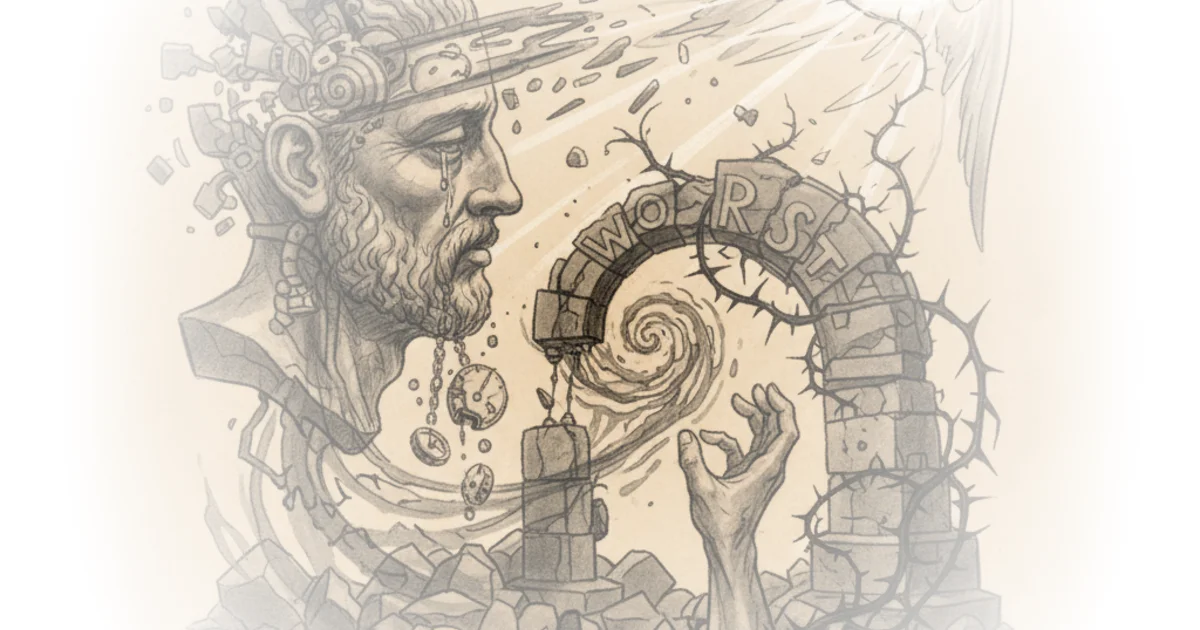
The commentary here is sharp: Schopenhauer destroyed the old security but left us exposed to the elements. Anarchierkegaard extends this critique to Immanuel Kant, suggesting that Kant's ethical system floats unmoored because it cannot ground the human self. The author notes that Kant's view of self-recognition "floats free over the '70,000 fathoms of the deep' —the will influences our rationality and the will cannot be undermined." This is a powerful image of philosophical insecurity; we are flying over creation without ever truly landing on it. Critics might argue that this dismissal of Kantian autonomy is too harsh, ignoring the practical utility of secular ethics. However, the author's point is that without a deeper anchor, that ethics remains a flight over an abyss.
The gap, while not necessarily wide, leaves us in philosophical insecurity.
The Crossroads of Dizziness and Choice
The piece pivots from this despair to the "Melancholic Dane," Søren Kierkegaard, whose work serves as the article's theological and philosophical backbone. Anarchierkegaard posits that the solution to the "70,000 fathoms" is not to look at the universe, but to look inward. The author emphasizes that true meaning only begins when one abandons the "view from nowhere" and starts with the specific, contingent agent. As Anarchierkegaard puts it, "One must first learn to know oneself before knowing anything else. Only when the person has inwardly understood himself, and then sees the way forward on his path, does his life acquire repose and meaning."
This framing draws on the historical concept of metanoia—a profound transformation of the mind often associated with Kierkegaard's later works. The author describes the human condition as standing at a crossroads, a moment of "dizziness of freedom." Here, the temptation is to choose quickly, but the real rupture happens when one realizes their reality has been broken by a past life of mere causality. Anarchierkegaard writes, "You recognise that there is a life where you were 'as such', a victim of mere causality and swept up into the movement of necessity as necessity moved to sweep you up."
The argument is that freedom is not the ability to pick any road, but the terrifying realization that we are drowning without help. The author suggests that the "miracle of free will" is only accessible when one admits they cannot walk on water alone. This is a bold claim: that the admission of weakness is the prerequisite for strength. A counterargument worth considering is whether this reliance on a "Wholly Other" undermines human agency rather than restoring it. Yet, the author insists that without this rupture, we remain self-tormentors.
Just as the bird that became exhausted crossing the ocean sinks down with feeble wing strokes toward the sea and now can neither live nor die, so it is also with the self-tormentor who becomes exhausted on the way across the distance between today and the next day.
The Radicalism of Self-Responsibility
The final section of the piece redefines the political implications of this theology. Anarchierkegaard argues that the most radical stance available is not a loud protest, but a "quiet conservativism of self-responsibility." The author contends that Christianity is fundamentally about breaking up "the Crowd" and dismissing the false necessity of social conformity. "The most radical political stance available," Anarchierkegaard writes, "is the stance that calls for the quiet conservativism of self-responsibility, as the one gifted a life and tasked to live it, and the radicalism of proceeding unimpressed by those who demand our obedience."
This is a provocative reframing of religious duty as a form of political resistance against the pressure to conform. The author suggests that recognizing one's sin and reliance on the "Father of Lights" is the only way to see through the distractions of the crowd. The text notes that sin is not just a moral failing but the quality that allows us to recognize ourselves before God. "Sin itself is the quality which allows us to recognise ourselves before God, but we could never even recognise sin without the help of God to see the unseen." This moves the discussion from abstract theology to the daily struggle of the individual against the pressure of the age.
Bottom Line
Anarchierkegaard's piece is a compelling, if demanding, argument that true freedom is found only in the collapse of the ego's attempt to stand alone. Its greatest strength is the vivid imagery of the "crossroads" and the "70,000 fathoms," which effectively dramatizes the stakes of philosophical despair. However, its reliance on a specific theological framework may alienate readers seeking a purely secular solution to modern anxiety. The reader should watch for how this concept of "rupture" applies to their own daily decisions, asking whether they are truly choosing or merely reacting to the waves of necessity.