Rafael Holmberg dismantles the comfortable academic habit of sanitizing Marx, arguing that the very act of making him "digestible" is what kills his revolutionary potential. In a piece that bridges high theory and local gossip, Holmberg reveals a paradox where nobody is a Marxist, yet everyone claims to be fighting one. This is not a history lesson; it is a diagnosis of why our current political language is so broken that billionaires and labor leaders are accused of the same ideology.
The Symptom of Theory
Holmberg begins by attacking the way universities have tamed Marx, stripping him of his edge to fit him into a lineup of standard philosophers. He writes, "The only way Marx is rendered digestible in academic discourse is by de-militarising him, by making him one amongst several philosophers of his time, or by retrospectively Hegelianising him." This framing is crucial because it suggests that the problem isn't Marx's ideas, but our inability to handle their raw, disruptive power. By smoothing out the rough edges, we create a version of Marxism that is safe but useless.
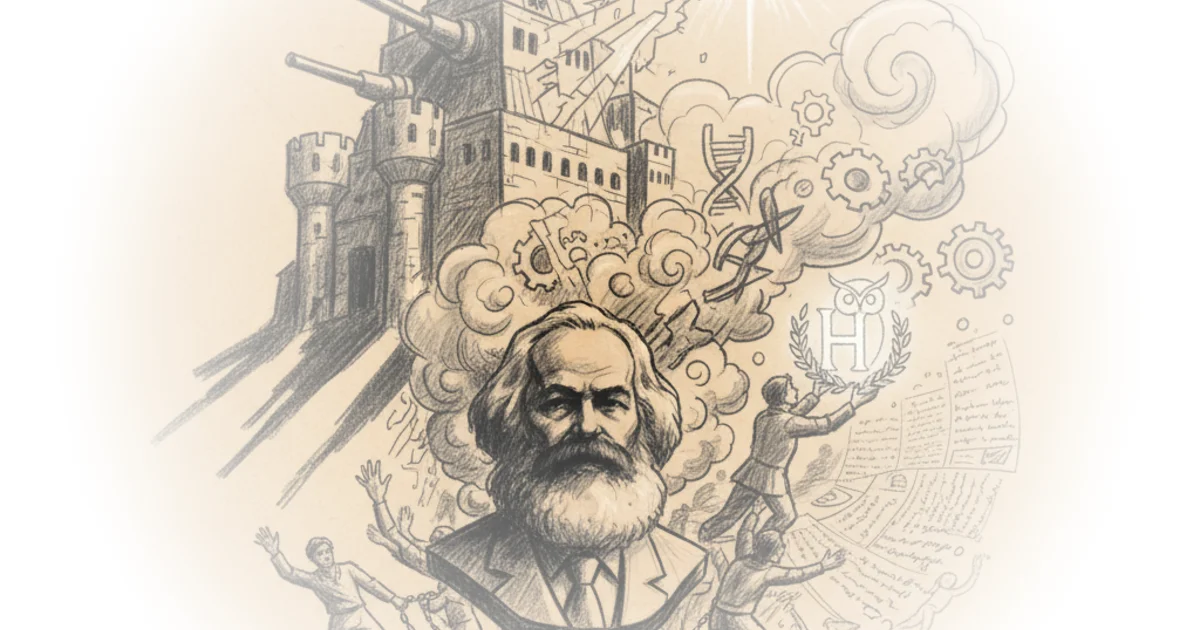
The author introduces a striking analogy to explain why this watered-down version persists. "Marx himself can in this sense be equated to Freud's paradox of the symptom," Holmberg argues, noting that removing the symptom often leads to "no functioning at all." This is a bold claim: it implies that our confusion about Marx is actually a necessary structural feature of our society, not just an intellectual error. If we fully understood Marx, the system that relies on misunderstanding him might collapse. Critics might argue that this romanticizes confusion, but Holmberg's point is that the "imperfect functioning" of our political discourse is the only way the current order survives.
To be an actual Marxist is to risk the true death of Marx.
The Villain in the Local Paper
Shifting from the abstract to the absurd, Holmberg contrasts academic taming with the crude propaganda found in a local newspaper on the Isle of Wight. There, Marx is depicted not as a philosopher, but as a "terrifying villain responsible for the death of tens of millions of people." Holmberg points out the hypocrisy in this narrative, noting that "when the same intentional administrative malpractices... led to the death of hundreds of millions of Indians under British occupation, this is declared as a mere contingency." This juxtaposition exposes the double standard at the heart of modern anti-communism: systemic violence by the West is treated as an accident, while the theoretical framework of the left is blamed for every tragedy.
The piece highlights how this propaganda has bled into mainstream politics, where figures like Keir Starmer are accused of following a "Marxist ideology" despite pursuing reactionary policies. Holmberg writes, "The insistence that the establishment is an authoritarian Marxist regime has accompanied the rise in power of multiple far-right parties." This observation is vital for busy readers trying to navigate current events; it explains why the right can claim to be fighting "cultural Marxism" while actually defending the very capitalist structures Marx criticized. The accusation has become a weapon to delegitimize any form of social safety net, regardless of its actual political lineage.
The Hegel Inversion
At the core of the essay is a complex but necessary re-evaluation of the relationship between Marx and Hegel. Holmberg challenges the standard textbook view that Marx simply inverted Hegel's idealism into materialism. Instead, he suggests a more tangled reality: "Hegel is too dogmatically materialistic. He restricts the Ethical State to the condition of a particular, determinate instance of subjectivity." In Holmberg's reading, Hegel is the one tied to specific nations and monarchs, while Marx offers a "universal language" that transcends borders.
This is a sophisticated argument that flips the script on who is the "universalist." Holmberg explains that for Hegel, freedom is bound to a specific state structure, whereas "Capitalist exploitation is borderless, and so is its critique." By grounding Marx in the global mechanics of capital rather than national history, Holmberg makes the theory feel more relevant to our interconnected world. However, this universalism comes with a cost. As the author notes, "Communism... speaks from a paradoxical perspective of the other side of the end of capitalist practices." It is a vision that can only be articulated from a place that does not yet exist, making it perpetually "inconsistent to the present."
The Internal Contradiction
The essay culminates in a look at how this tension plays out in the history of Marxist thought, specifically between Louis Althusser and Vladimir Lenin. While Althusser insisted on a clean "epistemological break" between Marx and Hegel, Lenin famously argued that one cannot understand Capital without The Science of Logic. Holmberg synthesizes these views by suggesting the conflict is internal to Marx himself. He quotes Marx's own disavowal: "if they are Marxists, then I myself am not a Marxist."
This quote serves as the anchor for Holmberg's final conclusion: the confusion is the point. "The contradictions inherent to Milei and Musk... could easily act as the double to the perpetually self-distancing position of Marx." The author brilliantly connects the erratic behavior of modern free-market capitalists—who demand regulation when it suits them—to the inherent instability of the Marxist project. The result is a world where "nobody and everybody is a Marxist," a state of affairs that keeps the concept alive precisely because it can never be fully realized or pinned down.
The attribution of Marxist doctrines to non-Marxist politics reflects the division not only between Marx and Hegel, but between being a Marxist and Marx himself.
Bottom Line
Holmberg's strongest move is reframing the "Marxist" label not as a fixed identity but as a structural symptom of our political confusion, effectively explaining why the term is weaponized by both the far-right and the establishment. The argument's vulnerability lies in its heavy reliance on dense philosophical abstraction, which may obscure the practical political lessons for readers seeking actionable insights. Ultimately, the piece succeeds in showing that the only way to keep Marx relevant is to embrace the very contradictions that make him so uncomfortable to define.