Derek Muller has a habit of upending what we think we know. In his latest piece, he argues that most people don't understand how bicycles actually work — and the evidence he presents is genuinely revelatory.
The Counterintuitive Physics of Turning
Muller opens with a demonstration that's hard to forget: he rides a modified bike where steering is locked to one side, making it impossible to turn left without first turning right. "You can still fully steer after I've pulled the pin out," he says, describing how the mechanism works. The result? "It's made it pulls the pin out but you can see that you can still fully steer." This setup reveals something surprising about how we actually navigate on two wheels — and it's not what most riders believe.
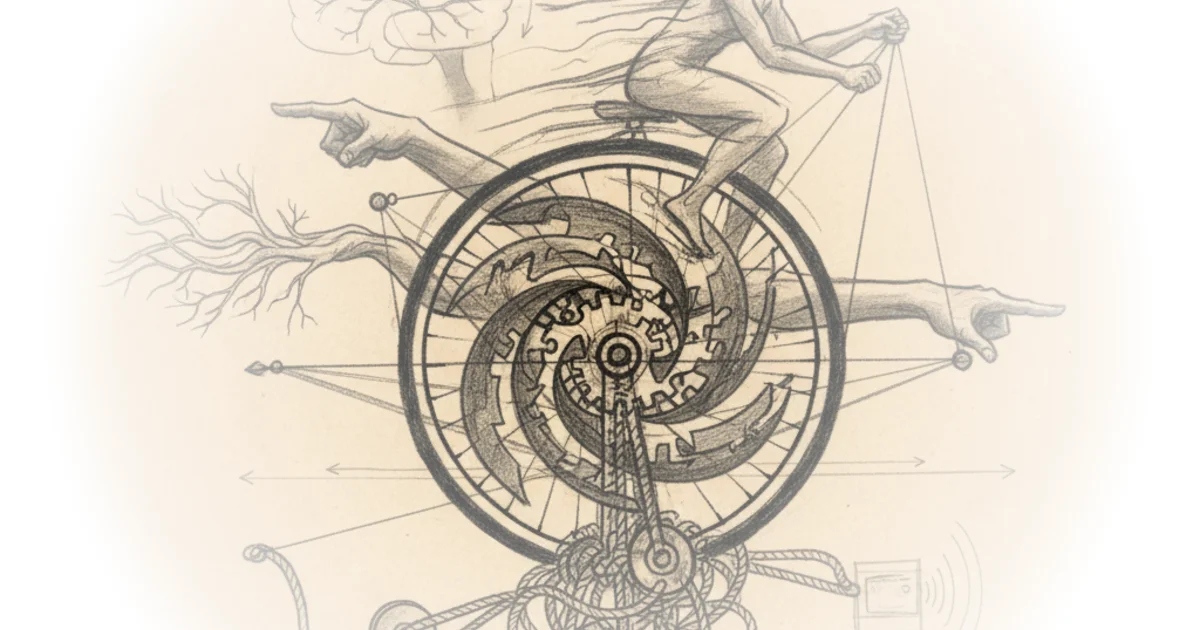
The core of Muller's argument is that steering doesn't just change your direction; it actively controls your balance. "Steering doesn't just affect the direction you're headed," he writes, "it also affects your balance." This distinction matters because it challenges everything we assume about riding. Most people believe you turn a bike simply by pointing the handlebars in the direction you want to go — like driving a car, where the front wheels follow wherever you point them. But bicycles don't work that way at all.
You can't turn left without first steering right and it's impossible to turn right without first steering left.
This is the video's most counterintuitive claim, and Muller proves it with experiments: when you steer right on a bike, you've actually steered it out from under yourself. Now you're leaning left, and the ground pushes back — so to make a right turn, you must countersteer to the left first. The same principle applies in reverse. It's a small shift in understanding, but it changes everything about how we think about balance.
Why We Balance (And What Keeps Us Upright)
Muller then pivots to an even more surprising claim: "Steering is not just for turning the bike — steering is for balancing." He illustrates this with a vivid analogy. "Imagine you want to make a right turn so you steer the handlebars to the right," he explains, "what you've done is effectively steered the bike out from under you so now you're leaning to the left and the ground puts a force on the bike to the left."
He compares this to balancing an inverted pendulum or a broomstick on your hand. The principle is identical: if you want to move in one direction, you first move the base in the opposite direction. Then — and only then — can you initiate movement. "If you want to turn right," Muller writes, "you first have to counter steer to the left so you can lean right into the turn." This is something anyone who rides knows intuitively but couldn't articulate explicitly. The video shows riders demonstrating this without thinking about it at all.
The next logical question: if balance requires constant steering adjustments, how do bikes stay upright when no one is riding? Most people assume it's gyroscopic effect from spinning wheels — the same physics that keeps a spinning toy upright. But Muller calls this wrong. "Most people believe it's the wheels spinning that creates some sort of gyroscopic effect that resists falling over," he says, but then demonstrates something different.
The Real Reason Bikes Stay Upright
Muller locks the steering completely and challenges viewers to ride straight. "All is happening is the steering is locked you just gotta ride it you don't have to turn you just go straight ride letting go" — even with extreme balancing techniques, no one could keep the bike upright for more than a few seconds. The gyroscopic effect alone doesn't work.
The real reason bicycles are stable without riders, Muller argues, is that they're cleverly designed to steer themselves: "If they start falling to one side, the handlebars turn in that direction to steer the wheels back underneath them." He identifies at least three mechanisms responsible for this corrective steering:
First, due to the angle of the front fork, the steering axis intersects the ground in front of where the wheel touches — so if the bike leans left, the tire's contact with the ground naturally turns the wheel left. The front wheel is essentially a caster wheel like those on strollers or shopping carts.
Second, the center of mass of the handlebars and front wheel are located slightly in front of the steering axis. When the bike leans, their weight pushes the wheel to lean in that direction — another self-correcting mechanism.
Third, gyroscopic effect does contribute, but not directly: it helps steer. If you push down on a gyro's left side, it turns right. "This is known as gyroscopic procession," Muller notes, and it works at ninety degrees from where force is applied.
The real reason bicycles are stable without riders is because they're cleverly designed to steer themselves.
Researchers have even built a weird-looking bicycle with counter-rotating wheels that eliminate gyroscopic effect entirely, plus no caster effect — yet this bike still stays upright due to mass distribution alone. This proves you don't need all three mechanisms to create stability. The takeaway is striking: bikes are stable primarily because they automatically correct themselves through steering.
What We Miss About Bicycles
The strongest part of Muller's argument is how he reframes what we thought we knew about balance. Most people believe balancing on a stationary bike is hard "because the wheels aren't spinning so there's no gyroscopic effect" — but that's not it at all. The truth, as Muller tells it: you use steering to keep the bike underneath you, and that mechanism fails when you're standing still.
"Even when going straight you're constantly making small steering adjustments to maintain balance," he writes. "You're moving the contact patch of the front wheel under you — you're doing exactly what you do when you balance a broomstick on your hand." This is the insight that makes the video sing: we aren't just riding; we're constantly, unconsciously performing physics to stay upright.
Critics might note that this deep dive into bicycle mechanics is more than most casual riders need to know. The practical knowledge of how to ride never required understanding these mechanisms — you simply learn by doing. But Muller argues that's precisely what makes it worth exploring: the gap between what we do and why we can do it.
Bottom Line
Muller's piece succeeds because he takes something ordinary — riding a bike — and reveals the physics hiding underneath. His strongest move is reframing steering as primarily for balance rather than direction, which changes how we understand every turn we make. The biggest vulnerability? He acknowledges that understanding bicycle stability "is still an active area of research" — meaning even experts are still discovering what's really happening. That uncertainty makes the video feel less like a lecture and more like a conversation still ongoing.