The Body as Archive: Firelei Baez on Filtering History Through the Senses
Firelei Baez does not make art that asks to be understood on first encounter. The Dominican-Haitian painter, whose large-scale works fuse Caribbean mythology with colonial-era scientific documents, describes her practice with a disarming metaphor: she considers herself a filter. The studio, she says, is "a repository where the energy that I have experienced in the world has to be expressed or I'll just burst." That framing, of the artist as conduit rather than inventor, runs through every facet of her work, from her material choices to her conceptual ambitions.
In this Louisiana Channel interview, Baez traces a path from a resourceful childhood in the Caribbean to Cooper Union in New York, from casta paintings to Octavia Butler's science fiction, from Carl Linnaeus's taxonomies to the myth of the siguapa. What emerges is not a linear narrative but a dense web of references that mirrors the paintings themselves: layered, allusive, requiring the viewer to lean in.
Origins Without the Origin Story
Baez resists the conventional artist origin story even while telling one. Her mother could replicate any garment from sight but could never pursue fashion professionally. Her sister drew beautifully at four, then abandoned art for medicine. Baez was left holding the impulse, and she frames it less as a calling than as a compulsion: "it's just a thing that makes me feel alive and it's been a point of refuge since I was a very young child."
The path to professional art was not paved with mentorship or institutional support. Her mother's encouragement was characteristically practical:
If you could figure a way to do it you're welcome to it. I won't stop you.
That conditional permission, generous in spirit but offering no material assistance, led Baez through community college and eventually to Cooper Union's tuition-free program. The subtext is worth noting: the art world's pipeline from elite prep schools to MFA programs was simply not available to her. She arrived at the "actual art world at large" through a side door, and that outsider trajectory informs her insistence on making work that does not presuppose art-historical literacy in its audience.
The Siguapa and the Problem of Categorization
Central to Baez's visual vocabulary is the siguapa, a folkloric trickster figure from Hispaniola whose feet face backwards, making her impossible to track. Baez uses the siguapa as both subject and structural principle. If you follow her footsteps, you walk in the wrong direction. The figure resists pursuit, categorization, and capture.
Baez connects this mythic figure directly to Carl Linnaeus's taxonomic systems, which she describes as foundational to Western biological science but riddled with projections and fictions, "especially for people like me and things within the new world." She points to Dutch colonial documentation of Brazil that included both moose and vampires as equally factual entries:
The mirage between them was then turned into a scientific method, so then giving us the room to say hey these are the places where we got it right and these are the places where we were horribly wrong.
This is a sharper critique than it might first appear. Baez is not simply saying that Linnaeus was racist, though his racial taxonomies certainly were. She is arguing that the entire epistemological apparatus of Western classification carries embedded fictions that have never been fully disentangled from the science built atop them. The siguapa, a creature who defies tracking, becomes a counter-model: what if the goal is not to classify but to evade classification entirely?
The Senses as Democratic Entry Point
Baez is candid about a tension in her work: it references histories that are opaque to many viewers. Caribbean folklore, colonial-era botanical illustrations, casta painting traditions, Afro-Caribbean religious symbolism. Rather than expecting her audience to arrive pre-educated, she uses sensory experience as what she calls "an anchor point."
Before you start conceptualizing it, before you start putting in different hierarchies and saying this thing doesn't belong to me or I don't belong in this space, you are already enmeshed formally with the work.
The strategy is to bypass intellectual gatekeeping through physical immediacy. Visceral color, immersive scale, mark-making that functions as "honey to draw the viewer closer." A skeptic might ask whether this approach risks aestheticizing difficult histories, turning colonial violence and racial categorization into beautiful surfaces that viewers consume without reckoning. Baez addresses this directly. She says she is "fully capable of making a juicy beautiful painting that is just all pleasure," but finds that insufficient. Pure pleasure "only sustains for a short period of time." She wants work that lingers, that gives viewers "the tools to reconcile opposing forces."
Whether the paintings achieve that reconciliation or merely gesture toward it is a question each viewer must answer in front of the actual work. The interview, naturally, cannot substitute for the sensory encounter Baez describes as essential.
Drexciya, Afrofuturism, and the Utility of Myth
One of the interview's most compelling passages concerns Drexciya, the underwater Black civilization imagined by two Detroit techno DJs in the 1990s. The myth begins with the most horrific premise imaginable: enslaved pregnant women thrown overboard during the Middle Passage. From that atrocity, the Drexciya myth imagines survival, adaptation, and a technologically advanced submarine civilization.
Baez anticipates the objection that such mythmaking is impractical whimsy:
If you're just focusing on the facts you'll be like what's this whimsy, it's not bringing food to the table, it's not helping someone get a job. But what it does do is to give you the idea, if you're in that space, to think: I am capable of technological advancements, I am capable of creativity, I'm capable of creating these complex healed spaces from within when the world at large tells me that I'm not.
This is the most explicitly political claim in the interview, and it cuts against both the art-for-art's-sake tradition and the demand that art produce measurable social outcomes. Baez positions myth-making as a precondition for agency: "as humans we're only able to achieve things that we think someone did it before us." The Drexciya painting, she explains, contains figures that emerge the longer you look, swimmers and dancers materializing from abstraction. The form enacts the content.
Hair, Gender, and the Romance Language Problem
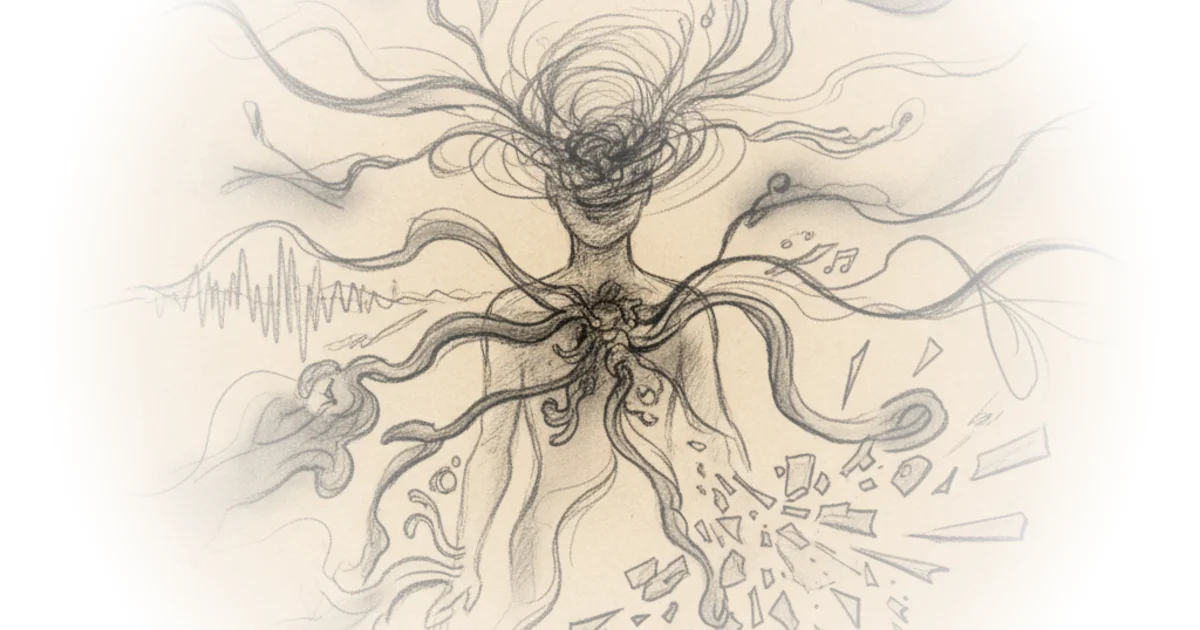
Baez returns repeatedly to hair as both a personal and political subject. In Caribbean and Latin American cultures, she explains, unmodified hair on women marks them as outside respectable society. "From childhood you're taught to essentially only be allowed to navigate the world by not being yourself." Her figures revel in unruly hair, matted fur, sensory tendrils borrowed from Octavia Butler's Oankali aliens.
She makes an interesting linguistic observation: in Spanish and other Romance languages, the feminine grammatical gender is the passive form. "The mountain, the chair, things that are waiting to be activated." But the women she grew up with were "very active, dynamic, badass women" who preached passivity while practicing the opposite. The paintings hold both truths simultaneously, depicting feminine figures that are at once restful and revolutionary.
The connection to Butler's Lilith's Brood trilogy is particularly apt. Butler imagined a species with sensory hair that perceives the world in its entirety, beyond the five human senses. Baez equips her figures with this capacity, turning hair from a site of social control into an organ of expanded perception.
The Viewer as Material
Perhaps the most radical claim Baez makes is that her paintings are not complete objects. They are unglazed, unframed, deliberately vulnerable to the viewer's breath and proximity. She describes the foxing and cracking of old manuscripts not as damage but as "an embedding of viewing, of an experience." When she invites viewers close, she asks them to "leave a bed of their breath and destroy that history, to transform it."
The viewer is the work. The viewer activating it and changing it.
This is a familiar claim in contemporary art, echoing everything from Duchamp to relational aesthetics. What distinguishes Baez's version is its specificity: the histories embedded in her source documents, colonial taxonomies, casta paintings, botanical illustrations, are not abstract. They are the bureaucratic infrastructure of racial categorization. To breathe on them, to degrade them incrementally, is to participate in their undoing. Whether this constitutes actual political transformation or remains a poetic metaphor contained safely within gallery walls is a tension Baez does not resolve, and perhaps cannot.
Bottom Line
Firelei Baez articulates a practice built on productive contradictions: beauty as a vehicle for difficult history, abstraction as a more truthful portrait of lived reality, mythic creatures as tools of political resistance. Her intellectual range is formidable, moving fluidly from Linnaeus to Octavia Butler, from casta paintings to Detroit techno. The risk in such density is that the conceptual apparatus overwhelms the sensory encounter she insists is primary. But Baez seems aware of this tension, and her repeated emphasis on the body, on breath, on proximity, on what the painting does to you before you can think about it, suggests an artist who trusts her materials more than her explanations. The interview is best understood not as a decoder ring for the paintings but as a parallel text, one more layer in a practice that resists the very idea of a single, trackable reading.