Fred Mills doesn't just describe a bridge; he exposes a national strategy where engineering feats serve as both economic engines and geopolitical statements. While the Huajing Bridge's staggering height of 625 meters is the headline, the author's most compelling insight lies in the sheer absurdity of the terrain it conquers: a region where "no 3 ft of level ground is a saying synonymous with the locals." This is not merely a story of concrete and steel, but a testament to a government willing to spend billions to turn an isolated mountain province into a global tourism hub.
The Geography of Isolation
Mills sets the stage by painting Guizhou province as a "Switzerland of China" that was historically cut off from the rest of the world. The region's topography is so severe that over 90% of the land is covered in mountains, making traditional travel nearly impossible. "Historically, Gujo has been something of an isolated island," Mills writes, noting that while moving around the province was difficult, accessing it was even harder. The author argues that the bridge is the culmination of a decades-long "mountain mission" to connect these remote areas, a mission that has already resulted in 32,000 bridges across the province.
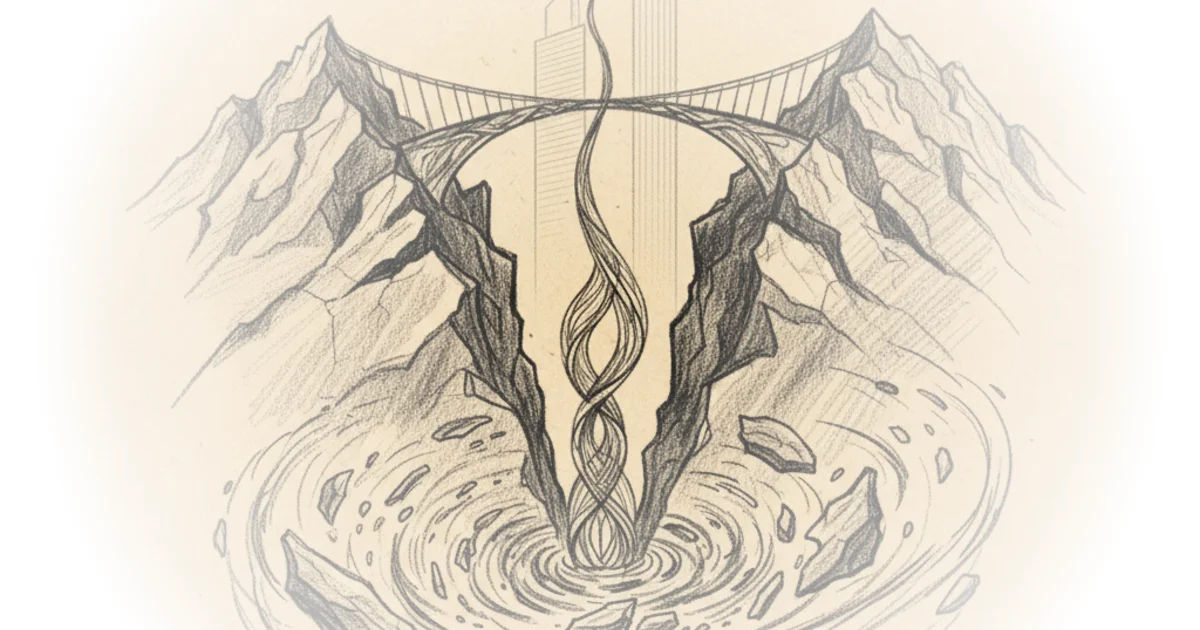
The narrative effectively shifts from the romantic to the practical. The Huajing Bridge isn't just a record-breaker; it is a functional necessity that slashes a two-hour drive around a canyon down to a mere two minutes. "Now the bridge forms a key part of the Guju S57 which is basically a 150 km highway that slices right through the heart of a mountain," Mills explains. This literal slicing of the landscape is the piece's most visceral image, illustrating a willingness to alter geography itself to facilitate movement.
Critics might note that the sheer scale of this infrastructure spending raises questions about debt and long-term maintenance in such a volatile environment, but Mills frames it as an essential investment in poverty alleviation rather than a vanity project.
Engineering Against the Elements
The technical breakdown of the construction is where Mills' commentary shines, moving beyond simple awe to explain the "why" behind the design choices. The bridge is a steel truss suspension bridge, a choice driven by the need to anchor massive cables into the hard rock of the canyon walls. "It's a wellproven system in rocky mountainous terrain like this as the support cables can be anchored into hard rock offering incredible stability," he notes. The scale of the material is staggering; the bridge's steel structure weighs 22,000 tons, roughly three times the weight of the Eiffel Tower.
Perhaps the most fascinating engineering challenge addressed is the wind. The canyon creates a "Venturi effect," where wind speeds increase dramatically as they are funneled through the narrow passage. To combat this, engineers didn't just rely on computer simulations. "Ultimately you really need to head to a facility with a wind tunnel," Mills writes, describing how scaled models were tested against recreated wind patterns. Even more innovative was the use of Doppler lidar, a laser system that measures wind speed by analyzing the frequency shift of light reflecting off moisture particles in the air. This real-time monitoring capability ensures the bridge can withstand gusts that rival the speed of an express train.
"The mountain side is anything but symmetrical. Um and so your two cables at the back coming down from the tower tops coming down to ground where the anchorages are um will very often meet the ground at completely different levels or or different places."
This asymmetry required the bridge's towers to be built at different heights—the north tower stands at 262 meters while the south is 205 meters—a detail that underscores the complexity of building in such an uneven landscape. The author also highlights the seismic considerations, noting that while the region isn't known for massive earthquakes, the bridge acts as a "glorified pendulum" that requires hydraulic shock absorbers to manage movement.
The Economic Calculus
The final layer of Mills' argument connects the engineering marvel to China's broader economic strategy. The bridge is a centerpiece of the "war on poverty," designed to generate revenue in regions outside of major hubs like Beijing and Shanghai. "Since 2012, the nation's been spending hundreds of billions to develop infrastructure projects in its poorest regions," Mills observes, linking the project to the Belt and Road Initiative.
The author makes a sharp pivot from infrastructure to tourism, revealing that the bridge is designed to be a destination in its own right. It features an 800-meter glass elevator, a coffee shop in the support tower, and a glass walkway on the underside of the deck. "China's hoping that Huhen will become a tourism trap," Mills writes, pointing to the inclusion of a bungee jump and plans for professional base jumping events. The bridge is no longer just a route; it is a spectacle.
This framing is effective because it reveals the dual purpose of such massive projects: they are functional arteries for commerce and simultaneously marketing tools for the nation. However, one might argue that relying on extreme tourism in a region prone to volatile weather and seismic activity introduces new risks that the initial engineering calculations may not fully address.
Bottom Line
Fred Mills delivers a compelling narrative that elevates the Huajing Bridge from a mere construction project to a symbol of China's aggressive infrastructure ambitions. The piece's greatest strength is its ability to humanize the engineering, showing how every bolt and cable was a response to the brutal realities of the canyon. Its vulnerability lies in the optimistic assumption that the economic returns from tourism will seamlessly offset the immense costs of building and maintaining such a structure in one of the world's most challenging environments.