The universe favors life — and Nick Lane finds that almost disturbing. In four billion years of evolution, every complex organism on Earth shares the same fundamental architecture: a cell with a nucleus, mitochondria powering it, and an electrochemical gradient that's essentially a bolt of lightning in miniature form. This isn't coincidence. It's chemistry pulling life toward a small number of possible solutions — and if we find life out there in the universe, it's probably going to look like us.
Why Eukaryotes Changed Everything
Nick Lane has spent decades studying eukaryotic cells — the sophisticated cells that make up plants, animals, fungi, and algae. These aren't just any cells. They're the cells that compose everything large and complex enough to see without a microscope. And here's what's strange: a plant cell under an electron microscope looks identical to a human cell. They carry the same machinery, the same nucleus, the same internal kit — yet one photosynthesizes in ocean water and the other walks around thinking about philosophy.
"If you look inside a plant cell or a fungal cell, it looks exactly the same under an electron microscope as one of our cells."
This uniformity isn't accident. It tells us these cells arose once — roughly two billion years into Earth's history — and never again. Bacteria and archaea have more genetic versatility between them than eukaryotes do. A single bacterial cell has less built-in machinery, but there are so many different types that collectively they've explored vast genetic sequence space. Four billion years to work on it, and they never found a way to become large and complex.
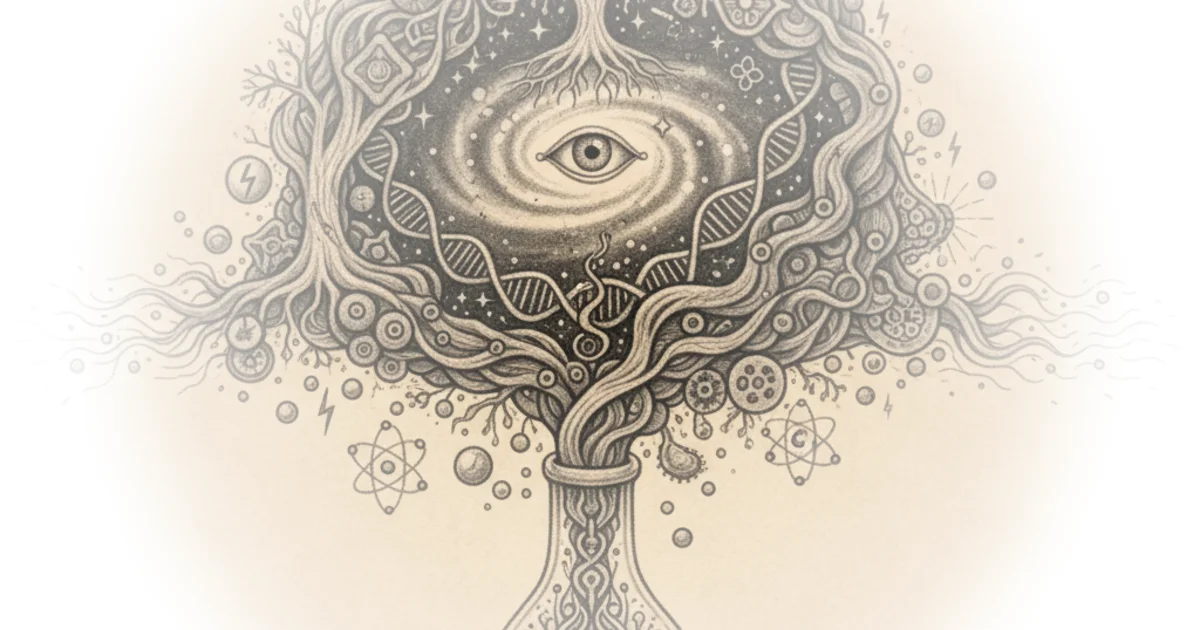
What eukaryotes did find was mitochondria — the power packs derived from bacteria that generate energy for cells. This wasn't immediate transformation. It changed what endpoints were possible.
The Origin of Life: A Hydrothermal Story
The question of how life began has always been one of science's most tantalizing puzzles. But Lane approaches it through a specific door: mitochondrial biology led him to eukaryotes, which led him to origins. And the story he tells is one of beautiful continuity between Earth's geology and living cells.
In the 2000s, researchers Bill Martin and Mike Russell proposed that the first life didn't emerge in some primordial soup like a lightning strike — it emerged from hydrothermal vents. Not black smokers with chimneys belching smoke, but mineralized sponges with pores shaped like cells. The early Earth had an acidic ocean and alkaline fluids mixing in these systems.
The chemistry was already there. Bacteria take carbon dioxide and hydrogen — the hydrogen bubbling from vents — and react them to make all the building blocks of life. They use the same metals found in early oceans: nickel, iron, sulfide. They're powered by that membrane potential, the electrical charge difference between inside and outside.
"It's like a cell is structured. And you've got an acidic ocean, you've got alkaline fluids coming out."
The membrane voltage is small but the membrane is only five nanometers thick — so shrinking yourself to molecular size, you'd experience thirty million volts per meter. That's equivalent to a bolt of lightning. The ATP synthase that sits in that membrane is universally conserved across all life — as conserved as ribosomes themselves.
What Mitochondria Actually Do
Mitochondria generate energy for cells through respiration. They derive from bacteria that produce energy the same way — generating an electrical charge on the membrane. This charge, about 150 to 200 millivolts, sits across a membrane five nanometers thick, creating what Lane calls "the strength of the force of the voltage across the membrane which is colossal."
When eukaryotes internalized these power packs, something shifted. They became free from the constraints of generating that charge externally — free to become larger and more complex.
TheKB cycle intermediates are small molecules made only of carbon, hydrogen, and oxygen with an organic acid group at the end. Add ammonia and you get amino acids. Add more hydrogen and you get sugars. React amino acids with sugars and you get nucleotides. This is the basic starting point for all of biochemistry today.
And here's what makes it remarkable: fatty acids spontaneously form bilayer membranes — exactly like cell membranes — under laboratory conditions at seventy to ninety degrees Celsius, across pH from seven to twelve, in the presence of calcium, magnesium, and other salts.
The Planetary Implications
This leads somewhere profound. If life emerged from these specific chemical constraints — if bacteria have always used this membrane potential, if eukaryotes internalized it once and never again — then what we see on Earth might be what we'd see elsewhere.
"If you've got a thousand planets with life on, maybe life is going to be the same way 999 out of a thousand times."
Carbon-based. Water-based. Cells using charges, hydrogen, carbon dioxide. The same underlying constraints. This isn't just speculation — it's chemistry pulling toward inevitability. Life as we know it isn't some cosmic accident; it's almost written by the rules.
Critics might note that these hydrothermal vent theories remain uncertain whether they can actually drive biochemistry in practice. The details are fiercely debated, and the continuity between geology and cells is beautiful but unproven.
Bottom Line
Lane's argument is compelling: given four billion years of evolution under identical chemical constraints, life converges on a small number of solutions. The biggest strength is how it connects origin-of-life research to evolutionary biology — showing that what we are isn't random chance but almost inevitable chemistry. Its vulnerability is that the hydrothermal theory itself remains contested. But the deeper point holds: if the universe favors life this strongly, finding it elsewhere might not require imagination — just good chemistry.