Justin E. H. Smith transforms a quiet moment of literary discovery into a profound meditation on how life emerges from apparent stillness. Rather than offering a standard book review, Smith uses the simple image of an egg to dismantle centuries of theological certainty and preformationist science, arguing that true understanding requires embracing the chaotic, unpredictable nature of development. This is not merely about biology; it is a framework for how we should approach knowledge, grief, and the very act of reading itself.
The Architecture of Grief and Discovery
Smith begins not with the egg, but with the human condition of loss. The narrative opens in a room filled with books, where the narrator, recently bereaved, finds solace not in the content of the books but in their physical presence. Smith writes, "I always liked to let my eyes run over the spines of books... tracing an original sequence as if composing riddles or long, unpublished verses." This framing is crucial: it establishes that meaning is often found in the accidental juxtaposition of things, not just in their intended order. The narrator's grief has stripped away the usual rituals of life, leaving only a desperate need to occupy the eyes.
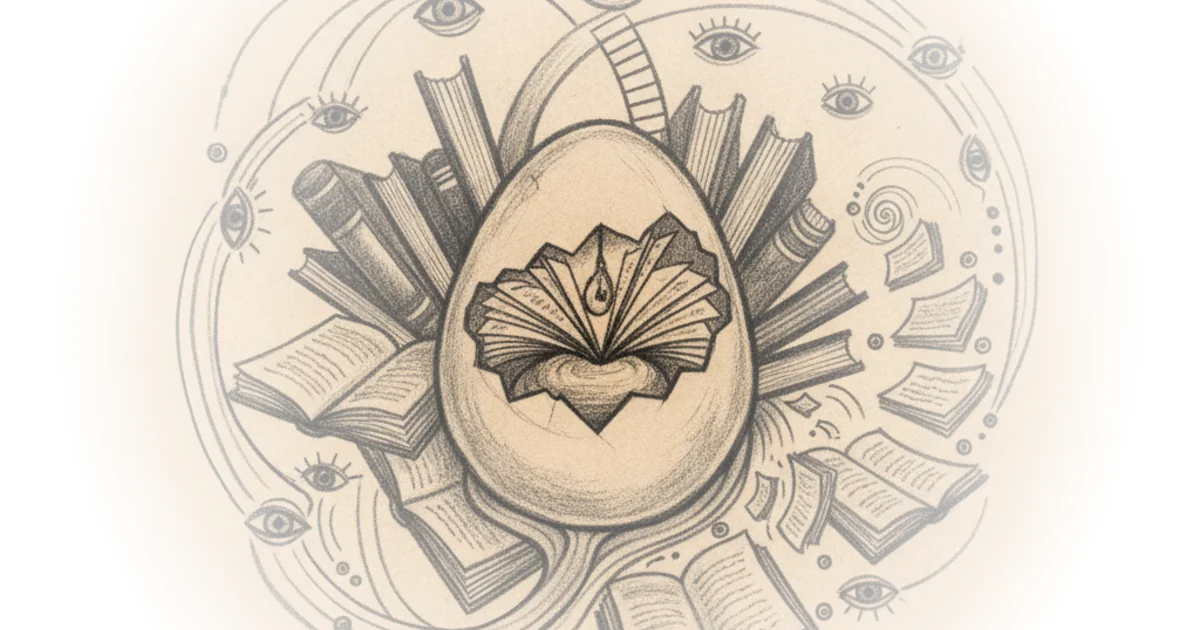
The turning point arrives when the narrator finds a volume by Diderot in a cafe, a chance encounter that mirrors the biological process Smith will soon describe. Smith notes, "I read to keep my composure, as one takes a cigarette or a drink; in this case, it was my eyes that needed to be occupied." The text suggests that literature acts as a stabilizing force, a "zephyr" that allows the reader to breathe again. This personal anecdote grounds the subsequent scientific and philosophical dive, reminding the reader that abstract concepts about life and matter are born from concrete human suffering.
"The power Diderot attributes to the egg is that of a revealer: what the examination of the egg by increasingly sophisticated tools will show about the origin of living beings will ensure the defeat of theology."
The Egg as a Revolutionary Concept
The core of Smith's argument lies in the historical shift from seeing life as pre-formed to seeing it as a process of emergence. Smith traces this back to the 17th century, referencing the work of Hieronymus Fabricius d'Acquapendente, whose dissections of chicken eggs in 1621 laid the groundwork for modern embryology. Smith explains that before this era, the prevailing view was that an embryo was a tiny, pre-formed being inside the egg, merely growing larger. Diderot, however, saw something more radical.
Smith quotes Diderot directly to illustrate this shift: "Do you see this egg? It is with this that one overturns all schools of theology and all the temples of the earth." The philosopher's insight was that the egg is a "sensible mass" only after the germ is introduced, and that heat and movement transform inert matter into life. This concept of epigenesis—the idea that form emerges gradually rather than unfolding from a pre-existing blueprint—was a direct challenge to the idea of a fixed, divine order.
The commentary here is particularly effective because it connects a biological fact to a philosophical revolution. Smith argues that understanding the egg was essential for those questioning the unpredictability of Nature, just as Galileo and Bruno had to understand the stars. The argument holds up well because it relies on specific historical figures and their actual contributions, rather than vague generalizations about the Enlightenment. However, one might note that Smith's focus on the "defeat of theology" simplifies the complex, ongoing dialogue between science and faith that persisted long after Diderot's time.
The Paradox of Fullness
The piece takes a sharp turn when the narrator is interrupted by a character named Ondré, leading to a debate about whether an egg is "full." This conversation serves as a metaphor for the tension between human perception and biological reality. Smith writes, "A full egg would be unlivable. It must have an air pocket to allow the chick to breathe during the last twenty-four hours before hatching; without it, it would suffocate." This biological detail is used to illustrate a deeper paradox: for life to emerge, there must be a void, a space for movement and change.
Smith connects this to the concept of symmetry breaking in embryology, noting that the heart's appearance determines the orientation of the head, breaking the initial symmetry of the embryo. This scientific fact is woven seamlessly into the narrative, reinforcing the theme that life is defined by its capacity to change and break patterns. The reference to symbiogenesis, though brief, hints at the even more complex reality that life often arises from the merging of distinct entities, further complicating the idea of a singular, pre-determined origin.
"Even if one tries to catch life in the egg, one can only fail... It is a dynamic... under the appearance of inertia."
The Unfinished Fresque
The piece concludes with a discussion about preserving grass between stones in a fresco, a metaphor for refusing to let things become static. Smith writes, "My idea is new and I have not polished my argument... It will be a good way not to freeze the fresco." This ending ties the entire narrative together: just as the egg must remain dynamic to hatch, and the fresco must remain open to change, so too must our understanding of the world resist finality.
Critics might argue that the piece leans too heavily on metaphor, potentially obscuring the rigorous scientific distinctions between epigenesis and other biological theories. Yet, Smith's strength lies in his ability to make these distinctions felt rather than just explained. The argument is that life, whether in an egg, a book, or a human life, is a process of becoming, not a state of being.
Bottom Line
Justin E. H. Smith delivers a masterful synthesis of biography, history, and philosophy, using the egg as a lens to examine the nature of emergence and the fragility of certainty. The piece's greatest strength is its ability to make abstract scientific concepts feel deeply personal and urgent, while its potential weakness lies in its romanticization of the historical conflict between science and religion. Readers should watch for how this framework of "dynamic emergence" applies to their own fields of inquiry, as the call to avoid "freezing the fresco" is a powerful reminder that understanding is always a work in progress.