Kings and Generals offers a rare, granular look at how a secluded agrarian society engineered a rapid ascent to global military power, framing the Meiji Restoration not merely as a political shift but as a desperate, calculated survival strategy against encroaching Western imperialism. While many histories focus on the personalities of emperors or generals, this piece argues that the collapse of the Tokugawa Shogunate was an inevitable result of economic rot and the inability to enforce isolation, setting the stage for a transformation that shocked the world. The narrative's most striking claim is that Japan's victory over Russia was not a fluke of luck, but the direct result of decades of industrialization and diplomatic maneuvering born from the humiliation of unequal treaties.
The Collapse of the Old Order
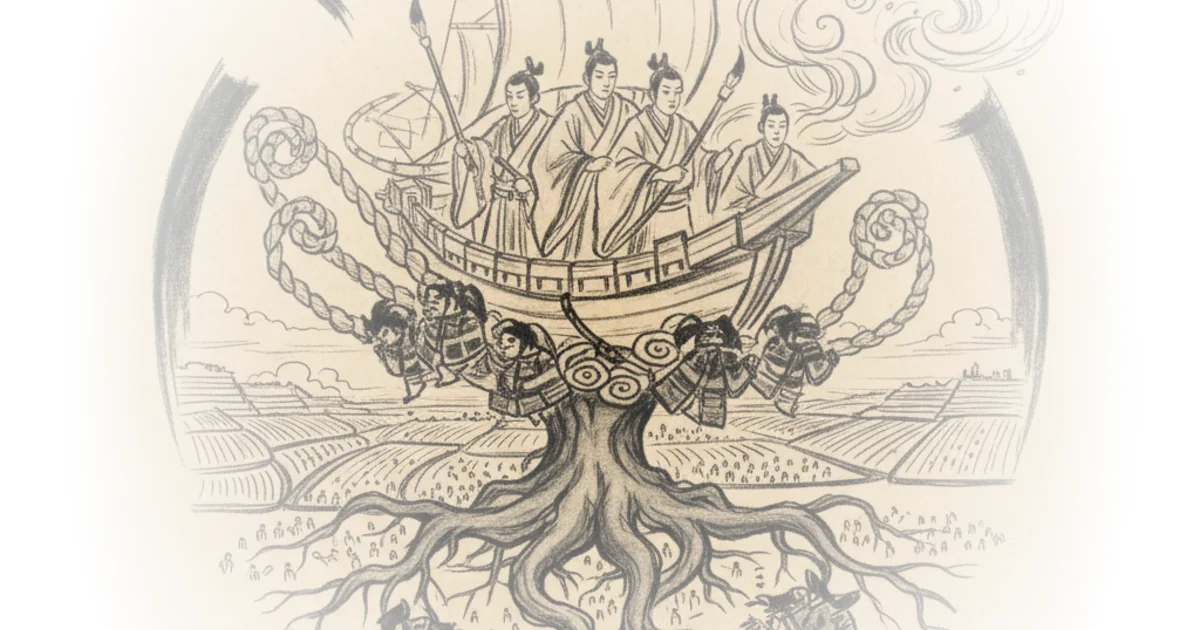
The coverage begins by dismantling the romanticized image of feudal Japan, revealing a society on the brink of economic and social implosion. Kings and Generals writes, "in the first half of the 19th century japan was an agrarian country of tens of millions of rice farmers a small minority of merchants who benefited from their hard work and the elite class of samurai who as peace continued exchanged their swords for calligraphy brushes." This vivid description highlights the paradox of a warrior class becoming dependent on the very merchants they despised, a tension that eroded the Shogunate's authority. The author correctly identifies that the rigid Neo-Confucian class system, which forbade taxing commerce, left the treasury empty and forced the government to debase currency, causing inflation that alienated the samurai.
The narrative then pivots to the external pressures that accelerated this internal decay. As Kings and Generals puts it, "an increase in foreign intervention contributed harshly as well since the year 1633 the shogunate had strictly regulated commerce with foreign countries especially european ones issuing their sekoku isolationist policy." The piece effectively illustrates how the arrival of Russian explorers and British gunboats shattered the illusion of safety, culminating in Commodore Matthew Perry's arrival in 1853. The author notes that the Shogun, knowing war was futile, sought a compromise, which led to a series of unequal treaties that left Japan in a "semi-colonial status politically and economically subordinate to foreign governments." This framing is crucial; it positions the Meiji Restoration not as an act of aggression, but as a defensive modernization project necessitated by the threat of colonization.
The fall of the Tokugawa Shogunate was inevitable as anti-western sentiment throughout the country began to rally around the sono joey movement which translates as revere the emperor expelled the barbarians.
Critics might argue that the "sonno joi" movement was less about national unity and more about a power grab by specific regional domains like Satsuma and Choshu, but Kings and Generals successfully captures the genuine national panic that fueled the movement. The transition from rebellion to state-building is described with clarity: the new imperial government abolished the class system, centralized power into an oligarchy, and modernized the military, effectively ending the samurai class through western-style tactics.
The First Sino-Japanese War and the Triple Intervention
The commentary moves swiftly to Japan's first major test on the international stage: the conflict with the Qing Dynasty over Korea. Kings and Generals writes, "for their strategy the japanese planned to defeat the modernized beijing fleet early on in the war so that they could gain command of the sea and land the fifth division to push the chinese out of korea." The piece details how the Japanese navy's decisive victory at the Battle of the Yalu River allowed them to dominate the land war, leading to the Treaty of Shimonoseki. This treaty granted Japan significant territorial gains, including Taiwan and the Liaodong Peninsula, and recognized Korean independence, effectively ending Chinese suzerainty.
However, the narrative takes a sharp turn when discussing the geopolitical backlash. The author explains that despite military success, Japan was forced to relinquish the Liaodong Peninsula due to the "Triple Intervention" by Russia, France, and Germany. Kings and Generals notes, "the japanese empire felt cheated by the triple intervention and saw the intrusion of the russians into what they considered their own sphere of influence as a humiliation." This moment is identified as the catalyst for Japan's aggressive naval buildup and its strategic pivot toward an alliance with Britain. The author argues that this humiliation was more psychologically damaging than any military defeat, hardening the resolve of expansionist factions within the government.
Born from the engulfing flames of Russian battleships the Japanese Empire would continue to expand through the 20th century becoming a dangerous threat to western rule in the east.
The piece effectively links the Triple Intervention to the subsequent Anglo-Japanese Alliance of 1902, portraying it as a masterstroke of diplomacy designed to prevent another coalition against Japan. It also highlights the intelligence advantage Japan held, noting that they had spies across Manchuria and knew the region better than the Russians, who were overextended by the incomplete Trans-Siberian Railway.
The Russo-Japanese War: A Shock to the World
The climax of the piece is the Russo-Japanese War, where the author details the meticulous planning and execution that led to a stunning victory against a European great power. Kings and Generals writes, "led by the legendary admiral togo heiheiro the ijn managed to keep the russian pacific fleet at bay while the ija landed at chemupo and quickly occupied korea." The narrative emphasizes the logistical nightmare for the Russians, whose Baltic fleet had to sail around the world, arriving in poor condition and too late to save Port Arthur.
The Battle of Tsushima is described as the definitive moment that shattered the myth of European invincibility. As Kings and Generals puts it, "the japanese were spectacularly victorious practically annihilating the russian fleet and shocking the western world with their naval prowess." The author connects this military victory directly to political consequences in Russia, suggesting the disaster was a heavy blow to the prestige of the Romanov dynasty, eventually contributing to the Russian Revolution. The Treaty of Portsmouth is presented as the culmination of this effort, securing Japan's status as a regional hegemon with control over Korea and South Sakhalin.
The commentary does a commendable job of balancing military detail with strategic analysis, showing how Japan leveraged its geographic proximity and industrial focus to overcome a larger, more resource-rich adversary. However, the piece briefly glosses over the brutal cost of this modernization, particularly the suppression of internal dissent and the human toll of rapid industrialization, focusing almost exclusively on state-level outcomes.
Bottom Line
Kings and Generals delivers a compelling narrative that reframes the Meiji Restoration as a high-stakes game of survival, where military modernization was the only path to avoiding colonization. The strongest part of the argument is the clear causal link drawn between the humiliation of the Triple Intervention and the aggressive, successful war against Russia. The piece's biggest vulnerability is its tendency to view history through a purely strategic lens, occasionally overlooking the social and human costs of such rapid transformation. For the reader, the key takeaway is that Japan's rise was not inevitable but a calculated response to existential threats, a lesson in how a nation can rapidly pivot from isolation to global power when faced with the alternative of subjugation.