Most people assume a country needs land, a permanent population, and an economy to exist. Sam Denby dismantles that assumption by spotlighting the only sovereign state in the world that lacks a demonym, a birthright citizenship, and a functional healthcare system, yet commands a diplomatic seat at the United Nations.
The Paradox of the Vatican
Denby opens by challenging the very definition of statehood, noting that while nations like France or Japan are universally recognized, the Vatican sits in a category all its own. "Perhaps most damningly the Vatican has no real permanent population," Denby writes, pointing out that every citizen is there only because they work there, and no one is born a Vatican national. This is a crucial distinction that separates the Vatican from every other nation on Earth. The author highlights the absurdity of the situation: "There isn't even a universally recognized term to refer to someone from the Vatican because nobody's from the Vatican."
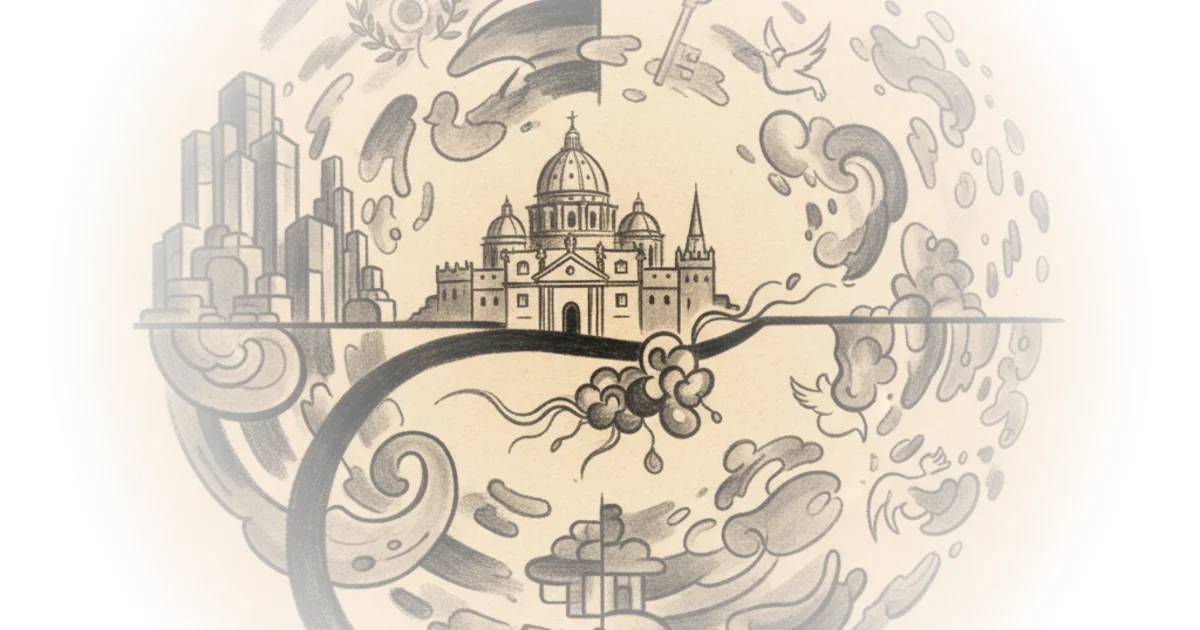
This framing is effective because it forces the reader to confront the idea that international recognition is a political construct, not a reflection of traditional metrics. Denby argues that the Vatican lacks the standard pillars of a nation: "It doesn't have a Healthcare System... it doesn't have an independent legal system... hardly a distinct cultural identity outside of the churches." Yet, despite these deficits, it enjoys "near Universal unequivocal recognition as a sovereign state." The strength of this argument lies in its ability to strip away the romanticism of the Vatican and reveal the cold, hard mechanics of how sovereignty is granted by the international community rather than earned through demographics.
The Vatican is the only country in the CIA World Factbook that just doesn't have a demonym listed because everyone who holds Vatican citizenship was born into another citizenship.
The Mechanics of the Holy See
The commentary then pivots to the historical and structural oddities that allow this anomaly to persist. Denby explains that the Vatican's sovereignty is not merely a relic of the past but a carefully constructed legal reality born from the 1929 Lateran Treaty. He notes that for sixty years, popes refused to leave the Vatican walls to avoid legitimizing Italian rule, a standoff that only ended when Mussolini needed the church's support. "This most notably handed over sovereignty of 49 square miles of land to the holy sea thereby forming the smallest independent country in the world," Denby explains.
However, the true complexity lies in the distinction between the Vatican City (the territory) and the Holy See (the governing body). Denby clarifies that "the holy sea is both the governing body of the Vatican State and the Roman Catholic Church that's to say there's zero distinction between the state and the church." This is a profound observation: the entity conducting diplomacy is technically a religious organization, not a state in the traditional sense. "The holy sea is more or less the government of the Vatican that government is in this case operationally Inseparable from the state but not all governments are so." This distinction allows the Holy See to maintain diplomatic relations even when it lacked territory, a feat no other religious body has achieved.
Critics might argue that this arrangement gives a single religious institution undue influence over global secular policy, yet Denby suggests the structure is unique because the Holy See is treated as a sovereign entity regardless of its territorial status. "The real explanation seems to be in the unsatisfying fact that everyone has always kept treating it as a sovereign entity and therefore it is one." This circular logic is the bedrock of the Vatican's power, a reality Denby presents with a mix of fascination and skepticism.
Diplomacy Without a Vote
The piece culminates in an analysis of the Holy See's role at the United Nations, where it operates as a Permanent Observer State. Denby traces this back to Pope John XXIII's intervention during the Cuban Missile Crisis, which convinced the UN to grant the Holy See a unique status. "It began with a world verging on nuclear war when Pope John the 23d boldly entered the Diplomatic fold like no modern Pope prior," Denby writes. The result was a compromise: the Holy See could speak and observe but could not vote, a constraint rooted in the Lateran Treaty's requirement for neutrality.
Denby illustrates the power of this non-voting status through the example of human cloning debates. While member states were divided, the Holy See pushed for a broader ban that included therapeutic cloning, arguing that "human embryos in the church's view were nothing less than human beings." This moral lobbying, rather than political maneuvering, shifted the global conversation. "Such persistence ultimately paid off as the return of the issue in '05 resulted in a ban on human cloning far wider reaching than that initially introduced in 01." The author's point is clear: the Holy See's influence comes from its ability to frame issues as moral imperatives rather than political compromises.
The church's influence over un proceedings is largely through rhetoric something it doesn't take lightly as four separate popes have taken the time to visit and speak at the UN.
Bottom Line
Denby's analysis succeeds in demystifying the Vatican by treating it as a case study in the fluidity of international law rather than a religious curiosity. The strongest part of the argument is the clear distinction between the territorial state and the non-territorial Holy See, which explains how a church can function as a state. The biggest vulnerability, however, is the reliance on historical precedent; as the world becomes more secular, the question of whether this unique diplomatic model can survive without the moral weight it once carried remains unanswered.
The real explanation seems to be in the unsatisfying fact that everyone has always kept treating it as a sovereign entity and therefore it is one.