Cory Doctorow cuts through the hype of artificial intelligence by asking a question that sounds absurd until you realize no one else is asking it: If these companies truly possess the technology to cure cancer or replace entire workforces, why are they selling it to us instead of using it themselves? This piece challenges the foundational economic logic of the AI boom, suggesting that the industry's refusal to compete directly with its customers reveals a fundamental lack of the god-like capabilities they claim to be building.
The Pick-and-Shovel Paradox
Doctorow opens with a historical observation about bookstores and the Rubáiyát of Omar Khayyám, noting, "I often wonder what the Vintners buy/One half so precious as the Goods they sell." He uses this to frame a modern economic puzzle: if you have struck gold, why are you still selling picks and shovels? The author argues that the current AI narrative is a variation of the classic "get-rich-quick" scam, where promoters claim to have an infinite money hack but are desperate for your capital to keep the lights on.
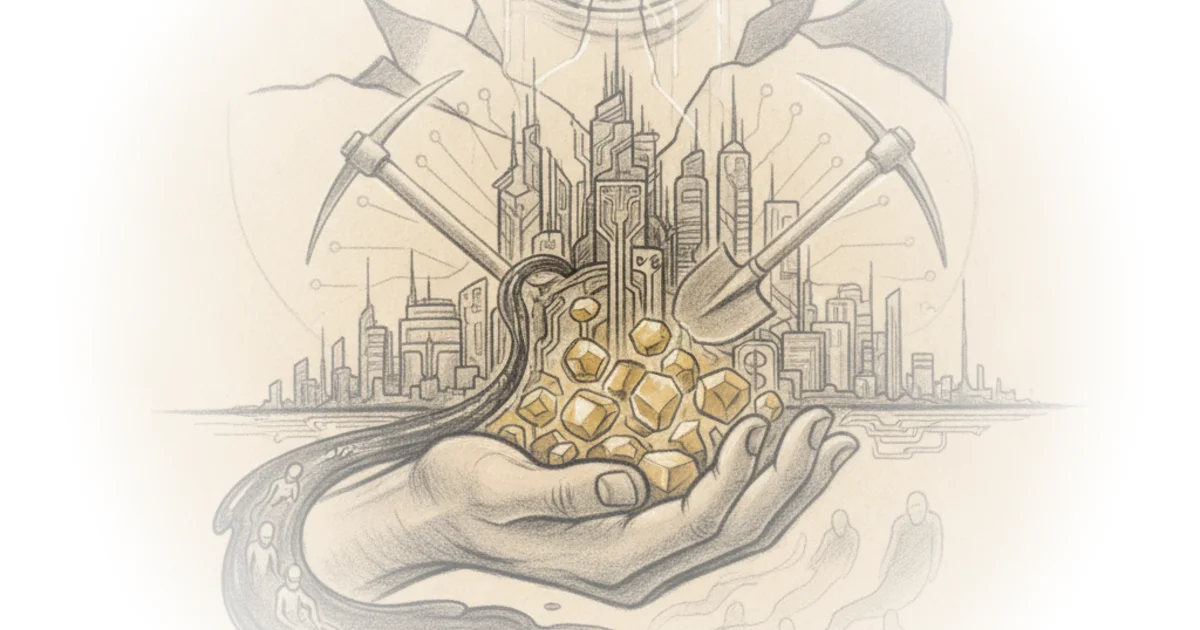
The core of Doctorow's argument rests on the behavior of the executive branch and major tech firms. He points out that when the administration's allies dismissed long-running cancer research in favor of a promised AI cure, they were essentially betting on a future that hasn't arrived. "If you've truly incubated a foetal demiurge in your 'AI lab,' why are you offering to sell it to me?" he asks. This rhetorical question exposes the fragility of the "artificial general intelligence" timeline. If the technology were truly ready to outperform human doctors or accountants, the logical move would be to vertically integrate—opening hospitals or tax firms—rather than licensing the software to existing providers.
"If the chatbot can do the job, and if the chatbot costs less than the worker who does the job today, then the chatbot company can profitably sell services more cheaply than anyone who presently employs that worker, because the chatbot company already owns the chatbot."
Doctorow suggests that the only reason this contradiction isn't obvious to the public is our collective immersion in a "go meta" economy. He describes a system where the most profitable business model is to be as far removed from actual value creation as possible. Instead of driving a taxi, you own the medallion; instead of owning the medallion, you start a rideshare app; instead of running the app, you invest in the options. This abstraction layer allows companies to profit from the promise of efficiency without ever having to demonstrate it in the real world.
Critics might argue that vertical integration is legally complex or that AI models are not yet reliable enough for high-stakes medical or legal deployment. However, Doctorow counters that if the models were truly as powerful as the marketing suggests, the cost of experimentation would be negligible compared to the profits of a direct service monopoly. The fact that they are choosing to sell tools rather than services suggests the tools are not as capable as claimed.
The Economics of Grift
The commentary shifts to a broader critique of the "scam economy," where the most lucrative business is often selling the tools for other scams. Doctorow highlights the absurdity of a market where people sell PDFs on how to get rich, and then sell software to generate those PDFs, creating a self-referential loop of financial fiction. He notes, "The inverse relationship between doing something useful and making money is deeply ingrained in our economic wisdom."
This framing is particularly sharp when applied to the current labor market. Doctorow observes that while America is "drowning in MBAs," there is a critical shortage of workers for essential roles like eldercare. The AI industry, in this view, is not solving the labor shortage but rather monetizing the anxiety around it. By selling "doctorbots" to hospitals run by executives, the AI companies allow those executives to claim cost savings without actually deploying a superior product. The AI firms become the wholesalers of picks and shovels to the retailers who are already struggling at the frontier.
"Why would you voluntarily split the take with some sucky, washed, non-god-generating business from before 2022?"
This question strikes at the heart of the venture capital model. If the goal were truly to immanentize the eschaton—to bring about a god-like future—the immediate profit motive would be secondary to the accumulation of total control over the technology. The decision to sell rather than consume implies that the current models are merely products, not the singularities they are marketed to be.
Bottom Line
Doctorow's most powerful contribution is the economic reductio ad absurdum: if the technology works as advertised, the business model makes no sense. The strongest part of this argument is its ability to bypass technical jargon and focus on the simple logic of profit and competition. The biggest vulnerability is that it assumes rational economic behavior in a market driven by speculative bubbles, where the promise of future dominance can justify present-day irrationality. Readers should watch for whether any major AI firm actually attempts to vertically integrate into service provision; if they don't, the "god in the machine" narrative is likely a mirage.