Adam Tooze dismantles a seductive but misleading binary that has taken hold in energy discourse: the idea that the world is splitting into 'electrostates' and 'petrostates.' His most provocative claim is that the United States is not a natural petrostate by economic definition, but rather a sophisticated economy making a political choice to freeze its development in a hydrocarbon-heavy model, a path only a nation of its unique size and wealth could attempt.
The Flaw in the Binary
Tooze begins by clarifying the terminology that has become so popular in recent headlines. He defines an electrostate not by its political ideology, but by its energy delivery method. "We call a country an electrostate, if it draws a large and increasing share of its total final energy consumption in the form of electricity," he writes. This distinction matters because the global clean energy transition hinges on the mantra to "electrify everything." While China is rightly identified as the archetypal electrostate—dominating electric vehicles and ultra-high-voltage transmission networks—Tooze warns against treating this as a fixed identity rather than a trajectory.
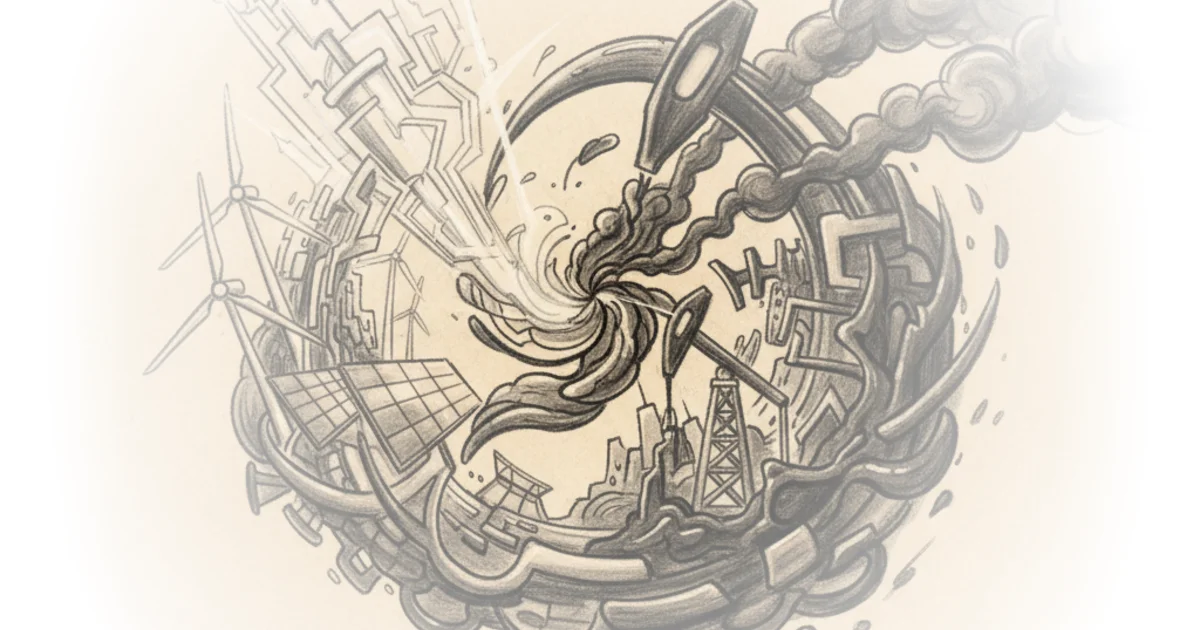
The author's analysis is strengthened by his historical grounding. He notes that the Soviet Union was once an "electrical engineering powerhouse," a fact that complicates the modern narrative that electrification is solely a Western or Chinese innovation. Furthermore, he points out that the advent of liquefied natural gas and battery technology has democratized the ability to electrify, meaning the advantage is no longer tied to having mountains for hydro or vast coal deposits. "The degree to which you are an electrostate is an expression not of underlying factor endowments, or of economic structure, but of economic and governmental rationality," Tooze argues. This reframing is crucial; it suggests that energy systems are matters of policy and engineering capacity, not just geography.
The designation of petrostate applies to an economy like that of Angola... but in the classic sense, it really does not make much sense when applied to the US.
The American Anomaly
The core of Tooze's argument challenges the casual use of "petrostate" to describe the United States. He meticulously breaks down the economic data, noting that while the shale revolution made the US the world's leading oil producer, the industry accounts for only 7-8 percent of US GDP. In contrast, classic petrostates like Saudi Arabia or Angola rely on hydrocarbons for the bulk of their government revenue and export earnings. "If pundits and politicians choose to talk about the US as though it were a 'petrostate' that is for political reasons. It is a matter of 'discursive construction', rather than an obvious economic fact," he asserts.
This is a vital correction for busy readers who may have absorbed the simplified narrative. The reality is more nuanced: Texas, often cited as the heart of American fossil fuel production, is simultaneously the nation's leading generator of renewable electricity. Tooze explains this paradox by invoking the concept of "Dutch disease," where a booming resource sector raises costs for others, ironically making those other sectors more desperate for cheap, clean power. "Being a competitive oil and gas producer... is not a license for waste," he writes. The economic logic of efficiency drives the adoption of renewables even in the most oil-rich regions.
However, a counterargument worth considering is whether the sheer political power of the fossil fuel lobby in the US distorts this economic rationality enough to override market signals. While Tooze acknowledges the lobby's strength, he might be underestimating how deeply entrenched regulatory capture can stall the very "economic sense" he describes.
The Unique American Choice
The most striking part of Tooze's commentary is his diagnosis of the US's unique position. Unlike China or the EU, which are driven by energy insecurity to decarbonize, or Saudi Arabia, which must diversify to survive, the US has the luxury of choice. It is the world's largest producer and consumer of oil, creating a self-contained market. "The US is large enough, rich enough and sophisticated enough to simply freeze in place the late 20th century model for the foreseeable future," Tooze writes.
He identifies this as a potential "closed petrostate"—a novel form of statehood where a nation uses its resource abundance to opt out of the global transition. This is not a natural outcome of resource endowments but a deliberate political decision. "For ideological reasons, they oppose a mixed model of fossil and electrotech development. This is a perverse, political choice," he notes regarding the current administration's stance. The obstacle to this path is not just ideology but infrastructure; the US grid is so fragmented that even if the political will existed, connecting new capacity is a nightmare. As he puts it, "the process of grid expansion, connection and interconnection is so broken, that even if generating capacity becomes available, it cannot be hooked up efficiently."
If the United States chooses to use its endowment of fossil fuels and the size of its economy to freeze in place the early 20th-century status quo and thus to fall more and more out of step with global electrotech development, that will not be a natural fact, but a matter of political choice.
This analysis holds up well against the backdrop of global energy trends. While the Gulf states are investing heavily in Chinese solar technology to build their own "electrostate sectors," the US risks isolating itself. The danger is that this isolation is framed as a return to energy independence, when in reality, it is a retreat from the technological frontier.
Bottom Line
Tooze's strongest contribution is exposing the "petrostate" label as a political weapon rather than an economic reality for the United States, revealing that the country's energy future is a matter of choice, not destiny. The argument's vulnerability lies in its reliance on economic rationality as the primary driver, potentially underestimating how institutional inertia and grid fragmentation could lock in a fossil-fuel future regardless of political intent. Readers should watch whether the US grid's structural failures become the primary bottleneck, effectively achieving the "frozen" state the administration desires without the need for explicit ideological decrees.