The Files That Won't Be Read
A Department of Justice that controls access to evidence. A Congress that must visit government computers during business hours to review documents. A transparency law with a deadline that passed without consequence. Heather Cox Richardson's February 10, 2026 entry captures a moment when institutional accountability depends on officials willing to watch the clock.
Controlled Transparency
The Epstein Files Transparency Act required full release by December 19. Only about half arrived. Many remain so heavily redacted they convey little information. Richardson writes, "As of yesterday, members of Congress who sit on the House or Senate Judiciary Committees can see unredacted versions of the Epstein files the Department of Justice (DOJ) has already released." But the viewing conditions matter: computers in the DOJ building, 9 AM to 6 PM, no electronic devices, 24-hour notice required.
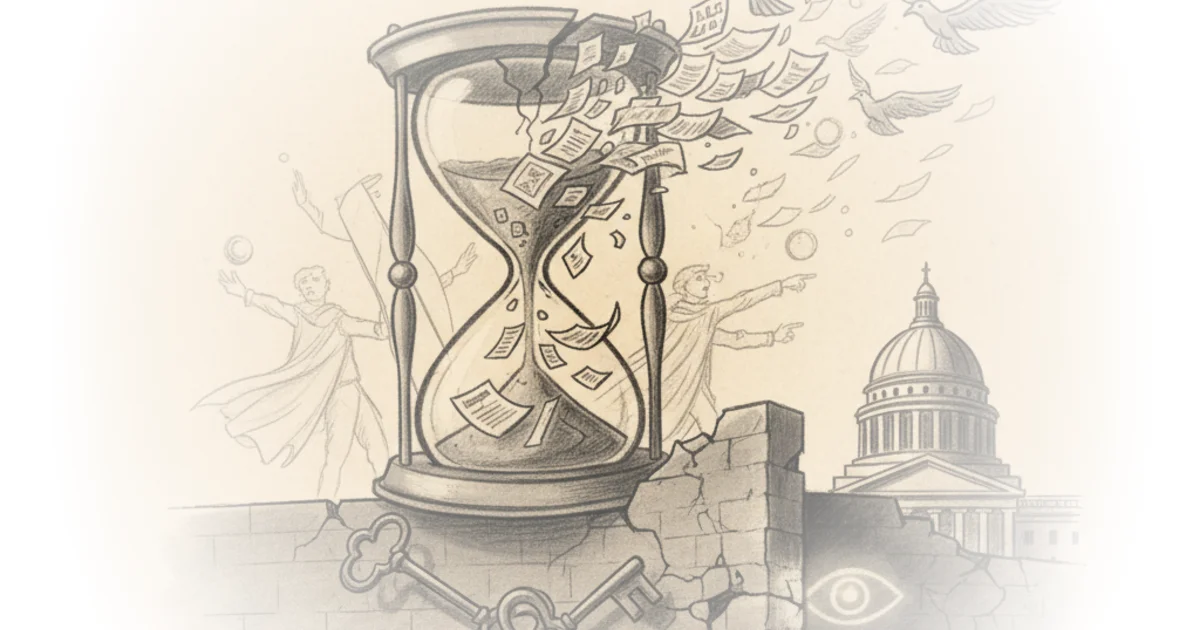
Representative Jamie Raskin requested access on behalf of Democratic Judiciary Committee members on January 31. They would be ready the next day. Richardson notes, "After members of Congress complained, on Friday, January 30, Deputy Attorney General Todd Blanche said they could see the unredacted documents if they asked." The offer came after complaints. The access came with constraints.
When Raskin searched for a particular name, it appeared more than a million times. He suggested limiting access is part of a cover-up. Richardson writes, "Raskin suggested that limiting members' access to the files is part of a cover-up to hide Trump's relationship with the convicted sex offender, a cover-up that includes the three million files the DOJ has yet to release despite the requirements of the Epstein Files Transparency Act." One file he saw referred to a child of nine. Raskin called it "gruesome and grim."
"There's still a lot that's redacted—even in what we're seeing, we're seeing redacted versions. I thought we were supposed to see the unredacted versions."
Representative Ro Khanna's frustration captures the gap between promise and practice. Unredacted access that remains redacted undermines the transparency law's purpose.
The Lutnick Question
Commerce Secretary Howard Lutnick lived next door to Epstein for more than ten years. He said in October he cut ties in 2005 after visiting Epstein's home and being disgusted. The files show otherwise. Richardson writes, "The files show that in fact, Lutnick not only maintained ties with Epstein but also was in business with him until at least 2018, long after Epstein was a convicted sex offender."
Members of both parties called for Lutnick to resign. Testifying before the Senate Appropriations Committee, Lutnick acknowledged more contact than previously admitted but maintained, "I did not have any relationship with him. I barely had anything to do with him." Even Republicans expressed discomfort with Lutnick's visit with his family to Epstein's private island.
Khanna framed the accountability question plainly. Richardson quotes him: "In this country, we have to make a decision. Are we going to allow rich and powerful people who were friends and had no problem doing business and showing up with a pedophile who is raping underage girls, are we just going to allow them to skate? Or, like other countries, are we going to have…accountability for the people who did that?"
In the U.S., fallout remains limited. Wall Street lawyer Brad Karp resigned—the first law firm to cave to demands last March. Material shows Karp plotted with Epstein to get a woman they disliked charged with a crime and deported. In Europe, revelations ended careers abruptly. The former British ambassador to Washington was fired. Two senior Norwegian diplomats are under investigation. Slovakia's national security advisor resigned. Poland launched an investigation into whether Epstein was tied to Russian intelligence.
Critics might note that European accountability reflects different political cultures and media environments, not necessarily stronger institutions. The U.S. has its own accountability mechanisms—just slower to activate.
The Immigration Hearing
Department of Homeland Security officials testified before the House Committee on Homeland Security. Funding runs out February 13. Officials warned a shutdown would disrupt operations and endanger national security. Richardson writes, "Todd Lyons, the acting head of Immigration and Customs Enforcement; Rodney Scott, the commissioner of Customs and Border Protection; and Joseph Edlow, the director of U.S. Citizenship and Immigration Services, all part of the Department of Homeland Security, testified today before the House Committee on Homeland Security."
Lyons defended ICE agents as properly enforcing immigration laws and as real victims of encounters that left protesters dead or injured. Most Republicans backed him, saying Democrats try to stop removal of criminals. Democrats asked about federal arrests of U.S. citizens and deaths of Renee Good and Alex Pretti.
Representative James Walkinshaw traced the policy origin. Richardson quotes him: "Look, all of this comes from Stephen Miller's sick and twisted, deranged Great Replacement theory. Whether these folks here…know it or not, they're…just pawns in Stephen Miller's sick and twisted scheme."
The ACLU filed a federal civil rights lawsuit after a raid on a horse racing venue in Wilder, Idaho. One hundred five undocumented immigrants were detained. Three hundred seventy-five U.S. citizens or lawful residents were temporarily detained. Only five arrests ended in criminal charges, all for unlicensed gambling.
Photographic evidence showed zip-tie bruises on a fourteen-year-old female U.S. citizen. The FBI field office in Boise and Homeland Security spokesperson Trisha McLaughlin initially denied allegations flatly. Richardson writes, "ICE didn't zip tie, restrain, or arrest any children. ICE does not zip tie or handcuff children. This is the kind of garbage rhetoric contributing to our officers facing a 1,300% increase in assaults against them and an 8,000% increase in death threats." After evidence and testimony, the FBI changed their assertion to say no "young" children were zip-tied.
Critics might note that initial denial followed by qualified admission suggests institutional resistance to acknowledging harm. The gap between "no children" and "no young children" matters for accountability.
The Fulton County Raid
Court documents unsealed today show the FBI raid on a warehouse in Fulton County, Georgia, was based on debunked claims of fraud from 2020 election deniers. Seven hundred boxes of ballots and other election-related items were seized. Richardson writes, "As Ashley Cleaves and Matt Cohen of Democracy Docket explained, the affidavit that informed the search warrant came from Kurt Olsen, one of the lawyers who worked with Trump to overturn the 2020 election and whom Trump has recently appointed director of election security and integrity."
Olsen recycled debunked theories. Legal analyst Joyce White Vance notes the statute of limitations has run out on potential election crimes from 2020. She exposes the weakness of the case itself. Both the General Assembly and the Georgia State Election Board that said there was no intentional fraud or misconduct in Fulton County's 2020 ballot counting were Republican-led.
White suggests the raid was "less about bringing a meritorious criminal prosecution against specific individuals and more about casting suspicion over Fulton County's voting system and ability to conduct a fair election."
The Governors' Dinner
The National Governors Association cancelled its annual bipartisan meeting with the president. Trump had disinvited two Democratic governors. The rest of Democratic governors refused to attend. Richardson writes, "Democratic governors have a long record of working across the aisle to deliver results and we remain committed to this effort. But it's disappointing this administration doesn't seem to share the same goal. At every turn, President Trump is creating chaos and division, and it is the American people who are hurting as a result."
White House press secretary Karoline Leavitt told reporters, "I just spoke with the president about this. It is a dinner at the White House. It's the 'People's House.' It's also the president's home, and he can invite whomever he wants to dinners and events here at the White House."
The National Governors Association chair, Oklahoma's Republican governor Kevin Stitt, wrote, "Because NGA's mission is to represent all 55 governors, the Association is no longer serving as the facilitator for that event, and it is no longer included in our official program."
The Grand Jury Refusal
A grand jury refused to indict six Democratic members of Congress for breaking a law that makes it a crime to "interfer with, impair, or influence the loyalty, morale, or discipline of the military or naval forces of the United States." Senators Mark Kelly of Arizona, Elissa Slotkin of Michigan, and Representatives Jason Crow of Colorado, Chris Deluzio of Pennsylvania, Maggie Goodlander of New Hampshire, and Chrissy Houlahan of Pennsylvania recorded a video last November reminding service members they must refuse illegal orders.
Richardson writes, "Although the bar for an indictment is so low that grand juries almost always return one, the Trump administration's attempts to harass those he perceives as opponents have been so outrageous that grand juries have repeatedly refused to go along." The New York Times called today's refusal "a remarkable rebuke."
Bottom Line
When transparency requires visiting government computers during business hours with no devices and 24-hour notice, the system protects itself more than the public. When officials maintain ties with a convicted sex offender until years after conviction and claim they "barely had anything to do with him," accountability depends on whether institutions value truth over loyalty. The files exist. The access is constrained. The verdict rests on whether Congress treats constrained access as cooperation or cover-up.