This piece from Kings and Generals does more than recount ancient battles; it dissects why the rigid, seemingly invincible Macedonian phalanx crumbled against the adaptable Roman legion. The most striking insight isn't about weaponry, but about the decentralized command structure that allowed Roman centurions to seize opportunities in real-time, a tactical flexibility the Hellenistic kings simply could not match.
The Terrain of Victory
Kings and Generals opens by setting the stage after Alexander the Great's death, noting how his successors established kingdoms that relied on the same phalanx formations that once conquered the known world. The author argues that "unit cohesion was the absolute key to victory," yet this very strength became the phalanx's fatal flaw when the ground beneath it shifted. The commentary highlights that while the phalanx required flat, unbroken plains to function, the Roman manipular legion was born from the necessity of fighting in the "mountains of central Italy."
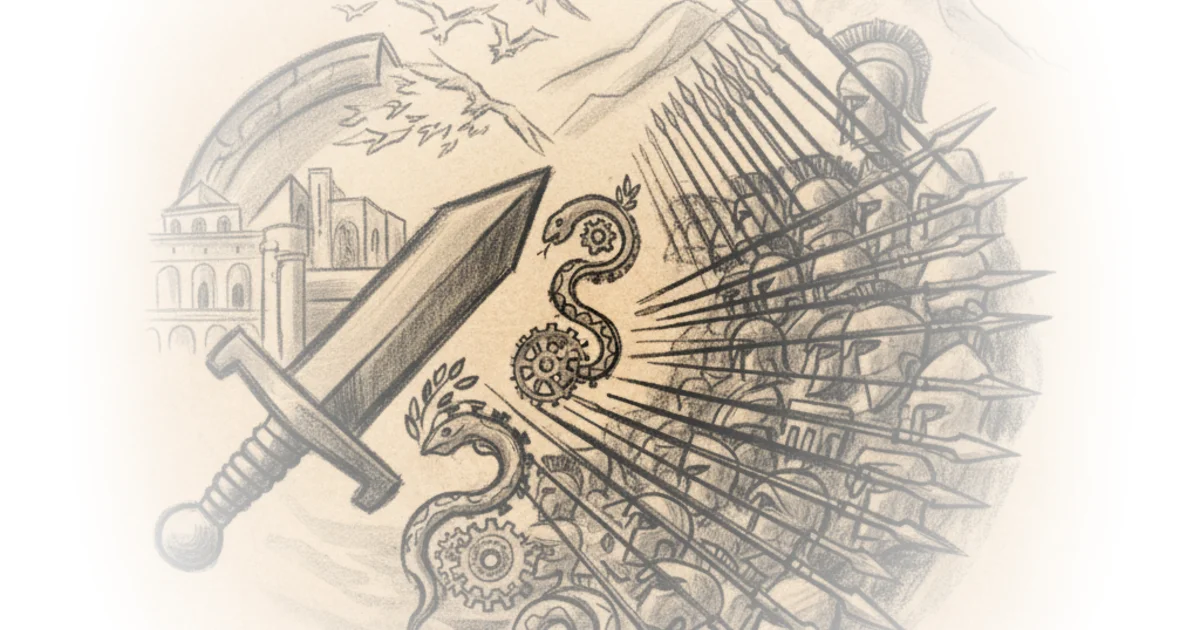
This framing is crucial because it shifts the narrative from "better soldiers" to "better systems." Kings and Generals writes, "the flexibility of the maniples to bend and stretch where needed meant that they performed much better in mountainous terrain whereas the phalanx ideally required flat ground to perform properly." This observation holds up well against historical records; the phalanx was a machine that broke when the terrain broke its formation, while the legion was a swarm that could flow around obstacles.
The Battle of Pydna serves as the primary case study. As the author describes, the Macedonians initially drove back Roman skirmishers on flat ground, but the turning point came when "the romans purposefully retreated onto the mountain slopes behind them and the macedonians pursued." The result was catastrophic for the phalanx: "as they advanced up the mountain the phalangites began to fray and split allowing the roman centurions to lead their men into the formation's gaps." This is a masterclass in tactical exploitation, where the terrain itself became a weapon for the Romans.
Critics might argue that the Romans also benefited from superior numbers and cavalry support in these engagements, factors the video glosses over to focus on infantry mechanics. However, the core point regarding formation integrity remains valid: without a cohesive front, the phalanx was helpless.
The contrast in performance between the two formations was shown clearly at the battle of pidna in 168 bc.
The Weaponry of Adaptation
The piece then dives into the hardware, contrasting the two-handed, 18-foot sarissa pike with the Roman short sword and heavy shield. Kings and Generals notes that the sarissa's iron heads were "designed to pierce armor and shields," yet they were useless once the Romans closed the distance. The author points out that the phalangite, burdened by a two-handed weapon and a small shield, was "almost useless" in close quarters, whereas the Roman legionary was a "hybrid missile troop as well as a sword-wielding heavy infantry unit."
This equipment analysis supports the broader argument about flexibility. The Roman pilum javelin was not just a weapon; it was a tactical tool designed to "cause them to discard their crucial shields and make them even more vulnerable." By forcing the enemy to drop their defense, the Romans neutralized the phalanx's primary advantage before the sword fight even began. The author effectively illustrates that the Roman system was designed to create chaos for the enemy, while the Macedonian system relied on maintaining order.
Leadership and Initiative
Perhaps the most compelling section of the commentary is the comparison of leadership styles. Kings and Generals argues that Hellenistic kings, viewing themselves as descendants of Alexander, felt compelled to lead from the front, which "deprived the rigid phalanx of much-needed leadership." In contrast, Roman consuls led from horseback, allowing them to see the whole battlefield and shift resources where needed.
The author provides a vivid example from the Battle of Cynoscephalae, where a Roman tribune saw an opening and acted without waiting for orders: "a lone military tribune managed to rally a significant number of legionaries to him and crashed into the seemingly triumphant macedonian right an action which won the battle for rome." This illustrates a profound cultural difference. As Kings and Generals puts it, "in the roman legions there was a high amount of command and control which was pushed down to the lowest ranks."
This decentralized initiative is the hidden engine of Roman success. While the Macedonian king was stuck in the thick of the fighting, Roman centurions were empowered to "take their own initiative" and exploit gaps in the enemy line. The author notes that at Magnesia, a tribune not only rallied fleeing soldiers but "executed those cowards who refused to reform," demonstrating a level of autonomous authority that would be unthinkable in the Hellenistic armies. This is a strong argument that the Roman victory was as much political and cultural as it was military.
The Cultural Aftermath
The piece concludes by noting the irony of the conquest: "Rome conquered Greece but Greece conquered Rome." The author suggests that the military defeat of the successor kingdoms led to a massive influx of Greek culture and slaves, which fundamentally altered Roman society. While this is a standard historical observation, Kings and Generals ties it back to the military theme by suggesting that the "mid-republican manipular legion had forged the roman state into the dominant force of the mediterranean," setting the stage for future reforms.
This kind of action where a small portion of a legion could act alone was a uniquely roman characteristic and was rarely seen in the phalanx.
Bottom Line
Kings and Generals delivers a sharp, tactical analysis that correctly identifies decentralized command and terrain adaptability as the deciding factors in the legion's victory over the phalanx. The argument's greatest strength is its focus on the human element of command—the Roman tribune's initiative versus the Hellenistic king's heroism—rather than just a list of weapons. However, the piece occasionally underplays the role of Roman cavalry and numerical superiority, which were also critical in these battles. For the busy reader, the takeaway is clear: in both ancient warfare and modern leadership, the ability to adapt and empower the individual often beats the power of a rigid, centralized machine.