In a rare moment of unscripted intimacy, Matt O'Dowd transforms a lockdown living room into a frontier of physics, arguing that the universe's deepest truths emerge not from rigid formulas, but from the chaotic, iterative process of human inquiry itself. This livestream isn't just a Q&A; it's a masterclass in how to navigate the boundary between established science and speculative theory without losing one's footing. O'Dowd's willingness to admit uncertainty while dissecting complex concepts like cellular automata offers a refreshing antidote to the polished, often sterile delivery of standard science communication.
The Architecture of Causality
O'Dowd immediately dismantles the common intuition that the speed of light is a fixed property of photons, reframing it instead as a fundamental limit on information transfer. "I like to think of the speed of light as the speed of causality," he explains, positing that it represents the rate at which a change in one part of the universe can influence an adjacent part. This distinction is crucial for the busy listener: it shifts the focus from a cosmic speed limit for objects to a structural constraint on reality itself. By defining the meter and the second, we essentially define the speed of light, making it a statement about our scale relative to the fundamental propagation of information.
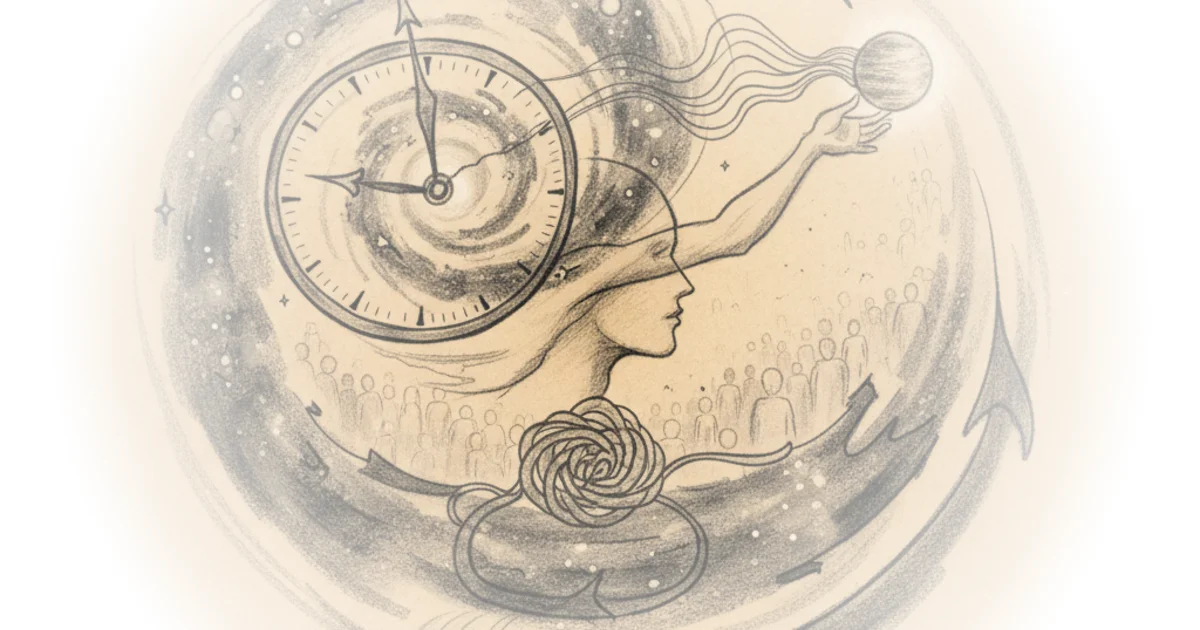
He illustrates this by suggesting the universe might function like an ensemble of tiny elements that "talk to each other at a certain rate," creating a propagation of causal influence. This framing is effective because it demystifies a constant often treated as magical, grounding it in the mechanics of interaction. However, a counterargument worth considering is that while this model explains the limit, it doesn't necessarily explain why that specific rate exists rather than another, leaving the ultimate origin of the constant still somewhat mysterious.
The Allure of the Wrong Theory
One of the most distinctive moves in O'Dowd's commentary is his celebration of historical scientific errors. He argues that archaic notions, such as the luminiferous ether, were not merely mistakes but necessary stepping stones. "I dearly love these old wrong theories," he admits, citing them as colorful and cool ideas that pushed science forward even after being disproven. He points to the "one electron universe" of John Archibald Wheeler and Paul Dirac's work as examples where incorrect premises led to profound insights.
This approach challenges the modern tendency to view scientific history as a linear march toward truth. Instead, O'Dowd suggests that the path is messy and that "wrong old science" is often the engine of progress. This lands because it humanizes the scientific method, showing that breakthroughs often come from following a hypothesis down a dead end and realizing what that dead end tells us about the structure of the universe. The production team, led by animator Leo in Brazil, supports this by turning these abstract, often counter-intuitive concepts into visual narratives that make the "wrong" theories feel as vibrant as the correct ones.
The universe is big and deep, and I cannot think of an end to topics that I want to talk about.
The Wolfram Conundrum
The livestream tackles the elephant in the room of modern theoretical physics: Stephen Wolfram's recent proposal that the universe is a type of cellular automaton. O'Dowd approaches this with a healthy dose of skepticism, noting that while he skimmed Wolfram's 450-page paper, he cannot verify the claim that it recovers the laws of physics. "I heard... that Wolfram's notion is superb and majestic, but probably a waste of time," he relays, citing a friend's assessment of the theory's lack of testability.
The core of O'Dowd's critique rests on the concept of "irreducible computability." He explains that in Wolfram's model, there is no way to predict what universe will emerge from a given set of rules without running a full simulation. "The only way to learn what universe emerges is to run a full universe simulation and see what universe emerges," he notes. This creates a significant hurdle for the theory: if a model cannot make unique, testable predictions that differ from existing theories, it risks being unfalsifiable. While giants like Gerard 't Hooft and John Archibald Wheeler have explored similar ideas of information emerging into physicality, O'Dowd emphasizes that Wolfram's work has not yet undergone the rigorous peer review necessary to validate its claims.
Critics might argue that dismissing a theory because it is computationally irreducible is premature, as the history of physics is full of concepts that seemed untestable until technology caught up. Yet, O'Dowd's insistence on the necessity of peer review and predictive power remains a vital checkpoint for any new "theory of everything."
The Human Element of Physics
Beyond the equations, O'Dowd highlights the immense collaborative effort required to make complex physics accessible. He reveals that a single episode can take weeks of work, involving a team that includes a producer, a director, and an animation crew in Brazil. "It's a labor of love," he says, acknowledging that the show's survival depends on the audience's enthusiasm and the support of PBS. This transparency about the production process adds a layer of credibility to the content; the audience understands that the clarity of the explanation is the result of iteration and artistic ability, not just the host's knowledge.
The discussion also touches on the nature of the questions asked, ranging from the serious to the absurd, such as the "favorite Mass Effect game." O'Dowd handles these with grace, using them to pivot back to deeper themes. When asked why the speed of light is what it is, he doesn't just give a number; he explores the philosophical implications of dimensionless units and the nature of observers. "Physicists like to set the speed of light as being dimensionless and set it equal to one," he notes, highlighting how the choice of units can reveal the underlying simplicity of the universe.
Bottom Line
Matt O'Dowd's livestream succeeds by treating the audience as intellectual peers, willing to explore the edges of known physics without pretending to have all the answers. The strongest part of his argument is the reframing of the speed of light as the speed of causality, a conceptual shift that clarifies the nature of the universe's structure. Its biggest vulnerability lies in the inherent difficulty of testing highly abstract theories like Wolfram's cellular automata, a challenge O'Dowd acknowledges but cannot fully resolve. For the busy listener, the takeaway is clear: the most exciting frontier in physics isn't just the discovery of new particles, but the ongoing, messy, and deeply human process of questioning how the universe computes itself.