Public Notice delivers a searing indictment that refuses to hide behind euphemisms, arguing that the current executive branch has abandoned the decades-long charade of racial neutrality to openly embrace white supremacy as governing philosophy. This is not a story about political rhetoric; it is a forensic accounting of policy shifts that would have been unthinkable a few years ago, from the Department of Homeland Security's cultural defense mandates to the systematic erasure of Black history from federal institutions.
The End of the Veneer
The piece's most striking claim is that the political strategy of plausible deniability has been discarded entirely. Public Notice writes, "The party of today, embodied as it is in Donald Trump and the administration he leads, is no longer so worried about being called racist, because it has unashamedly taken white supremacy as its cause." This is a bold assertion, yet the evidence provided suggests a fundamental shift in how power is exercised. The author points to the administration's embrace of "remigration," a term historically associated with far-right European movements, as proof that the goal is no longer just restriction, but the forced removal of non-white populations.
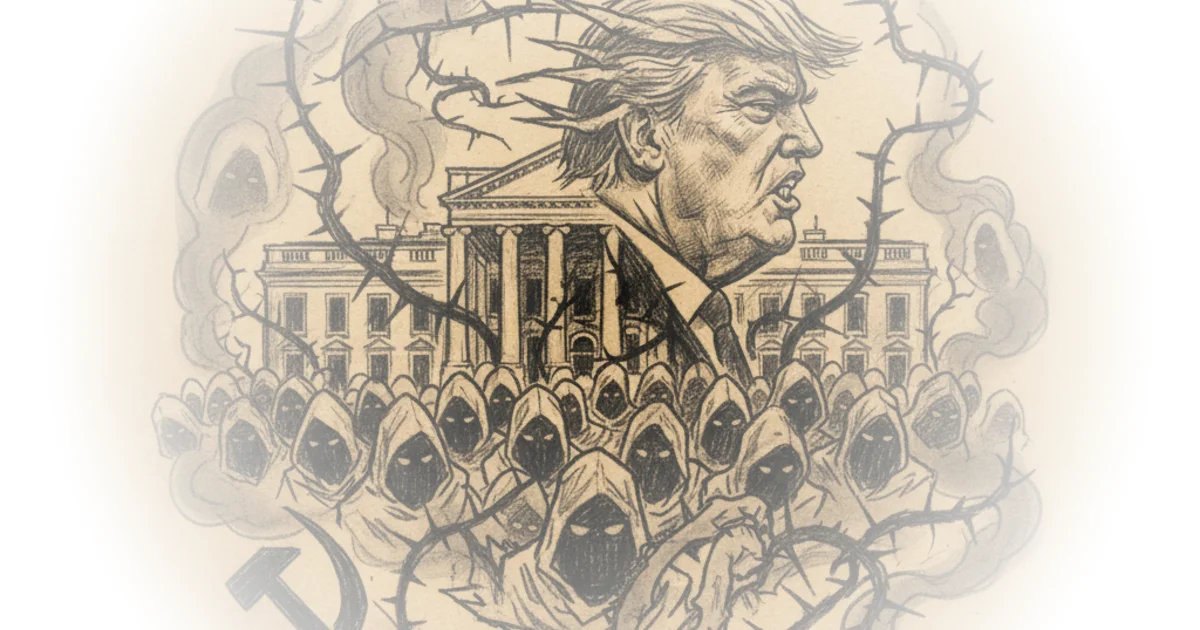
The commentary highlights how the administration has weaponized specific tragedies to justify broad xenophobia. Using the killing of a National Guard soldier by an immigrant from Afghanistan, the executive branch announced a "permanent pause migration from all Third World Countries." Public Notice notes that this is not an isolated incident but part of a pattern where "subtlety is no longer necessary." The author contrasts this with the past, where conservatives would quote Martin Luther King Jr. to deflect accusations of racism, whereas now, the administration is actively dismantling the very idea of a multi-racial democracy.
The thin veneer of race neutrality, so often a cover for the maintenance of a status quo that advantages whites, has been cast off.
This framing is effective because it connects disparate policy moves—from the Department of Labor's use of Aryan imagery to the State Department's pressure on allies—to a single, coherent ideology. The article argues that the administration is not merely reacting to events but is actively trying to reverse the arc of history. As Public Notice puts it, "This appears to be an attempt to prove that the arc of history does not bend in one direction, but can double back and reverse course."
The Architecture of Exclusion
The coverage meticulously details how this ideology is being baked into the bureaucracy. The author points out that the administration has assembled the least diverse federal leadership in decades, with 91 percent of confirmed appointees being white. But the impact goes beyond personnel; it extends to the erasure of history itself. Public Notice writes, "The administration has gone on a tear through the federal budget, slashing funding and eliminating projects that focus in any way on race, whether it's pulling books by Black authors from Department of Defense libraries, deleting datasets on minority health and pollution exposure, or removing museum displays about Black soldiers."
This section draws a direct line to the historical "Southern strategy" and the tactics of the past. The author references the 1968 Fair Housing Act, noting that Vice President JD Vance's recent comments about wanting to live next to people "who I have something in common with" are a direct echo of segregationist arguments used to oppose that very legislation. Public Notice observes, "This is precisely the argument made by segregationists when opposing the Fair Housing Act of 1968, which made it illegal for landlords to refuse to rent to someone based on their race, religion, or national origin."
The piece also invokes the legacy of Lee Atwater, the Republican strategist who famously explained in 1981 how the party had to move from explicit slurs to coded language like "states' rights" to maintain political viability. Public Notice argues that the current administration has rendered Atwater's playbook obsolete. "Trump's political success suggests that may no longer be true," the author writes, suggesting that the electorate is now willing to accept explicit appeals to prejudice. The article notes that the administration is not just tolerating this but encouraging it, with staff "giggling in their Nazi group chats" and spokespeople spreading lies about immigrants.
Critics might argue that the administration's actions are driven by legitimate concerns over border security and economic stability rather than racial animus. However, the article counters this by pointing to the specific targeting of white South Africans for refugee status and the exclusion of South Africa from the G20 summit due to the "imaginary oppression" of its white citizens, suggesting that the racial calculus is the primary driver, not security.
The Political Reality
The commentary shifts to the political consequences of this ideology, using the Tennessee 7th Congressional District special election as a case study. Despite the district being heavily gerrymandered to favor Republicans, the race is unexpectedly close. Public Notice notes that "Trump's unpopularity has put the race in striking distance for Behn," a Democratic candidate who has managed to run a strong campaign despite her own controversial stances.
The article highlights the disconnect between the administration's base and the broader electorate. While the executive branch pushes a hardline white nationalist agenda, the voters in Tennessee are reacting to the economic fallout. Public Notice writes, "His approval rating on the economy is 21 points underwater due to frustration over tariffs and the cost of living." This suggests that while the administration may be doubling down on its ideological purity, the political cost is becoming increasingly tangible.
The piece concludes by examining the resilience of the Democratic opposition in the face of this new reality. Even in a district designed to be unwinnable for Democrats, the competitiveness of the race signals a potential fracture in the Republican coalition. Public Notice argues that "if Behn comes up short, her competitiveness is still a failure for Republicans," indicating that the administration's strategy may be alienating the very voters needed to sustain their power.
The army of goons kidnapping people off the street, the edgelords crafting the administration's social media trolling, the spokespeople spreading lies about immigrants, the mid-level staffers giggling in their Nazi group chats — none of them are unwilling participants in Trump's white supremacist project.
Bottom Line
Public Notice's strongest asset is its refusal to treat the administration's actions as isolated policy errors, instead presenting them as a coordinated, ideological project to dismantle the norms of a multi-racial democracy. The piece's greatest vulnerability lies in its assumption that the electorate will inevitably reject this approach, as the political data from Tennessee shows that while the strategy is polarizing, it has not yet resulted in a wholesale rejection of the party's direction. Readers should watch for how the administration's explicit rhetoric translates into legislative outcomes and whether the economic backlash will force a strategic pivot or a further hardening of positions.