Matt O'Dowd challenges the most deeply held assumption in modern science: that understanding the smallest parts automatically explains the whole. In a field obsessed with finding the 'theory of everything,' he suggests we may have hit a wall where the rules of the micro-world simply stop connecting to the macro-world in the way we expect. This isn't just abstract philosophy; it is a direct confrontation with the failure of our most powerful experiments to find the 'new physics' that was supposed to save our current models.
The Illusion of a Seamless Ladder
O'Dowd begins by dismantling the convenience of reductionism, the idea that nature is built in neat, stacked layers where the upper levels are just the sum of the lower ones. He notes, "We don't need cell biology to describe your pulse rate. We just need a number of beats per minute." This observation highlights the concept of "emergence," where complex systems develop their own rules that are independent of their constituent parts. As O'Dowd explains, "The dynamics, the rules describing the layer arise from the potentially very different dynamics of its many parts." This is a crucial distinction for busy readers to grasp: the universe does not necessarily speak a single language from the bottom up.
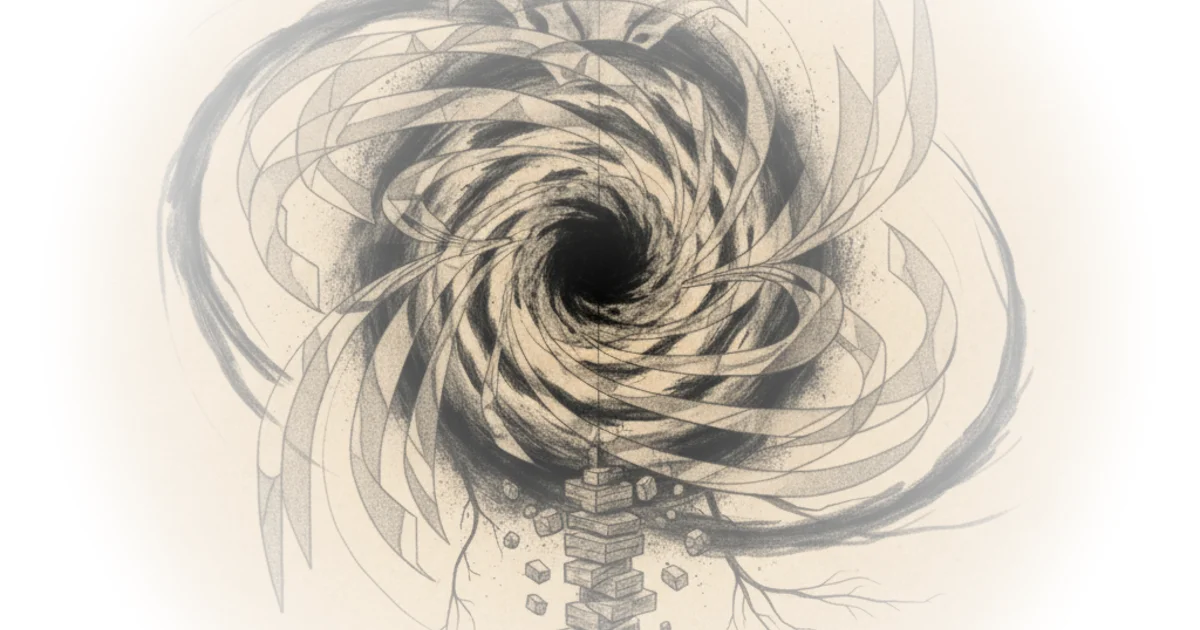
The author uses fluid dynamics as a prime example of this independence. He writes, "The Navia Stokes equations predict the time dependent behavior of fluids with incredible accuracy... with no reference to the nature of the individual particles making up the flow." This is the power of "effective field theories"—mathematical frameworks that work perfectly within a specific range of scale but fail when pushed too far. O'Dowd argues that we have been assuming these theories are merely stepping stones toward a single, ultimate truth, but the evidence suggests they might be dead ends.
"The parts should not know about the whole; emergence goes from small to big."
Critics might argue that this skepticism undermines the entire scientific enterprise, which has historically thrived on reductionism. However, O'Dowd's point is not that reductionism is wrong, but that it has limits. The breakdown of these theories is not a bug; it is a feature that signals a deeper, perhaps unbridgeable, gap in our understanding.
The 17-Layer Chasm
The most startling claim in the piece concerns the "hierarchy problem"—the baffling gap between the scale of known particles and the scale where gravity and quantum mechanics finally collide. O'Dowd illustrates this with a shocking comparison: "There is as much difference between the plank scale to the scale of the Higs as there is between the atom and the blue whale." If this analogy holds, we are looking at a universe where the fundamental building blocks are separated from the deepest layer of reality by a void 17 orders of magnitude wide.
This gap is problematic because it implies that the Standard Model of particle physics is not just an approximation, but potentially a complete description of its own domain, with no deeper layer to explain its parameters. O'Dowd writes, "Many would say that this idea feels unnatural, claiming it requires very precise tuning of the parameters of that UV theory." The expectation was that new particles would appear near the mass of the Higgs boson to stabilize the math, but the Large Hadron Collider found nothing. As O'Dowd puts it, "They did not find that physics. At least the Large Hadron Collider hasn't yet, and it's probed quite a bit deeper than where this physics was supposed to appear."
This absence of new physics forces a re-evaluation of the "naturalness" principle that has guided theoretical physics for decades. If the universe is fine-tuned to an extreme degree, or if the deeper layers are simply inaccessible, then the dream of a single "theory of everything" that unifies all forces may be a mirage. O'Dowd suggests we might be facing a reality where the feedback between scales is not the smooth, local interaction we assumed, but something far more complex.
Bottom Line
O'Dowd's strongest argument is his reframing of the missing data from the Large Hadron Collider not as a failure of the machine, but as a fundamental clue that our reductionist worldview is incomplete. The piece's greatest vulnerability lies in its reliance on the concept of "naturalness," which is a philosophical preference rather than a proven law of nature. The reader should watch for how the physics community responds to this growing silence from the deep energy scales, as it may signal the end of the search for a unified theory and the beginning of a new, more fragmented understanding of reality.