In an era defined by scorched-earth rhetoric and the glorification of force, this piece from Wayfare offers a startling counter-narrative: that true divine power often manifests not in the earthquake or the fire, but in a quiet whisper. The article's most provocative claim is that Elijah's legendary zeal—his willingness to execute hundreds of priests without direct command—may have been a spiritual miscalculation rather than a triumph. It challenges the modern appetite for vigilante justice by suggesting that bypassing due process in the name of righteousness is itself a form of lawlessness.
The Inversion of Power
Wayfare begins by dismantling our expectations of how revelation works. We are conditioned to look for the dramatic, the violent, and the overwhelming. Yet, the piece argues that "the contrast of that quiet voice with the tempest, earthquake, and fire that precede it is striking." The editors draw a sharp parallel between Moses at Sinai, where God's presence was undeniable amidst thunder and smoke, and Elijah at Horeb, where God explicitly rejected those same displays. This inversion is crucial because it reframes the prophet's entire career.
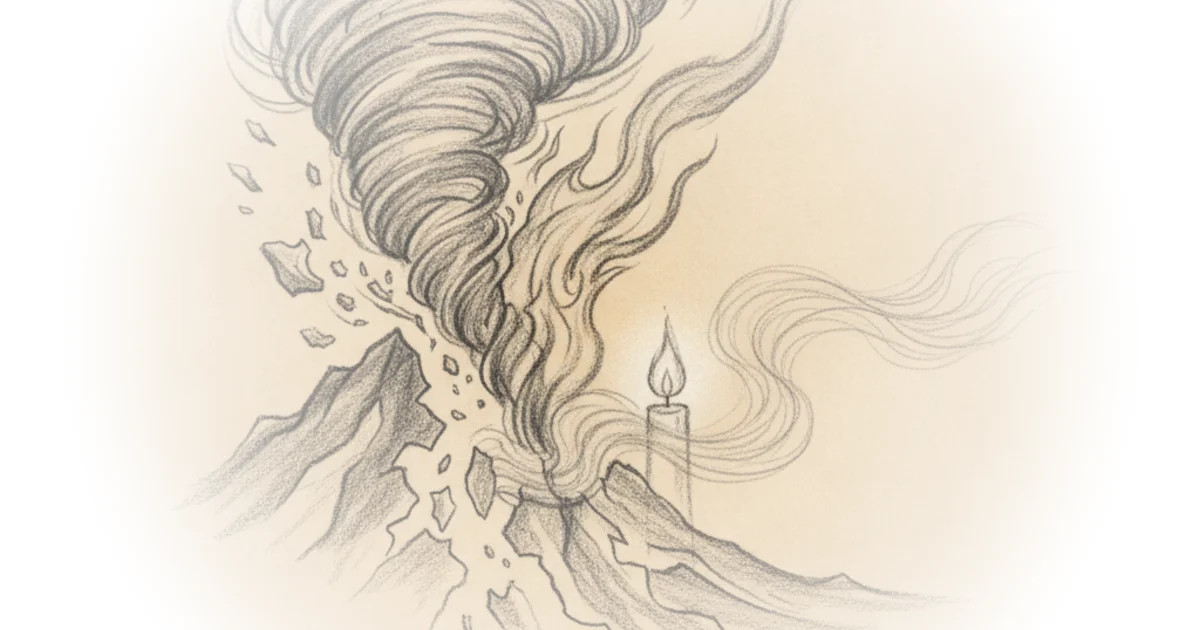
The article notes that Elijah had just orchestrated a massive display of force: calling down fire to consume an altar and ordering the execution of 450 priests of Baal. "After winning the contest over whose God was real, Elijah ordered the execution of the 450 priests of Baal," Wayfare reports. But this show of strength failed to change the hearts of King Ahab or Queen Jezebel. The piece suggests a gentle rebuke here: "Had he pressed his advantage too far in taking up the prerogative of divine judgment and capital punishment upon the priests of Baal?" This is a difficult question for any reader who equates moral clarity with decisive, violent action.
It is exceptionally dangerous to believe you have privileged access to the mind of God and that you have the right to act on His behalf. God is God, and humans are all too human.
The commentary leans heavily on the Jewish scholar Jonathan Sacks to unpack this tension. The piece highlights how Elijah, despite witnessing the "still small voice," repeats his defense: "I have been very [zealous] for the Lord." By failing to change his answer after the vision, the article argues, Elijah demonstrated he had not understood the lesson. He was told that someone else must take his place because he could not let go of the sword. The editors note that this mirrors Moses's own failure at Meribah, where rashness cost him entry into the promised land.
The Danger of Zealotry
The argument shifts from ancient history to a stinging critique of contemporary culture. Wayfare posits that our modern world is saturated with the very zealotry Elijah struggled to master. "Our modern culture is saturated with zealotry," the piece states, pointing to vigilante fiction, polarized social media rhetoric, and political theater where lives are treated as collateral damage in ideological battles.
The editors warn against the seduction of the "zealot, who circumvents both [legal and political processes]," noting that such figures are often more dangerous than the threats they claim to avert. This is not a call for passivity, but for a higher form of wisdom found in restraint. The piece asks a haunting question: if we suppose God is pleased with our current brand of aggressive partisanship, "then we may expect soon to find that we have no more need of the still small voice at all." Perhaps it has already ceased to strive with us.
A counterargument worth considering is whether this framing risks romanticizing inaction when confronting genuine evil. If a tyrant like Jezebel were present today, would a "still small voice" be enough? The piece acknowledges that Elijah's actions had legal warrants under Mosaic law but suggests the method was the issue. It implies that even justified violence can become a perpetuation of chaos if it bypasses established processes.
Listening in the Noise
The final section connects this ancient lesson to modern spiritual survival, drawing on Latter-day Saint scripture and leadership. Wayfare references the Book of Mormon's description of Christ's voice as "not a harsh voice, neither... a loud voice," suggesting that our current environment has dulled our ability to hear anything but the scream. The editors quote President Dallin H. Oaks warning that in coming days, it will be impossible to survive spiritually without the Holy Ghost because the adversary is so effective at disguising truth.
The piece concludes by asking if we are capable of listening at all. It references Max Beckmann's 1920 painting Woman with Candle, an image of quiet focus amidst darkness, as a visual anchor for this argument. Just as the Shekhinah (the divine presence) is often associated with a dwelling or a quiet space rather than a storm, the editors suggest that truth requires us to settle down. "Perhaps his voice will remain unintelligible... until we finally settle down and listen with renewed humility," Wayfare writes.
If the still small voice—the quiet 'voice of perfect mildness'—is a sound we can only hear when we are listening, are we listening?
Bottom Line
The strongest part of this argument is its refusal to sanctify violence even when it appears righteous, forcing readers to confront the possibility that their own "zeal" might be blinding them to wisdom. Its biggest vulnerability lies in the practical application: translating a call for humility into a strategy against active persecution remains difficult. Readers should watch for how this concept of "restraint as power" plays out in current debates over justice and security, particularly where the line between protection and aggression is blurred.