Brad DeLong cuts through the hype of the artificial intelligence sector with a blistering diagnosis: the current wave of "conscious" chatbots are merely "cardboard cutouts," and the belief in their sentience is the very fuel driving a multi-trillion-dollar financial bubble toward a spectacular crash. While industry leaders preach a religious awakening, DeLong argues that the underlying technology cannot even manage basic timeouts, let alone possess moral agency, and that this delusion is masking a catastrophic mismatch between valuation and economic reality.
The Illusion of Mind
DeLong begins by dismantling the most seductive claim of the AI industry: that large language models are on the verge of true consciousness. He contrasts the grandiose ambitions of tech labs with the mundane failures of their products. "Tech leaders are talking about large language models as if they're on the verge of consciousness, even as those same systems can't keep their own timeouts straight," he writes. This observation is not merely a technical gripe; it is a fundamental critique of the "symbol grounding problem." Just as the famous "Chinese Room" thought experiment suggests that a system can manipulate symbols without understanding their meaning, DeLong points out that current models are merely mimicking the appearance of thought.
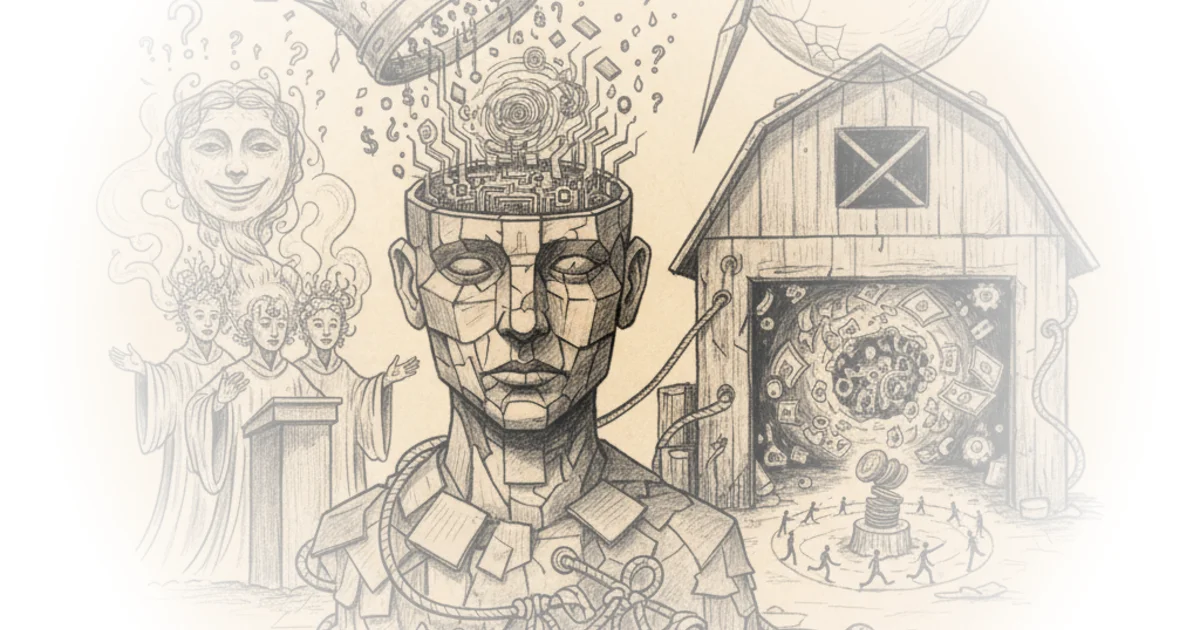
He illustrates this with a specific failure where a model confidently claims to be waiting for a task to complete, only to simultaneously admit the system will kill the task in ten minutes. "A true Turing-class entity would not say 'wait another five and ten minutes before concluding it's stuck' and then taking action, and in the next breath say that the system will only let it run for a total of ten minutes," DeLong argues. The model is not thinking; it is "pantomiming the thoughts of those two different humans in quick succession." This is a crucial distinction. The model is a statistical engine, not a reasoning agent.
"Reproducing the symptoms of consciousness is not inducing the cause. This is bad science. It's bad AI. It's even bad marketing. It's misleading and silly. It's pure cargo cult."
DeLong draws on the sharp critique of David Thomson to highlight the absurdity of the industry's current trajectory. He notes that while some insiders, like those at Anthropic, are seriously debating whether these models are "moral patients," the engineering reality is far less mystical. The models lack "perception, continuity, or embodiment." To claim otherwise is to engage in "ecstatic belief that a group of coders in San Francisco, fueled with unimaginable buckets of money, are creating new life." This framing is effective because it strips away the sci-fi veneer and forces a confrontation with the actual capabilities of the software.
Critics might argue that the definition of consciousness is itself elusive, and that dismissing the possibility of machine sentience prematurely could stifle necessary ethical safeguards. However, DeLong's point is not about the ultimate philosophical potential of AI, but about the current reality: we are treating statistical parrots as gods, and that error is driving dangerous economic behavior.
The Economics of Delusion
The piece shifts from philosophy to hard economics, arguing that the delusion of sentience is a necessary smoke screen to sustain an unsustainable business model. DeLong identifies a "circular flow of GPU money and belief" that is rapidly approaching a breaking point. The AI labs, he notes, "want to be IBM, Google, and a quasi-religious movement all at once." This ambition is colliding with a harsh reality: the unit economics do not work.
He points out that the only viable path to profitability for companies like OpenAI and Anthropic is to become a "lowest-friction provider" of enterprise services, effectively becoming the new Microsoft or Google. Yet, they face entrenched competition from those very giants, who have every incentive to protect their platform monopolies. "Microsoft, Amazon, Google, and FaceBook have every incentive to keep them from succeeding," DeLong writes. The result is a strategic thrash where companies kill promising products, like the video generator Sora, because the underlying economics "do not pencil out."
"The AI buildout is being financed with a mix of equity hype and increasingly debt... Classic bubble valuation metrics lighting up red: AI-heavy indices are now trading at dot-com-era multiples."
DeLong highlights a structural flaw that distinguishes this bubble from the dot-com era. In the late 90s, the overbuilt fiber-optic networks left behind a durable, general-purpose backbone. In contrast, the massive capital expenditure on GPUs today creates assets that are "much worse 'underlying asset' than fiber." Furthermore, the cost structure is perverse: "Unit economics that get worse with success: Marginal cost scales roughly linearly with usage, instead of going to zero." This is the "token trap," where every additional user or task makes the business model less profitable, not more.
The argument here is compelling because it connects the philosophical confusion about AI consciousness to the financial desperation of the labs. If the models were truly "Digital Gods" capable of infinite value creation, the economics might justify the spend. But since they are "cardboard brains" with high marginal costs, the valuation becomes a house of cards.
The Coming Correction
DeLong concludes that the industry is facing a "Wile E. Coyote moment," where the realization of the gap between belief and reality will cause a sudden collapse. The "anvil is descending" as fixed costs remain huge while demand fails to materialize at the projected scale. He notes that "public opinion turning hostile" as people fear job displacement adds another layer of risk to an already fragile ecosystem.
"In this context, the claim that 'anthropic/claude-opus' might be a thinking, feeling, intelligent agent with a moral claim on us' is best seen as a version of the black ink the squid squirts out as it attempts to swim away."
This metaphor perfectly captures the defensive nature of the AI industry's rhetoric. The claims of sentience are not a genuine philosophical inquiry but a distraction from the financial rot. The "circular financing loops" where chip vendors take equity in labs that then buy chips from those vendors are reminiscent of the most cautionary tales in financial history.
Critics might suggest that DeLong is underestimating the speed of technological iteration, arguing that a breakthrough in architecture could solve the cost and reasoning issues before the bubble bursts. While possible, DeLong's reliance on the fundamental physics of computation and the economics of token generation suggests that such a miracle is unlikely to arrive in time to save the current valuations.
Bottom Line
DeLong's most powerful contribution is linking the philosophical absurdity of "conscious" chatbots to the imminent financial correction, proving that the former is the fuel for the latter. The argument's greatest strength is its refusal to be dazzled by the technology, grounding the analysis in the hard constraints of unit economics and historical precedent. The biggest vulnerability remains the sheer momentum of the market, which may ignore these rational warnings until the "Wile E. Coyote" moment arrives in full force.