Theme Parks as Creative Liberation
George Saunders has built a career on fiction set in grotesque, ramshackle theme parks. From "CivilWarLand in Bad Decline" to "Pastoralia" to "My Chivalric Fiasco," these surreal amusement venues recur so consistently across his work that a reader finally asked him point-blank: why all the theme parks? Saunders, writing from the road during a book tour for "Vigil," offers an answer that is less about symbolism and more about the mechanics of writing itself.
The typical assumption is thematic. Theme parks as capitalism critique. Theme parks as commentary on the entertainment-industrial complex. Saunders acknowledges this reading but pushes past it.
For me, these elements are not really there to make a story "about" something, but simply to give it energy.
That distinction -- between illustration and energy -- sits at the heart of his entire creative philosophy.
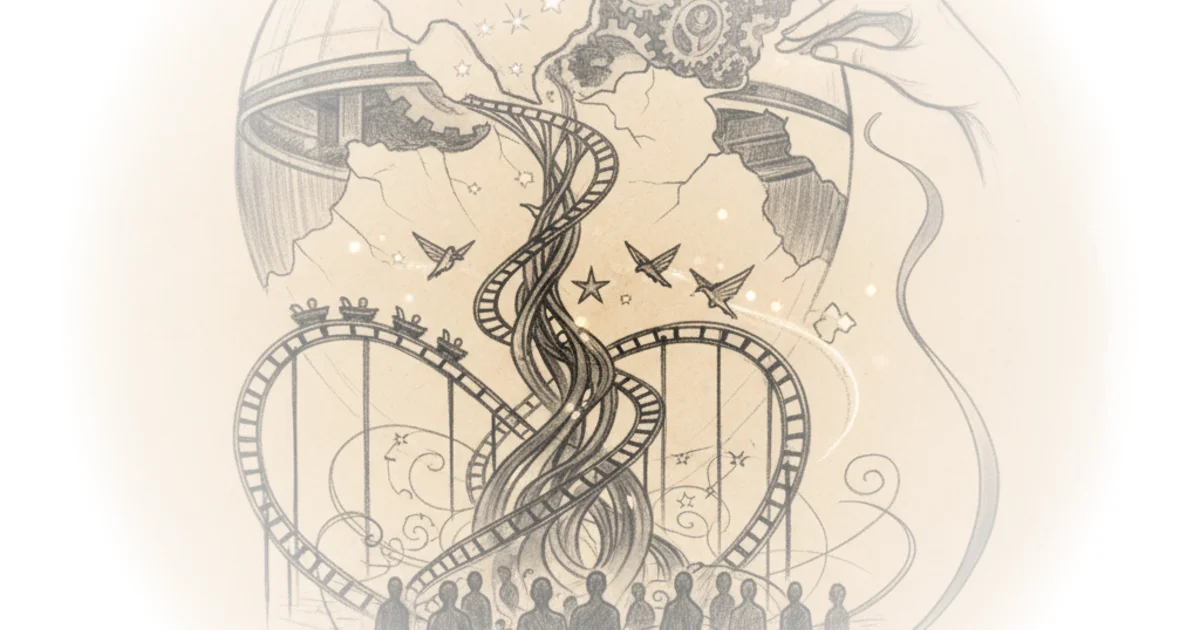
The Amarillo Dream
The origin story traces back to a low point. Saunders was working as a groundsman at an apartment complex in Amarillo, Texas, uncertain about his future as a writer. Then a dream handed him something unexpected: a voice entirely unlike the Hemingway imitation he had been laboring under.
I believe it was my subconscious throwing me a life raft -- sort of saying, "You're never going to figure this out on your own. Hear: grab on to this."
That dream produced "A Lack of Order in the Floating Object Room," which was accepted by The Northwest Review and ultimately secured Saunders his place in the Syracuse MFA program. It changed his life. But he did not absorb its lesson immediately. Instead, he retreated into what he calls "HemingwayLand" for another three years.
The breakthrough came later, with the now-famous "La Boda de Eduardo" conference room epiphany. Armed with a new creative mandate -- be fast, funny, entertaining, and abandon all planning -- Saunders needed material to work with. His solution was startlingly practical: he knocked off his own earlier story, but relocated it to a different theme park. That became "The Wavemaker Falters," the seed of the entire CivilWarLand collection.
Destabilizing the Knowing Mind
What the theme parks actually do, according to Saunders, is disable the part of his brain that wants to control everything. The mechanism is simple but surprisingly effective.
As soon as I set a story in some strange theme park, it de facto became a comic story. And that meant....freedom.
The absurdity of the setting forced new language. It undercut his "static ideas about what a story should do" -- namely, be serious, teach a lesson, and demonstrate direct experience. The conscious, planning mind got sidelined, and what emerged instead was material that told Saunders things he actually thought about work and American life, things he might never have accessed through deliberate inquiry.
Saunders frames this as a general principle for writers. Theme showed up precisely because he was not hunting for it.
I had just started dancing, for fun, and theme...showed up.
It is a compelling account of how indirection can outperform intention. Though one might reasonably wonder whether this explanation has itself become a kind of formula -- a polished origin myth that Saunders deploys so fluently it risks flattening the messy reality of how any given story actually gets written.
Random Elements and the Reluctant Mind
Saunders extends the theme park principle into a broader theory of craft. The idea is juxtaposition: combine elements that resist easy reconciliation and let the writing process itself forge the connection. He offers a concrete example from his story "Liberation Day," where he grafted his long-running research into the Battle of the Little Big Horn onto a science fiction premise about people hanging on a wall, dramatizing stories fed into them.
There was no relation between the plight of those people on the wall and the Battle of the Little Big Horn, and then, with each new draft, there started to be one, but it was subtle and even now I can't say exactly what it is.
This is Saunders at his most honest. He cannot fully articulate the connection even after completing the work. The story grew to accommodate the intrusion, the intrusion adapted to the story, and the result avoided the "distinctive smell of something predetermined and then imposed on the reader."
He warns, though, that the trick is not as simple as it sounds. Random combination quickly collapses into clever resolution. A story about "bears" and "adultery" will, in most writers' hands, immediately seek to reconcile those elements too neatly -- a cheating bear in a zoo, a couple confessing affairs while menaced in the wilderness. The overdetermination problem reasserts itself.
Whatever this "getting out of our own way" move is, it's not simple. Writing is such a subjective thing and we long for formulas and mantras that let us switch off the constant doubt and just get to it.
Ghosts, Ventriloquism, and Diminishing Returns
The theme parks are not the only destabilizing device in Saunders's toolkit. The ghosts that populate "Lincoln in the Bardo" and "Vigil" serve the same function: when a ghost enters the narrative, something "too-knowing" in the author gets knocked off balance. Similarly, his third-person ventriloquist voice -- burrowing so deep into a character's diction that the language "goes satisfyingly overboard" -- achieves the same creative disruption in stories like "The Falls" and throughout "Tenth of December."
The idea, I think, is that I want to urge myself into a zone where I don't know what's happening next or what the criterion for that determination might be.
Saunders is candid about the risk of diminishing returns. He acknowledges that "deciding" to use a theme park, after having done so many times for well-understood reasons, is "fraught." It can become yet another formula. This self-awareness is characteristic but also slightly paradoxical -- the entire essay is itself a formula for avoiding formulas, a carefully articulated theory of why theories are dangerous.
Bottom Line
Saunders offers one of the most lucid accounts available of how a working fiction writer actually generates material. The theme parks were never symbolic architecture. They were cognitive crowbars, prying open a mind that defaulted to imitation and control. The deeper argument -- that craft is the individualized answer to "How do I get myself profitably lost?" -- applies well beyond fiction writing to any creative discipline where the conscious mind tends to strangle its own best impulses. Whether Saunders can continue to surprise himself with tools he now understands this well remains an open question, and to his credit, he seems to know it.