In an era where parental anxiety about screens often defaults to prohibition, Peter Gray offers a startlingly counterintuitive thesis: the smartphone is not the enemy of childhood, but a necessary tool for its evolution. Gray argues that treating digital life as a separate, dangerous realm ignores the biological imperative for children to master the tools of their time, just as hunter-gatherer children mastered bows and arrows. For busy parents seeking clarity amidst the noise of alarmist headlines, this piece reframes the smartphone not as a digital pacifier, but as a modern extension of the trustful, autonomy-supportive parenting that has kept humans safe and thriving for millennia.
The Hunter-Gatherer Precedent
Gray's central argument rests on a historical comparison that challenges the modern notion of the "incompetent child." He posits that the idea that children lack the capacity to follow rules is a recent invention, one that contradicts our species' survival strategy. "Parents in band hunter-gatherer cultures are, as a group, the most trustful, autonomy-supportive parents ever found by anthropologists," Gray writes, noting that these communities allowed children to roam freely from age four while teaching them specific safety rules about poisonous mushrooms or dangerous snakes. This historical lens is crucial; it suggests that the solution to digital risks isn't isolation, but education.
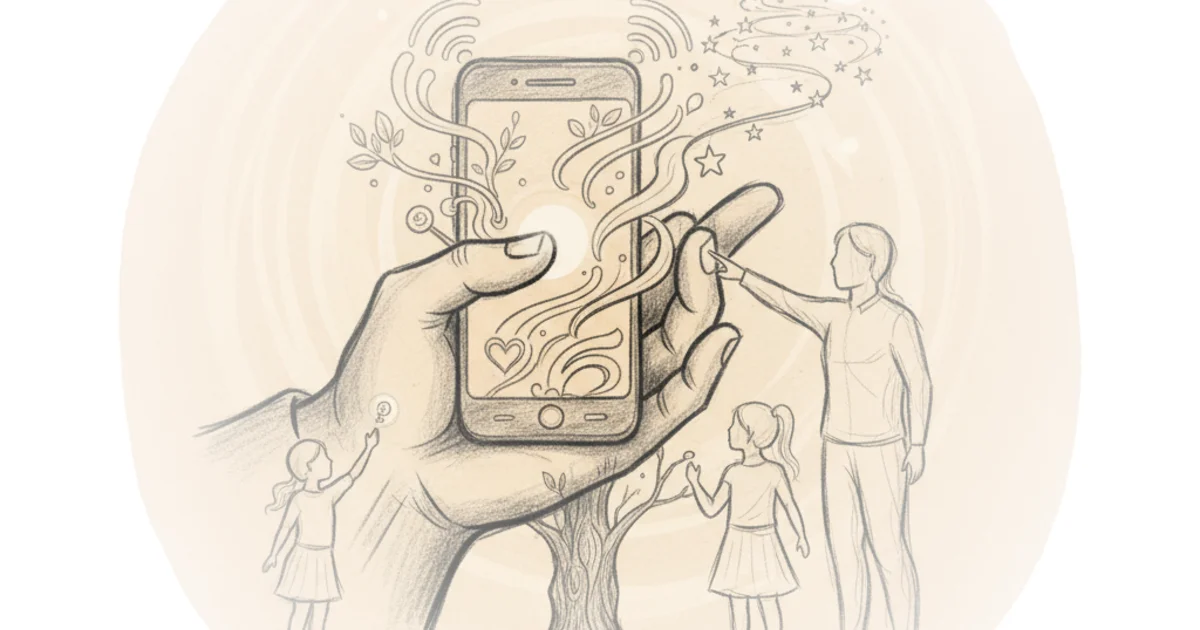
The author contends that just as 1950s parents taught kids to look both ways before crossing the street rather than forbidding them from leaving the house, today's parents must teach digital safety rules. "The concept of the mentally incompetent child is largely an invention of modern times," he asserts, a claim that forces a re-evaluation of current restrictive policies. This framing is effective because it shifts the burden from the device to the pedagogy. Critics might argue that the digital landscape presents unique, algorithmic dangers that a 1950s street crossing analogy cannot fully capture, particularly regarding the addictive design of social media. However, Gray's point remains that the response to danger—teaching rules rather than banning activities—is a timeless parenting strategy that we are currently abandoning.
"To grow up healthy, children must explore the digital world as well as the physical one. Luddites have never changed the course of history."
The Smartphone as a Tool of Autonomy
Gray meticulously catalogs the benefits of smartphone ownership, moving beyond the usual screen-time debates to focus on agency. He lists nine distinct advantages, ranging from outdoor safety and navigation to creative self-expression and the ability to connect with peers. He emphasizes that for many children, the phone is the primary vehicle for maintaining "the culture of childhood," a social sphere that has largely been destroyed in the physical world by adult fears. "Today, adult fears and misbeliefs have largely destroyed the culture of childhood in the physical world, so children have wisely recreated it in the digital world," Gray observes. This is a profound insight: the phone is not replacing social interaction; it is preserving it where the physical world has become too restrictive.
He also highlights the developmental importance of mastering the dominant tools of one's culture. Drawing on the philosopher Karl Groos, Gray notes that children are biologically predisposed to play with the tools of their time. "Children in hunter-gatherer cultures play with bows and arrows and digging sticks and fire... In our culture today the digital computer is obviously the most prominent tool of our time, so no wonder children are drawn to it." This argument reframes screen time not as wasted time, but as essential practice for future competence. The author suggests that giving a child a smartphone is an act of trust, a way of saying, "I believe you are capable of learning to use this powerful tool."
Mitigating the Risks Without Banning
The piece does not shy away from the dangers, but Gray treats them as manageable hazards rather than existential threats. He identifies sleep deprivation as the most consistent negative effect, yet points out that the solution is surprisingly simple: where the phone is parked at night. "Sleep deprivation does not derive from smartphone ownership per se but from where you park the phone at night," he writes, citing studies showing that keeping phones out of the bedroom restores sleep patterns to normal levels. This specific, actionable advice cuts through the vague anxiety that often paralyzes parents.
Gray also addresses the risk of social isolation and distraction, arguing for the implementation of clear etiquette rules rather than total bans. He suggests that smartphones should be banned in specific settings like school recess or family dinners to ensure face-to-face communication remains the priority. "It's rude to respond to a ding on your phone when you are engaged with someone in real-world conversation," he states, advocating for a culture of respect that applies to both adults and children. The author's mantra, "I control my phone; it does not control me," serves as the guiding principle for self-regulation. A counterargument worth considering is whether children possess the prefrontal cortex development necessary to consistently resist the highly engineered algorithms of modern apps without constant external scaffolding. Yet, Gray's approach of teaching self-discipline through practice, rather than enforcing it through prohibition, aligns with the broader goal of raising self-regulated adults.
Bottom Line
Peter Gray's most compelling contribution is the shift from a narrative of protection to one of preparation, arguing that the smartphone is a vital tool for navigating the modern world rather than a barrier to it. The piece's greatest vulnerability lies in its reliance on the assumption that parents can effectively teach digital safety in a landscape where tech companies design products specifically to bypass human willpower. Ultimately, the strongest takeaway is that trust, coupled with clear safety rules, remains the most effective strategy for raising resilient children in any era.