In a landscape saturated with despair over inflation, More Perfect Union makes a startling claim: the solution to skyrocketing grocery prices isn't a new technology or a deregulation bill, but a government-run grocery store that already exists and works. The author bypasses the usual theoretical debates to present a living, breathing counter-example: the Defense Commissary Agency, a massive retail chain that delivers massive savings to military families while operating at a fraction of the cost of its private competitors. For busy readers tired of hearing that high prices are inevitable, this piece offers a concrete proof of concept that challenges the very foundation of the current food economy.
The Myth of the Broken Model
More Perfect Union begins by dismantling the standard narrative that government-run stores are doomed to fail. The author notes that critics often point to a litany of failed municipal grocery stores in places like Baldwin, Florida, and Erie, Kansas, to argue that public ownership is a dead end. "Critics will tell you that grocery stores are already just barely scraping by," the author writes, summarizing the conventional wisdom that private efficiency is unmatched. The piece effectively reframes these failures not as evidence of government incompetence, but as the result of small-scale operations lacking the leverage and subsidies that a national system could command.
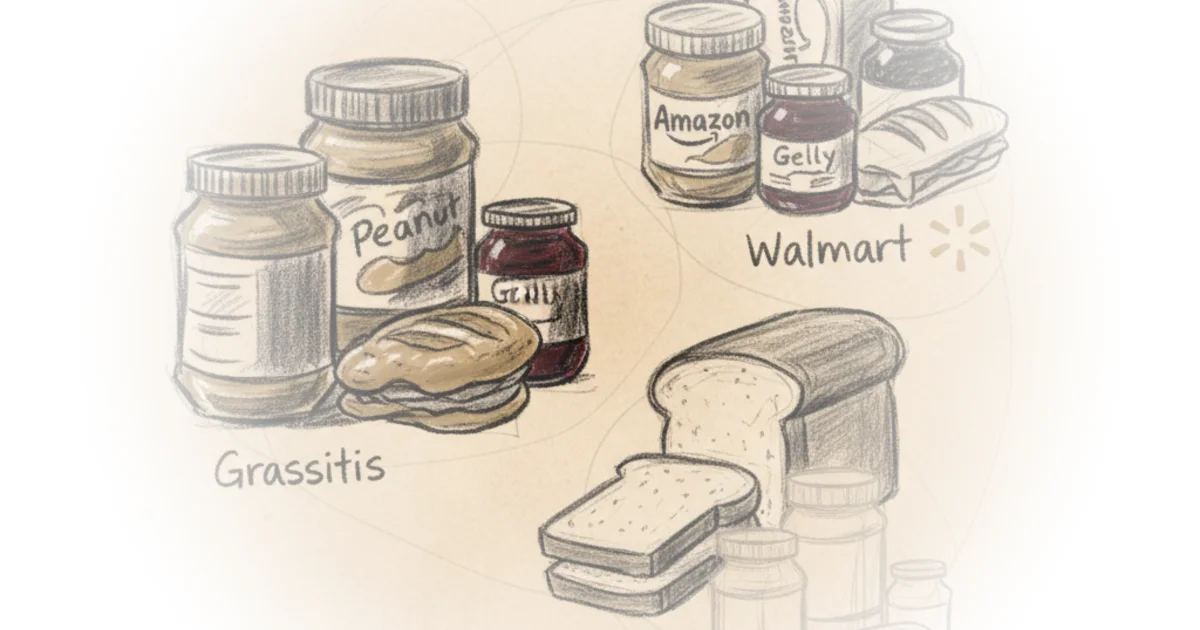
The commentary highlights a crucial distinction often missed in political discourse: the difference between a government store trying to compete on a level playing field and one designed as a public utility. "The profit margin in a grocery store is 1 or 2%," the author observes, noting that private grocers survive on razor-thin margins while extracting value for shareholders. This is a powerful point because it shifts the blame from the model of public ownership to the constraints placed upon it. Critics might argue that government bureaucracy inevitably leads to waste, but the author counters this by introducing the Defense Commissary Agency (DECA) as a system that has thrived for nearly two centuries.
The DECA Exception
The core of the argument rests on the existence of the Defense Commissary Agency, a chain of nearly 250 stores serving military families. More Perfect Union interviews Bill Moore, the former CEO of DECA, to explain how this system defies the laws of conventional economics. "The Defense Commissary Agency is a global grocery chain whose mission is to provide groceries to military families at significantly lower prices," Moore explains. The author uses this testimony to illustrate that the commissary is not a theoretical experiment but a proven, scalable reality.
The piece addresses the most common objection head-on: the fear of limited choice and poor quality. "The New York Post had written that government-owned grocery stores led to Soviet style markets that left customers stuck with just one brand," the author writes, only to immediately debunk this with on-the-ground reporting from West Point. The coverage reveals that DECA is highly responsive to consumer demand, having shifted from a rigid "cost plus 1%" pricing model to a variable pricing strategy that subsidizes staple items like milk to drive overall savings. This responsiveness directly contradicts the stereotype of the sluggish, unresponsive government agency.
Privatization is really a politically correct term that is really saying we're going to eliminate a pretty important benefit to military families.
The author's analysis of the funding mechanism is particularly sharp. While critics claim taxpayers foot the bill for a massive subsidy, the piece reveals that the DECA subsidy is a mere 0.2% of the total defense budget. "This is for almost 250 stores serving 8.8 million households," the author notes, emphasizing the efficiency of the model. The argument is bolstered by the revelation that even staunch critics of government intervention, such as Representative Jen Kiggins, defend the commissary system because no private entity can legally match its statutory savings requirement. This political nuance adds significant weight to the proposal, suggesting that the barrier to entry isn't economic feasibility but political will.
The Political Economy of Food
The final section of the piece exposes the entrenched interests that prevent this model from expanding. More Perfect Union points out that the grocery industry is not a free market but a highly consolidated oligopoly protected by lobbying and shareholder demands. "Kroger alone pays $2.2 billion a year in dividends to shareholders," the author writes, contrasting this extraction of wealth with the DECA model where savings are returned to the consumer. The piece argues that the current system prioritizes profit maximization over food security, creating food deserts and inflating prices for everyone.
The author concludes by highlighting the irony that the very politicians who rail against government overreach often rely on or support the commissary system. "I save an average of $2 to $3 off my favorite Tamok chocolate peanut butter ice cream when I buy it on base," one supporter notes, illustrating the tangible benefits that transcend ideology. The coverage suggests that the radical solution to high grocery prices is simply to treat food as a public utility rather than a commodity, a shift that would require dismantling the powerful trade groups that currently block such reforms.
Bottom Line
More Perfect Union's strongest asset is its use of the Defense Commissary Agency as an undeniable counter-example to the claim that government cannot run efficient grocery stores. The piece effectively proves that high prices are a choice, not an inevitability, by showing a system that saves families billions annually. However, the argument's biggest vulnerability is the assumption that a civilian public utility could replicate the unique funding and political protections of the military system without a massive, contentious legislative overhaul. Readers should watch for how this model might be adapted for civilian use in the face of intense industry lobbying.