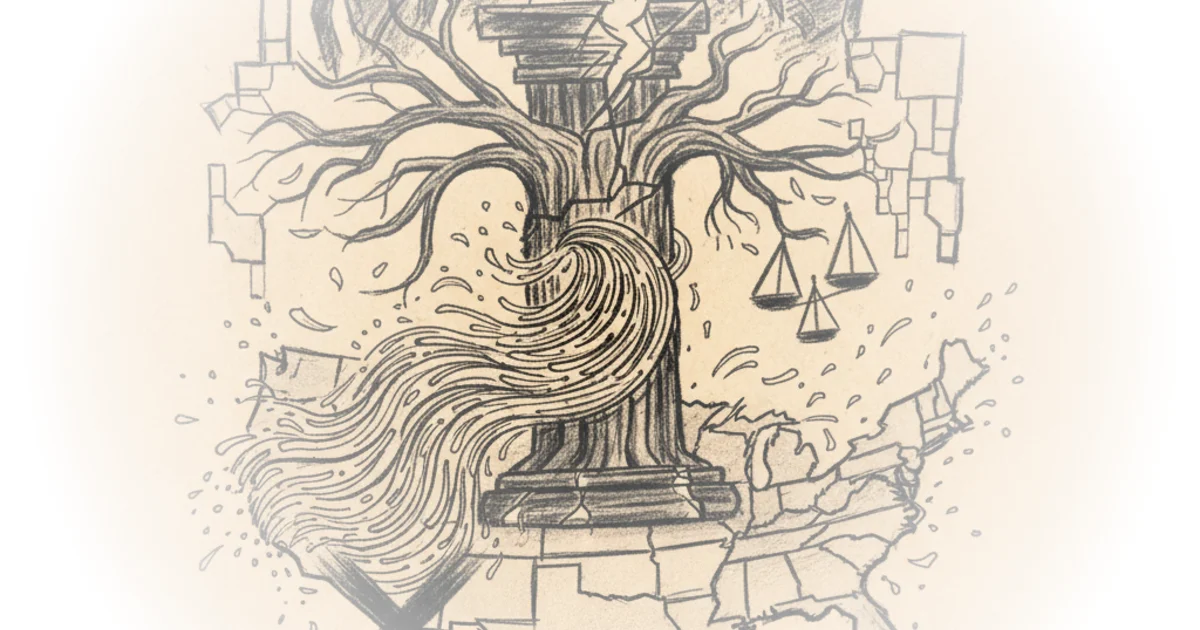
G. Elliott Morris identifies a statistical fallacy at the heart of a recent Supreme Court decision that effectively dismantles the Voting Rights Act's primary enforcement mechanism. By demanding that plaintiffs separate race from party in their legal arguments, the Court has created a logical impossibility in a political landscape where the two are inextricably linked. This is not merely a technicality for legal scholars; it is a blueprint for immediate, widespread disenfranchisement across the American South.
The Statistical Trap
Morris argues that the conservative majority in Louisiana v. Callais committed a fundamental error in causal reasoning. The Court ruled that to prove racial vote dilution, plaintiffs must "control for party affiliation" before their evidence of racial bloc voting can be considered valid. Morris dismantles this premise by explaining that in modern America, political party is not an independent variable that exists alongside race; it is a "mediator" through which race operates.
"If you subtract the effects of political party from the analysis of polarization, you are subtracting away the very evidence of polarization you are trying to study!"
This framing is crucial because it exposes the decision as a self-fulfilling prophecy. By treating party as a confounder that obscures racial intent, the Court ignores the reality that race shapes party identification, which in turn shapes vote choice. As Morris notes, the justices are asking plaintiffs to prove a causal link while simultaneously removing the very mechanism that creates that link.
The author reinforces this with polling data showing that while racial gaps in voting collapse when controlling for party, the initial gap is massive and undeniable. The Court's new standard essentially tells plaintiffs to ignore the left-hand side of the data—the real-world outcome—and focus only on the right-hand side, where the evidence of discrimination has been mathematically erased.
"The Court treats party as though it explains racial polarization away, when in fact party today is largely how racial polarization shows up in elections — which are, y'know, contests between parties."
Critics might argue that the Court is simply trying to distinguish between legitimate partisan gerrymandering and illegal racial discrimination. However, Morris points out that this distinction collapses when the state's partisan goals are indistinguishable from racial outcomes. The decision assumes a level of separation between race and party that simply does not exist in the current electorate.
Rewriting the Rules of Engagement
The decision in Callais does more than just introduce a statistical hurdle; it fundamentally alters the burden of proof established in Thornburg v. Gingles, the 1986 precedent that defined the three preconditions for vote-dilution cases. Morris highlights how the Court has now required plaintiffs to produce alternative maps that satisfy the state's "legitimate districting objectives," including specific partisan goals.
"A state can defend a racially dilutive map as a partisan map, then require plaintiffs to draw an alternative that preserves the same partisan advantage as the map they are challenging."
This creates a Catch-22 for civil rights litigants. If a state claims its map was drawn to protect incumbents or maximize partisan advantage, the plaintiffs must now draw a new map that achieves those exact same partisan results while also creating a majority-minority district. Morris describes this as giving politicians "permission to discriminate against voters, as long as they say it's for partisan purposes."
The practical consequence is immediate. Morris details how Tennessee has already passed a new congressional map that splits Memphis's majority-Black district into three majority-white, Republican-leaning seats. Under the old rules, this would have been an obvious violation of the Voting Rights Act. Under the new Callais standard, the state's defense is simply that they were targeting Democrats, not Black voters.
"The Supreme Court has given parties the license to pick their voters."
This shift effectively immunizes "super-mandering," where a dominant party can use computer algorithms to sort voters into districts that maximize their edge, regardless of racial impact. The combination of Callais and the earlier Rucho v. Common Cause decision, which declared partisan gerrymandering non-justiciable, leaves voters with no federal recourse.
The Human Cost of a Mathematical Error
The most disturbing aspect of Morris's analysis is how quickly this theoretical statistical error is translating into concrete political reality. The article notes that legislatures in at least six Southern states are already moving to redraw maps under this new framework. The result is the systematic removal of minority voting power under the guise of partisan strategy.
"This is the result of a simple statistical error. And yet, the consequences will be anything but simple."
The decision ignores the historical context of the Voting Rights Act, which was passed in 1965 specifically because race and party were already deeply entangled in the South. By demanding a separation that history and data prove is impossible, the Court has effectively nullified the Act's protections. As Morris puts it, the Court is asking plaintiffs to "prove the green segment is not part of the yellow circle" in a Venn diagram where the circles are fully overlapping.
Bottom Line
G. Elliott Morris delivers a devastating critique of the Supreme Court's logic, demonstrating that the Callais decision relies on a statistical misunderstanding that renders the Voting Rights Act unenforceable. While the Court frames this as a neutral standard to separate race from politics, the reality is a legal shield for racial discrimination disguised as partisan strategy. The strongest part of this argument is its reliance on causal diagrams and polling data to prove the impossibility of the Court's requirement; its biggest vulnerability is the Court's apparent willingness to ignore that evidence in favor of a political outcome. Readers should watch for the rapid implementation of new maps in the South, which will likely cement Republican control of Congress for a generation under the cover of this new legal fiction.