Daniel Tutt strips away the sentimental veneer of the family to reveal a stark, economic engine designed to reproduce class inequality. This is not a warm reflection on domestic life, but a rigorous argument that the modern household is a political site where the contradictions of capitalism are managed, concealed, and perpetuated through the very act of love. For busy readers navigating a crumbling middle class, this reframing offers a crucial lens: the stress we feel isn't just personal failure, but the structural friction of a system demanding impossible standards.
The Lie of the Middle-Class Family
Tutt begins by dismantling the idea that the family is a natural, quasi-religious sanctuary. He argues that viewing the family as a unified moral unit blinds us to its primary function in the capitalist economy. "The contradictions of the family have to be understood through the prism of class conflict and the problem of value or we mistake the family as a quasi-religious institution," Tutt writes. This is a bold opening move that forces the reader to abandon the comforting notion of the family as an exception to the market.
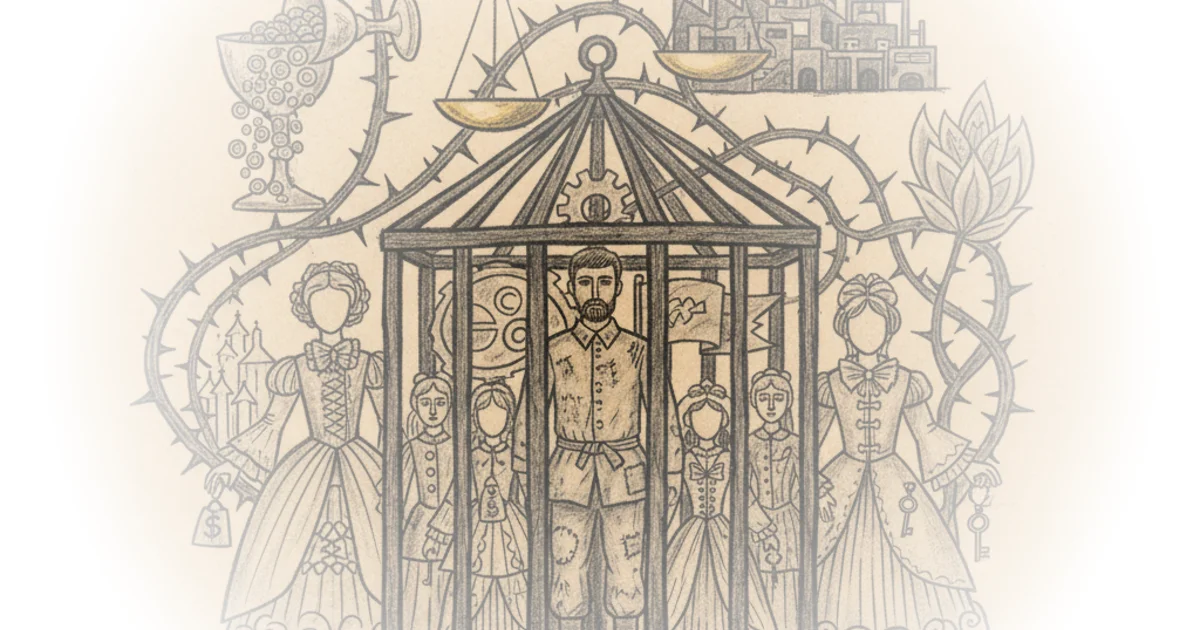
The author posits that the middle-class family is built on a fundamental deception. It promises a shelter from market pressures while simultaneously preparing children to re-enter that same market as disciplined workers. "The middle class family is founded on a lie," Tutt asserts, noting that it must cultivate "personally singular subjects" to ensure their future economic success. This singularization is achieved through "gifts" of leisure, care, and education that appear disinterested but are actually investments in future labor power. The brilliance of this analysis lies in how it explains the exhaustion of modern parenting; we are trying to fulfill a promise of singular success that the economic structure no longer supports.
Critics might argue that this economic reductionism ignores the genuine emotional bonds that sustain families regardless of class. However, Tutt anticipates this, acknowledging that the family is both a "beautiful exception" and a "potentially pathological monster." He insists, "The politically salient function of the family does not rest on its potential for pathological abuse, it rests on its capacity to regenerate the material forms of the class interest of the family." This distinction is vital. It prevents the argument from devolving into a critique of bad parents and keeps the focus on the systemic role the institution plays.
The middle class family is founded on a lie: it promises a shelter from the market while preparing children to sell their labor power.
The Historical Struggle for the "Personal"
Tutt then takes a historical turn, tracing the origin of the "personal"—the idea that we have an autonomous private life—to the struggles of the working class. He draws on the work of Eli Zaretsky and Stephanie Coontz to show that the right to a private life based on love, rather than just economic necessity, was a hard-won demand. "The very project of the personal... was born from a series of political demands of the working class," Tutt explains. Before the 20th century, working-class families were bound by collective survival; the bourgeois ideal of the cultivated individual was a luxury they were barred from.
This historical context adds depth to the current crisis. The working class demanded access to the bourgeois family model, and the welfare state briefly expanded it, but the underlying economic reality never changed. "The middle class family forms the horizon of demands and yet these demands are unfulfillable," Tutt writes. This creates a "pancaking of class formation" where working-class families are forced to strive for an ideal that is materially out of reach. The result is a pervasive sense of failure and inequality, masked by the ideology that the family is a private sphere free from political interference.
The argument here is compelling because it reframes the decline of the family not as a moral collapse, but as a class conflict. As Tutt notes, "One form of the family faces repression, the other a fundamental deceit." The working class faces the repression of impossible economic demands, while the middle class faces the deceit of a promise that is increasingly hollow. This dynamic explains why the family remains a flashpoint in political discourse; it is the primary site where the failure of social reproduction is felt most acutely.
Abolition and the Future of the Family
Finally, Tutt addresses the provocative question of family abolition. He clarifies that for Marxists, this does not mean destroying the family structure itself, but abolishing the class domination that distorts it. He points out that even in historical communist revolutions, the nuclear family structure remained, suggesting a deep psychic attachment to the unit. "The family at a germinal level is resistant to commodification while also deeply complicit in it," Tutt observes. The goal, therefore, is not to eliminate the family, but to change the material conditions that make it a site of inequality.
Tutt argues that true abolition would mean freeing the family from the need to reproduce class status. "We fight for a different material and institutional arrangement in which the promises of the personal are delivered, distributed and exchanged," he writes. This shifts the debate from a cultural war over family values to a materialist struggle over resources and social support. The most striking implication is that without the "infusion of family gifts," the family would already be dissolved into the market. Those already discarded by the system experience this "abolition" daily, living only in the "socialized paternalism of the market."
Bottom Line
Tutt's strongest contribution is his ability to connect the intimate anxieties of parenting to the macro-structures of class and capital, revealing the family as a political battleground rather than a private retreat. However, the argument's greatest vulnerability lies in its potential to understate the resilience of non-bourgeois family forms that have always existed outside this specific logic of singularization. Ultimately, the piece demands that we stop blaming families for the failures of the economy and start demanding an economy that can actually sustain them.
The family is the place where the market's promises are both made and broken, a site of love that is inextricably bound to the logic of domination.