While tech pundits warn that artificial intelligence will vanish from economic ledgers because its outputs are cheap, this piece flips the script with a counterintuitive truth: the real value of AI isn't in the tokens it generates, but in the human hours it liberates. Nominal News argues that we are obsessing over a flawed accounting identity while missing the profound shift in how societies convert income into actual well-being.
The Trap of the Ledger
The article begins by dismantling a popular fear voiced by tech podcaster Dwarkesh Patel, who suggests that because AI makes information cheap, its massive value will be "super undervalued" in Gross Domestic Product. Patel notes that "GDP would show raw inputs (aka chip & energy), and raw outputs (aka cost of tokens). But wouldn't clearly reflect the value of the crazy new [stuff] that's being cooked up in those tokens." The piece acknowledges the logic here but pivots to a deeper economic reality. It points out that this isn't a new problem; it's the same issue we face with free internet services or even basic utilities like water.
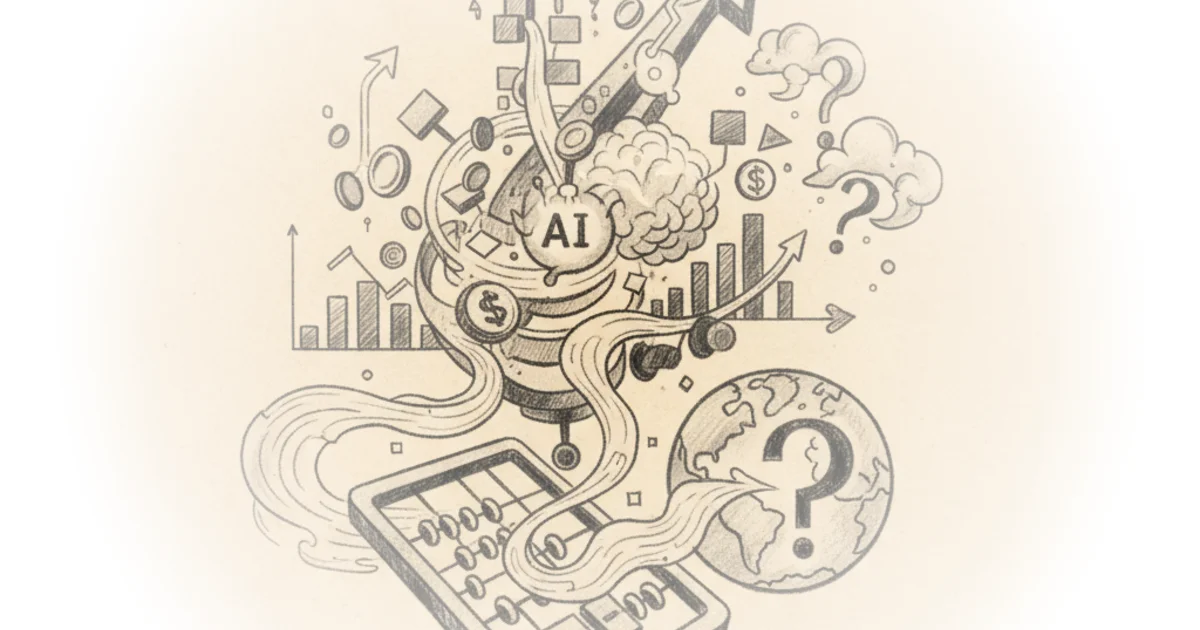
To illustrate this, the editors cite Martin Hagglund's analogy of a village well. "As a result we are wealthier in an existential sense, since we have freed up time to do other things besides go and get water out of necessity," the piece explains. The argument holds water: if a technology saves you an hour a day, that hour doesn't disappear from the economy; it gets reinvested into other productive activities or leisure. The piece asserts, "Even if these things would be free, the impact from freeing up human time and creativity drives other economic activity that ultimately is captured by GDP."
This reframing is crucial. It suggests that the anxiety over AI's invisibility in GDP stats is a category error. The metric isn't blind; it's just tracking the secondary effects of time savings rather than the primary utility of the tool itself. However, a counterargument worth considering is that the transition period might be messy. If AI displaces labor faster than the economy can reallocate that freed-up time to new industries, the GDP could indeed dip before it rises, masking the long-term welfare gains.
GDP is not the issue – it's our over-interpretation of it that is.
Beyond the Numbers
The commentary then shifts to the limitations of GDP as a proxy for human happiness, a point the editors bolster with a 2018 quote from Joseph Stiglitz: "If we focus only on material wellbeing – on, say, the production of goods, rather than on health, education, and the environment – we become distorted in the same way that these measures are distorted; we become more materialistic." Nominal News uses this to introduce the work of economists Jones and Klenow, who proposed a "consumption-equivalent" welfare measure that factors in leisure, inequality, and life expectancy.
The article provides a striking example of why GDP fails as a standalone metric. In 2005, French GDP per capita was only 67% of the US level, yet when adjusted for life expectancy and working hours, the French welfare picture looked significantly better. The piece notes that Americans worked 877 hours annually compared to 535 for the French. This data suggests that a country can be "richer" in currency but poorer in the things that actually constitute a good life.
Building on this, the editors propose a fascinating theoretical model: viewing welfare as a production function where income is an input, but a "welfare technology" (H) determines the output. "The H parameter... tells us how effectively a country converts income into welfare/happiness," the piece argues. This explains why nations like Qatar have high GDP but low welfare conversion rates, while countries like Iceland punch above their weight. The implication is that policy should focus less on maximizing the numerator (GDP) and more on optimizing the denominator (the social institutions that turn money into happiness).
The Bottom Line
Nominal News delivers a sophisticated critique of our economic obsession, correctly identifying that the fear of AI being "undercounted" misses the point of what economic growth is actually for. The strongest part of the argument is the shift from measuring production to measuring conversion efficiency—the idea that a society's success depends on how well it turns income into well-being. The biggest vulnerability, however, is the assumption that the "freed up time" from AI will automatically be productively or happily reallocated; history shows that technological displacement often creates periods of deep social friction before new equilibriums are found. Readers should watch for how policymakers begin to adopt these "Beyond GDP" metrics, as they may soon become the true scoreboard for national success.