The word gets thrown around endlessly — on Twitter, in opinion columns, at dinner tables. But what if we've completely misunderstood neoliberalism? That's the provocative thesis from historian Quinn Slobodian, who argues we've been looking at the concept all wrong.
What Neoliberalism Actually Means
Most people use "neoliberalism" as shorthand for something simple: markets unleashed, states withering away, austerity, privatization. The word has become a catch-all for everything from Reagan's social conservatism to printable money to gay people in the military. It’s become meaningless through overuse.
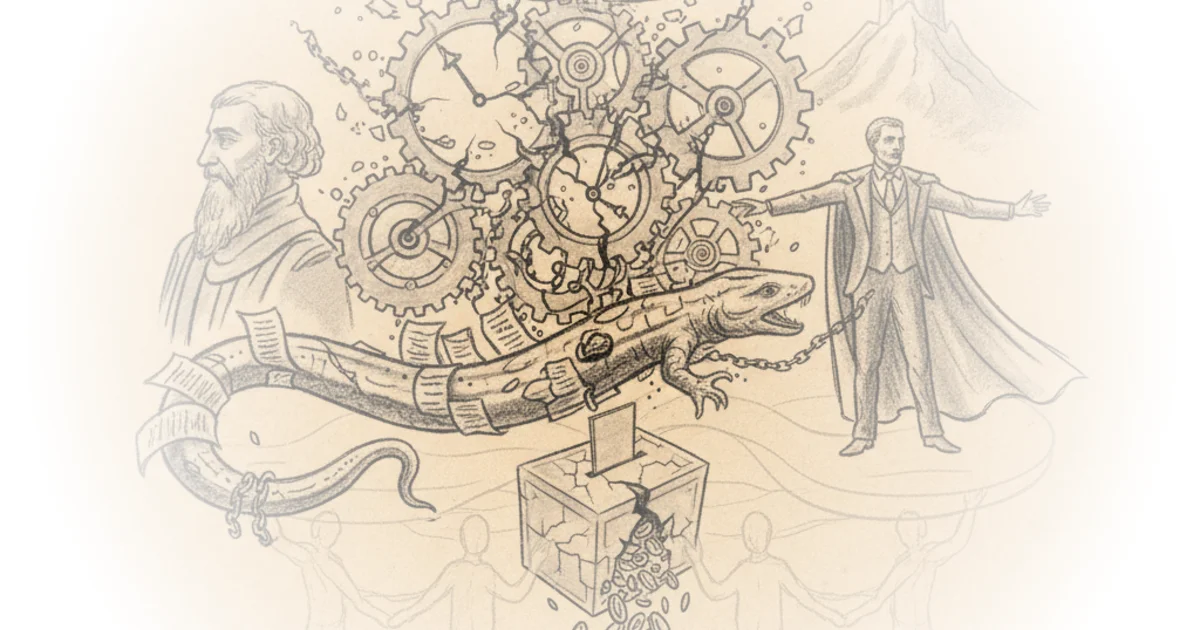
But Slobodian, a professor of international history at Boston University, sees it differently. He argues neoliberalism isn't primarily about freeing markets — it's a project of state design and legal design. It's less a theory of markets and more a theory of how to build institutions that protect certain kinds of market outcomes while blocking others.
Neoliberalism is actually less a theory of markets and more a project of state design and legal design.
This matters because it changes where we look for the origins. Most people point to the 1970s — the closing of the gold window, the Volcker shock, Reagan and Thatcher's elections. But Slobodian says we need to go back much further: to the late nineteenth century and the first age of globalization.
The Lost World Before WWI
That period from roughly 1870 to the outbreak of the First World War was a moment of remarkable global integration. New technology — steamships, telegraphs — made it easy for people and goods to move across borders. Anchored by the gold standard, there was a convergence of world prices toward a common standard. A single world market emerged.
This wasn't just economic abstraction. There was high levels of labor mobility. People could travel around the world and compete as workers, sell and buy things as consumers and producers. It was globalization before anyone called it that.
The First World War smashed all that up. And what came next — particularly in the former Austro-Hungarian Empire — revealed something crucial about what neoliberalism would eventually become.
The Habsburg Puzzle
The Austro-Hungarian Empire managed something remarkable: it was both a single economic space but also a place with many nationalities, each with their own schools and sense of political representation. It solved a puzzle that stumped policymakers for decades after: how to have one interconnected economic space where people can compete as workers and consumers while also giving them a sense of national identity and political representation.
Think about it this way: the challenge was squaring unity with diversity. The Empire did it. The World War shattered it. And the people Slobodian studies — including Friedrich Hayek and Ludwig von Mises, socialized in that milieu — saw the shattering of the world economy as a catastrophe worth trying to reverse.
These thinkers were fixated on reassembling some version of that lost unity where people are happy culturally, don't feel oppressed, and will play along with the security of private property. They wanted to protect what they called Dominium — the rule of property and ownership — from Imperium, the rule of governments.
The Geneva School
In the 1920s, as countries that had been part of the Austro-Hungarian Empire created their own mini manufacturing states and nationalized things, a group of thinkers moved to Geneva and tried to figure out what institutions could protect property rights in a world after empire. They asked: could international institutions like the League of Nations actually be used primarily for protecting free trade and investor rights?
The answer was complicated. After World War II, as European overseas empires ended and decolonization swept Africa and Asia in the 1950s and 1960s, new states wanted to use their independence to nationalize foreign-owned resources. The expropriations were huge. But interestingly, that wasn't considered taboo at the time — as long as you gave just compensation.
This is where Slobodian's argument gets most interesting: he traces how international institutions gradually scaled up that Habsburg model over roughly 100 years, eventually creating what we now call neoliberal economic governance infrastructure. The story isn't about markets magically unfettering themselves. It's about states deliberately designing laws and institutions to protect certain kinds of property rights.
Counterpoints
Critics might argue this framework lets neoliberalism off the hook — framing it as merely a neutral project of institutional design rather than a political project that actively shaped inequality. Others might point out that understanding neoliberalism as an intellectual tradition risks ignoring its very real effects on working-class populations and democratic participation. The policy implications differ depending on which definition you accept.
Bottom Line
Slobodian's strongest contribution is reframing what we mean when we talk about neoliberalism — moving from a vague political label to a specific project of institutional design with historical roots stretching back before the 1970s. His vulnerability is that this framework can sound almost technocratic, downplaying how genuinely contested and politically contentious the concept has always been. The next time someone throws around "neoliberal" as an insult, remember: they've probably never actually defined it.