In a digital landscape saturated with algorithmic noise, Mona Mona's October 17 roundup offers a startling antidote: a curation that treats philosophy not as an academic exercise, but as a survival kit for a world fracturing under the weight of artificial intelligence and political despair. The collection's most provocative move is its refusal to separate the abstract from the urgent, juxtaposing ancient questions about the nature of matter with modern crises of trust and genocide. This is not a passive list of links; it is a deliberate argument that the only way to navigate the coming decade is to unlearn our current certainties.
The Architecture of Trust and Misinformation
The roundup's heaviest anchor is the piece on AI, which Mona Mona highlights with a stark warning about the erosion of social cohesion. "AI and the Total Destruction of Trust: Generating fake videos, ripping the social fabric, and what comes next," she notes, capturing the immediate threat posed by synthetic media. The author argues that we are facing a crisis where the very concept of shared reality is being dismantled. This framing is effective because it moves beyond the typical tech-bro fear-mongering about job loss to address the deeper epistemological collapse. The argument suggests that when false beliefs spread through "conceptual spaces," as another entry in the list suggests, the geometry of our public discourse is fundamentally altered.
"The Geometry of Misinformation: How Conceptual Spaces Help Explain Why False Beliefs Spread."
Critics might argue that focusing on the mechanics of misinformation distracts from the political actors who weaponize it, but Mona Mona's selection implies that understanding the structure of the lie is the prerequisite for dismantling it. The curation suggests that without a new philosophical framework for truth, policy interventions will be merely reactive.
The Human Cost of Political Silence
The roundup does not shy away from the most contentious geopolitical fault lines. In a section dedicated to the ongoing conflict in Gaza, Mona Mona critiques the narrative surrounding Kamala Harris's memoir, 107 Days. She writes, "Harris still won't adequately deal with the Biden administration's complicity in the Gaza genocide, or her own role." This is a rare instance where the philosophical lens is turned sharply on the executive branch's moral accounting. The commentary here is unflinching: it demands a reckoning that goes beyond campaign rhetoric to address the humanitarian catastrophe. The inclusion of this piece alongside lighter topics like Jane Goodall's views on death creates a jarring, necessary dissonance. It forces the reader to confront the reality that while we ponder the afterlife, the living are being erased.
The piece on the Gaza conflict is particularly vital because it centers the human cost rather than the strategic maneuvering. "Early coverage of Kamala Harris's campaign memoir... has been unfair," Mona Mona observes, yet she pivots immediately to the substance of the omission. The argument is that the failure to address complicity is not a political oversight but a philosophical failure to recognize the value of human life. A counterargument worth considering is that memoirs are inherently self-justifying, but the critique here is that the silence on specific atrocities is a choice, not an accident.
Reimagining Work, Love, and Existence
Beyond the political, the roundup explores the internal landscape of a society under stress. Mona Mona selects Kathi Weeks's work to challenge the sanctity of labor, drawing an analogy between work and marriage to ask, "Must Work Suck So Much?" The curation suggests that the modern work ethic is a form of depoliticization, a way to keep citizens too exhausted to demand structural change. This connects to the broader theme of "post-socialist melancholia" found in the entry on Disco Elysium, which explores the "ruins of a promised Utopia." The argument is that our current despair is not just economic but existential—a lingering grief for a future that never arrived.
"For Jane Goodall, death was the 'next great adventure'... What the great primatologist and humanitarian's final message can teach us about dying (and living)."
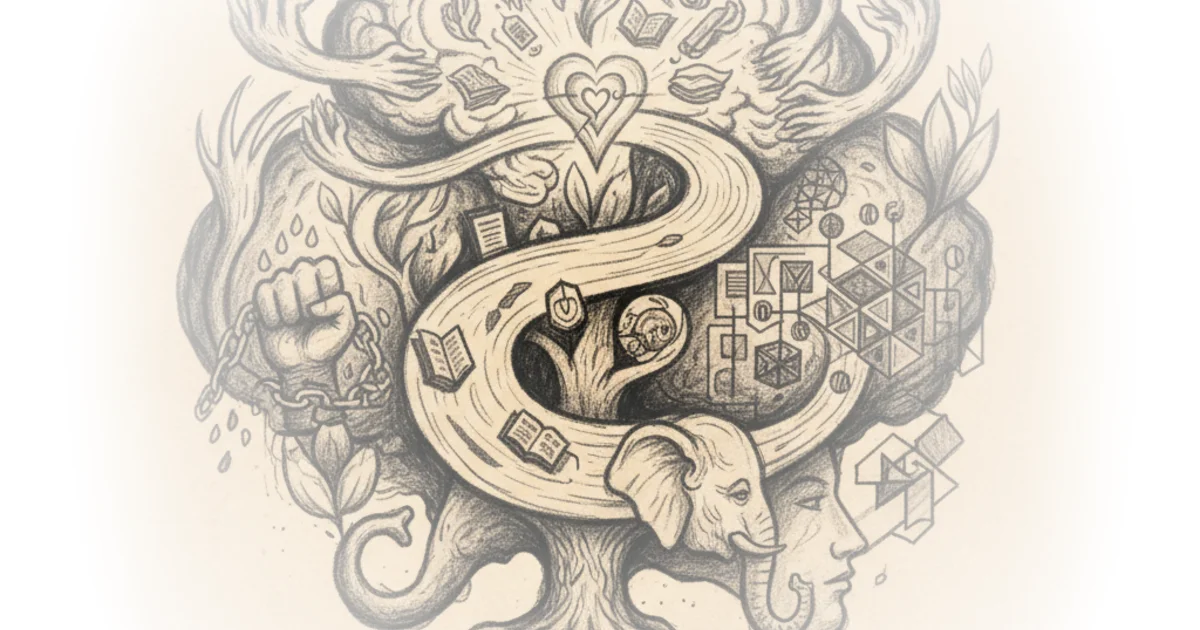
Mona Mona also includes a piece that challenges the very definition of humanity. "Aristotle was wrong about elephants and about us," the author notes, breaking down the notion of human exceptionalism. This is a crucial pivot. By dismantling the idea that humans are the sole bearers of consciousness or value, the roundup opens the door to a more inclusive ethics. This is particularly relevant in an age of AI, where the question of what constitutes a "mind" is no longer theoretical. The selection of this piece alongside the AI entry creates a powerful dialogue: if we are not exceptional, and machines are becoming more like us, where does dignity reside?
Bottom Line
Mona Mona's roundup succeeds by refusing to let philosophy remain an ivory tower exercise; it forces the discipline to grapple with the raw, messy realities of AI-driven distrust, state complicity in violence, and the crushing weight of modern labor. The strongest part of this curation is its ability to weave the personal (love, death, work) with the systemic (genocide, misinformation, policy) without losing the thread. Its biggest vulnerability is the sheer density of its demands on the reader, requiring a mental agility that few possess in a crisis. The reader should watch for how these philosophical frameworks are tested as the administration and the public navigate the coming wave of synthetic media and geopolitical instability.