Jason Slaughter delivers a scathing, data-driven indictment of Toronto's Finch West Light Rail Transit (LRT), arguing that a $3.5 billion project has become a symbol of car-centric planning failures rather than a solution for mobility. While many critics focus on budget overruns or construction delays, Slaughter zeroes in on a more immediate, infuriating reality: the train is slower than the bus it replaced, with an average speed of less than 12 km/h on opening day. This is not just a story about bad transit; it is a case study in how political interference and design choices can actively sabotage public infrastructure.
The Speed Trap
The core of Slaughter's argument rests on the sheer absurdity of the train's performance. He notes that on opening day, the train took 55 minutes to cover 10.3 kilometers, a pace that has led to viral videos of pedestrians racing and beating the train. "The Finch West LRT is worse than any of those other new LRT lines in pretty much every way," Slaughter writes, drawing a sharp contrast with modern systems in Bergen, Luxembourg, and Copenhagen that he recently visited. This comparison is powerful because it isolates the failure to local decisions rather than global trends in light rail technology.
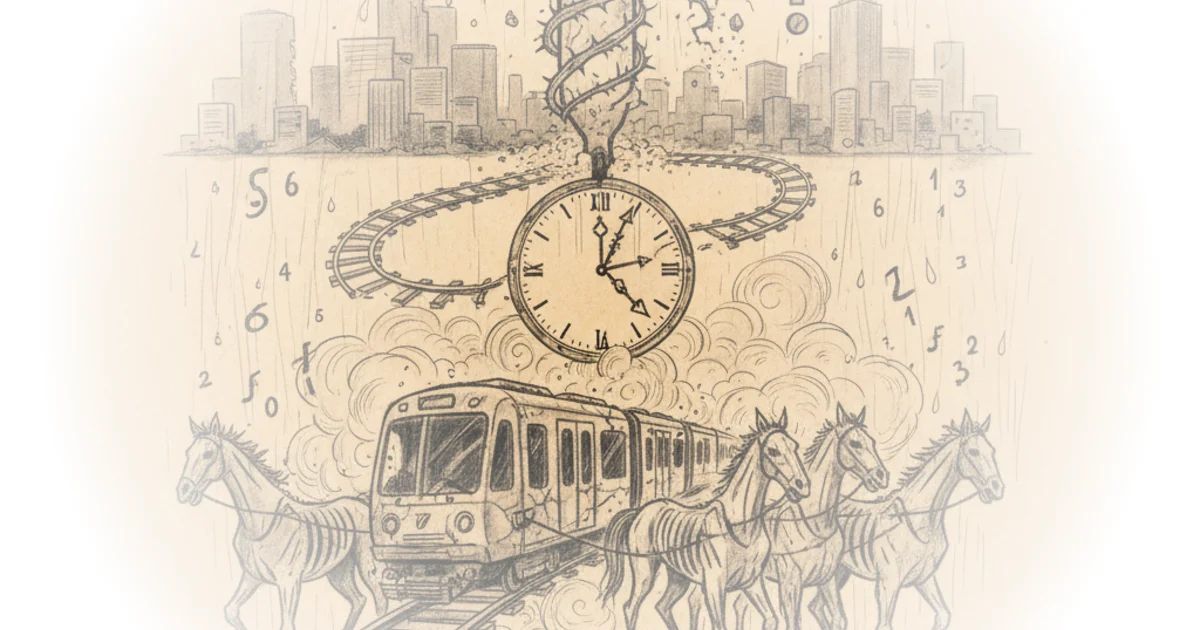
The author identifies traffic signal priority as the primary culprit. Despite running in a dedicated lane, the trains are forced to stop at almost every intersection, often waiting for left-turning cars to clear before the light changes for the tram. "It is absolutely insane that this rapid transit line costs $3.5 billion to build and yet trains full of people need to sit at a red light so that a couple of drivers can turn left first," Slaughter writes. This observation cuts to the heart of the issue: the system was designed to accommodate cars first, treating the train as a secondary user of the road.
Critics might argue that safety concerns regarding mixed traffic at intersections justify the delays, but Slaughter dismantles this by pointing out that the speed restrictions apply even in areas with no pedestrian conflict. The Toronto Transit Commission (TTC) claims these low speeds are part of a "Vision Zero" commitment, yet Slaughter finds this reasoning hollow. "I would love to see Toronto implement a 25 km per hour speed limit for cars, the things that are overwhelmingly responsible for the vast majority of road deaths, and see how well that goes over," he writes. This highlights a hypocrisy in safety policy where the vehicle designed to move many people is treated as more dangerous than the private cars that cause the most fatalities.
It is absolutely insane that this rapid transit line costs $3.5 billion to build and yet trains full of people need to sit at a red light so that a couple of drivers can turn left first.
Design Flaws and Political Ghosts
Beyond traffic lights, Slaughter points to fundamental design errors that prevent the train from ever reaching its potential speed. The stations are spaced too closely together—sometimes less than 450 meters apart—meaning the train must brake and accelerate constantly, never getting up to speed. "If stations are too close together, then the train needs to stop so often that it never gets up to speed. And that is a major problem with the Finch West LRT," he explains. This is a classic urban planning error where the desire to serve every neighborhood node destroys the efficiency of the rapid transit line.
The author also traces the roots of this failure to political sabotage, specifically the cancellation of the original "Transit City" plan by former Mayor Rob Ford and his brother, Doug Ford. Slaughter expresses visible frustration at seeing Doug Ford, now the Premier of Ontario, celebrate the opening of a project he tried to kill. "It really pisses me off to see his eating grin in the press photos in the opening day of the Finch West LRT when the reality is that he did everything in his power to kill and or them," Slaughter writes. While this political commentary adds emotional weight, it serves a practical purpose: it explains why the line is a patchwork of compromises rather than a cohesive system.
The physical layout of the stations further exacerbates the problem. By placing the tracks in the center of a suburban arterial road, the design forces pedestrians to cross multiple lanes of traffic to access the platforms. "Along the entire length of the line, this LRT line runs right in the middle of a suburban arterial road... This means that at every single station, transit passengers are dropped off in the middle of the strode and need to cross multiple lanes of car traffic to get to where they're going," Slaughter writes. He contrasts this with the LRT in Luxembourg, which runs along the side of the road, allowing for direct access to destinations without interacting with car traffic. This distinction reveals that the Toronto project prioritized the flow of cars over the safety and convenience of riders.
Bottom Line
Jason Slaughter's coverage is a masterclass in holding infrastructure accountable, moving beyond the usual "it's delayed" narrative to expose a system that is functionally broken by design. His strongest argument is that the Finch West LRT was never intended to be fast; it was built to minimize inconvenience to drivers, resulting in a service that is slower than the bus it replaced. The biggest vulnerability in the piece is its reliance on the assumption that political will exists to fix these deep-seated design flaws, given the history of interference. Readers should watch whether the promised signal priority changes actually materialize, or if this line remains a monument to car-centric planning for decades to come.