Michael Tracey delivers a masterclass in political absurdity, stripping away the apocalyptic rhetoric surrounding Zohran Mamdani's mayoral victory to reveal a fractured coalition held together by dynastic grudges and last-minute directives from the White House. While the national narrative screamed about an "existential threat" to Western Civilization, Tracey found voters in Borough Park more concerned with the personal history of 1994 than the ideological purity of the ballot. This is not a story about the end of an era, but a chaotic collision of ego, fear, and the strange mechanics of a divided electorate.
The Myth of the Existential Threat
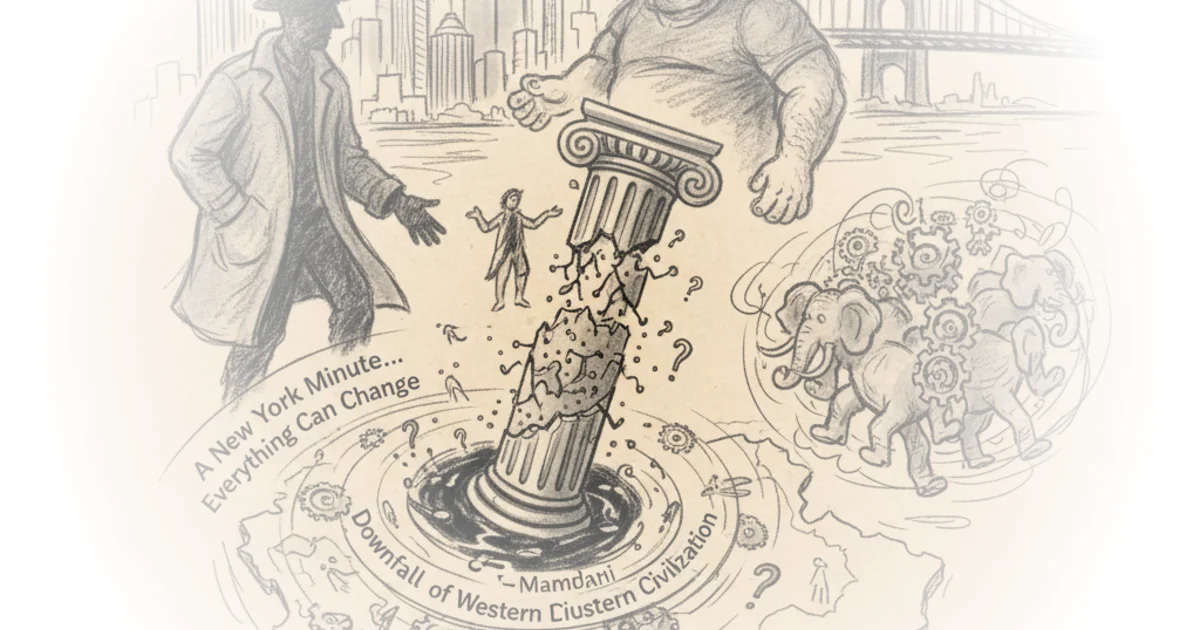
Tracey immediately dismantles the feverish claims that Mamdani's election signals the collapse of Western order. "The idea that Zohran Mamdani is going to bring about the downfall of Western Civilization is stupid," he writes, noting that few who make such claims can even define the civilization they claim to be saving. The author argues that the failure of the Republican establishment to rally behind Andrew Cuomo—the only viable alternative backed by the current administration—exposes the hollowness of the "emergency" narrative. If the threat were truly dire, Tracey suggests, the 146,000 voters who supported Curtis Sliwa would have swallowed their pride to back the establishment candidate.
Instead, the author found voters driven by personal animus rather than policy. "He's a miserable rat bastard!" one Sliwa supporter in Queens shouted about Cuomo, according to Tracey. This raw emotion, Tracey posits, was the real barrier to a unified front. The piece suggests that New York Republicans were so unconvinced of the threat that they were willing to contribute to Mamdani's election as a long-term political chess move, using the new mayor as a foil for future statewide campaigns. "If the theory is true... NY GOP bigwigs such as Giuliani and Pataki were so unconvinced of Mamdani's existential threat that they were willing to contribute to his election, rather than defeat him," Tracey observes. This reframing shifts the focus from ideological warfare to cynical political maneuvering.
The 1994 Ghost and the Borough Park Paradox
The commentary digs into the historical baggage that dictated voting patterns, specifically the "decades-old dynastic blood feuds" among aging political figures. Tracey highlights how George Pataki's 1994 upset victory over Mario Cuomo made endorsing Andrew Cuomo a "mortal political sin," regardless of the current political climate. Meanwhile, Rudy Giuliani's support for Sliwa over the administration's preferred candidate is framed as a symptom of his own embittered, tunnel-visioned state rather than a coherent strategy.
Yet, the most striking evidence comes from Borough Park, where the administration's influence cut through decades of local friction. Tracey recounts a surreal encounter with a Hasidic voter named Levy, who explained his choice with blunt pragmatism: "I voted for Cuomo, because Trump said so. I think Trump deserves our respect. He knows things that we don't." This moment captures the bizarre intersection of the "Old World" and modern political machinery, where voters in a neighborhood described as having "Kosher cell phones" followed a directive from the White House to vote for a candidate they otherwise despised.
The author details how this directive was amplified by a self-styled "Jewish political guru" named David Weinberger, who convinced his followers to "vote with our noses closed" once the administration's stance was clear. "The moment that the Truth came out, he said Trump deserves the benefit of the doubt," Tracey writes, quoting the voter's logic. This section illustrates how the executive branch's influence can override deep-seated local grievances, creating a coalition that is as fragile as it is fascinating.
It's like the "Old World," except with Kosher cell phones. In a New York minute, everything can change.
Critics might argue that Tracey overstates the cohesion of this coalition, noting that the "One on One" contrast between Cuomo and Mamdani might have yielded different results regardless of Sliwa's presence. However, the author's point stands: the fragmentation of the anti-Mamdani vote was less about strategy and more about personal loathing and historical baggage.
The Curtis Sliwa Factor
The piece turns its gaze to Curtis Sliwa, the perennial candidate whose role in the election remains shrouded in conspiracy and contradiction. Tracey notes that Sliwa's supporters are convinced he made a secret deal with Mamdani, a theory bolstered by Sliwa's "begrudging admiration" for the winner while reserving his "most intense vitriol" for Cuomo. When pressed on whether he was angling for a role in the new administration, Sliwa reportedly "launched into a raging tirade" rather than answering.
The author questions the credibility of Sliwa's claims, particularly his unproven assertion of a $10 million bribe to drop out of the race. "Why didn't he report it to law enforcement, which he claims to be such a stalwart supporter of?" Tracey asks, pointing out the candidate's history of fabricating stories, such as a past claim of being abducted by transit police. The piece suggests that Sliwa's refusal to identify the alleged culprits, combined with his financial desperation, paints a picture of a man more interested in the spotlight than in solving the city's problems.
The most telling moment comes when Sliwa is confronted about his silence regarding the administration's endorsement of his rival. "Curtis, are you afraid of Trump?" Tracey asks, noting that the usually bombastic radio host went "mealy-mouthed" in response. This hesitation, the author argues, reveals the true power dynamic: even the most vocal critics of the establishment will fall silent when the White House speaks.
Bottom Line
Tracey's greatest strength lies in his ability to cut through the noise of political apocalypse to reveal the messy, human realities of a fractured electorate. His biggest vulnerability is the reliance on anecdotal evidence from a single, chaotic election day, which may not fully capture the broader structural shifts at play. However, the piece serves as a vital reminder that in New York politics, as in the rest of the country, the most powerful forces are often not ideologies, but personal grudges and the unpredictable influence of the executive branch.