Dave Borlace cuts through the noise of pandemic-era environmental optimism to expose a stubborn, growing climate blind spot: the global freight industry. While headlines celebrated cleaner city air, Borlace argues that the surge in online shopping has quietly accelerated a freight boom that threatens to derail net-zero goals unless we solve the electric-versus-hydrogen debate immediately.
The Hidden Engine of Emissions
Borlace begins by dismantling the assumption that the lockdowns solved our carbon problem. He points out that while aviation and factory pollution dropped, the logistics of e-commerce surged. "Over the past 10 months or so you've probably seen lots of news stories discussing how the 2020 lockdowns might be helping the good citizens of this planet's globalized Human Society... to learn how to rein in our consumption," he notes, before pivoting to the reality: "an increase in online shopping inevitably means an increase in the number of Home deliveries and it also drives the ever expanding Global Freight industry."
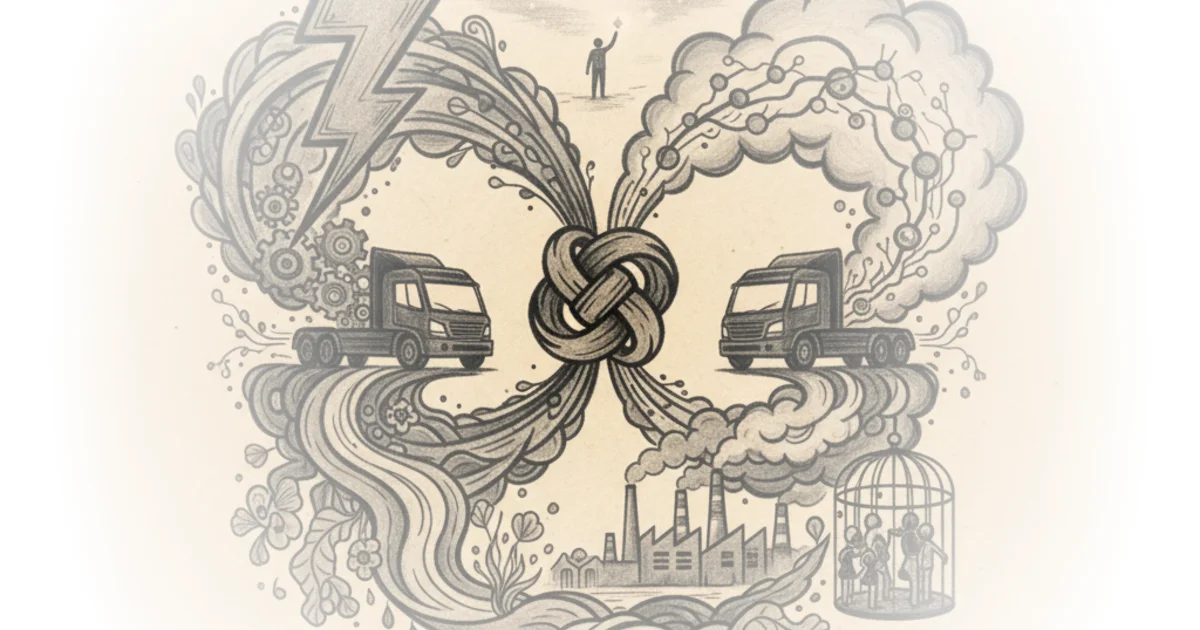
The stakes are higher than most realize. Citing the International Energy Agency, Borlace highlights that road freight consumes 17 million barrels of oil daily. Without intervention, that figure is projected to climb to 22 million barrels by 2050. The author's framing is effective because it shifts the focus from passenger cars—which get all the policy attention—to the heavy-duty vehicles that actually move the global economy. "The International Energy agency suggests that in the very short term that means vehicle efficiency standards combined with improvements in logistics and operations," Borlace writes, noting that regulations are finally catching up in the EU, India, and China.
However, efficiency alone has a ceiling. Borlace argues that tweaking diesel engines or switching to biofuels is a dead end. He dismantles the biofuel narrative with brutal efficiency, citing studies that show biodiesel from palm oil can produce three times the emissions of fossil fuels when land-use changes are factored in. "Recent Studies have found that the process of producing biofuels can generate more carbon dioxide than the fuels themselves," he states. This is a crucial correction for readers who might view "green" fuels as a silver bullet. The same skepticism applies to natural gas; Borlace notes that when well-to-wheel emissions are calculated, the net benefit often vanishes entirely.
"The trouble is there are several billion other people on the planet who haven't quite reached your level of Enlightenment yet and they are still going to demand the stuff they want when they want it."
The Battery vs. Hydrogen Divide
With incremental fixes ruled out, Borlace turns to the core question: electric batteries or hydrogen fuel cells? He acknowledges the common counterargument—that electric trucks are only as clean as the grid charging them, and most hydrogen is currently made from fossil fuels. "At this stage I know there'll be a lot of people out there yelling that electric vehicles are no better if they're being charged off of a grid powered by coal," he admits. But his rebuttal is pragmatic: the grid is greening, and green hydrogen is scaling, making the transition inevitable regardless of current imperfections.
The coverage shines when detailing the global race. Borlace highlights China's dominance, noting that "China accounts for 65% of the global Fleet of Electric Light commercial vehicles," while also leading in hydrogen buses. He contrasts this with the fragmented but ambitious efforts in the US and Europe. The narrative moves from policy to hardware, discussing everything from German aerodynamic rear wings that reduce drag by 10% to the massive infrastructure challenges ahead.
A counterargument worth considering is the sheer physical limitation of battery weight for long-haul trucking. While Borlace mentions the Tesla Semi's impressive specs—a 500-mile range and a 20-second 0-60 time—he glosses over the weight penalty of batteries compared to hydrogen, which remains a critical factor for heavy freight. Nevertheless, his assessment of the market is sharp: major logistics players like Amazon, FedEx, and DHL are already pledging to electrify because the math works. "Tesla reckoned their vehicle has a 2-year payback time and a lifetime fuel cost saving of around $200,000," Borlace writes, underscoring that economics, not just altruism, will drive adoption.
The Infrastructure Bottleneck
The most distinctive part of Borlace's analysis is his deep dive into the infrastructure required to make this transition real. He describes the "Electric Road System" being tested in Europe, where trucks connect to overhead wires via a pantograph, similar to trams. "One of the systems under consideration in Europe is a network of Electric Road systems where trucks are fitted with a Pantagraph on their roof that can hook onto an electricity cable suspended by overhead wires above the highway," he explains. This hybrid approach allows trucks to run on battery power for the final leg of delivery while drawing massive power from the grid during transit.
Borlace also addresses the grid stability concern head-on. He argues that the trucks themselves can become a solution, not just a load. "Because the trucks will essentially represent a fleet of mobile batteries that'll dwarf the scale of stationary batteries they could be fitted with vehicle to grid software technology so they can be fully integrated with electricity grids providing frequency regulation to support grid stability." This reframing of trucks as grid assets is a sophisticated insight that elevates the piece beyond a simple technology comparison.
Critics might note that the capital investment required for such a massive overhaul of highway infrastructure is staggering and politically difficult to secure. Borlace acknowledges the cost but frames it as a job creator and a necessary investment to avoid climate catastrophe. "The cost of implementing new infrastructure will be pretty enormous but so will be the investment opportunities for the commercial Enterprises who choose to take the plunge," he concludes.
Bottom Line
Dave Borlace's strongest contribution is his refusal to treat the freight transition as a simple technology swap; he correctly identifies it as a systemic infrastructure challenge requiring grid upgrades, new charging standards, and a global shift in logistics. His biggest vulnerability is perhaps an over-optimism regarding the speed of hydrogen scaling, which remains technologically and economically more fragile than battery-electric solutions. The reader should watch for how the "Electric Road System" pilots in Europe evolve, as they may hold the key to solving the range and weight paradox of heavy-duty transport.