The day the dinosaurs died was one of the worst days in Earth's history. But it also created the world we live in today.
Sixty-six million years ago, an asteroid roughly 12 kilometers wide slammed into what is now Mexico. The explosion was billions of times more powerful than the bombs dropped on Japan. Every animal within 1,800 kilometers was instantly vaporized. A shock wave blast across the land for 1,500 kilometers. Magnitude 11 earthquakes shook the planet. Rock rained down from the sky, triggering worldwide wildfires. Ash filled the sky, creating a nuclear winter that lasted years. Photosynthesis shut down. An entire ecosystem collapsed.
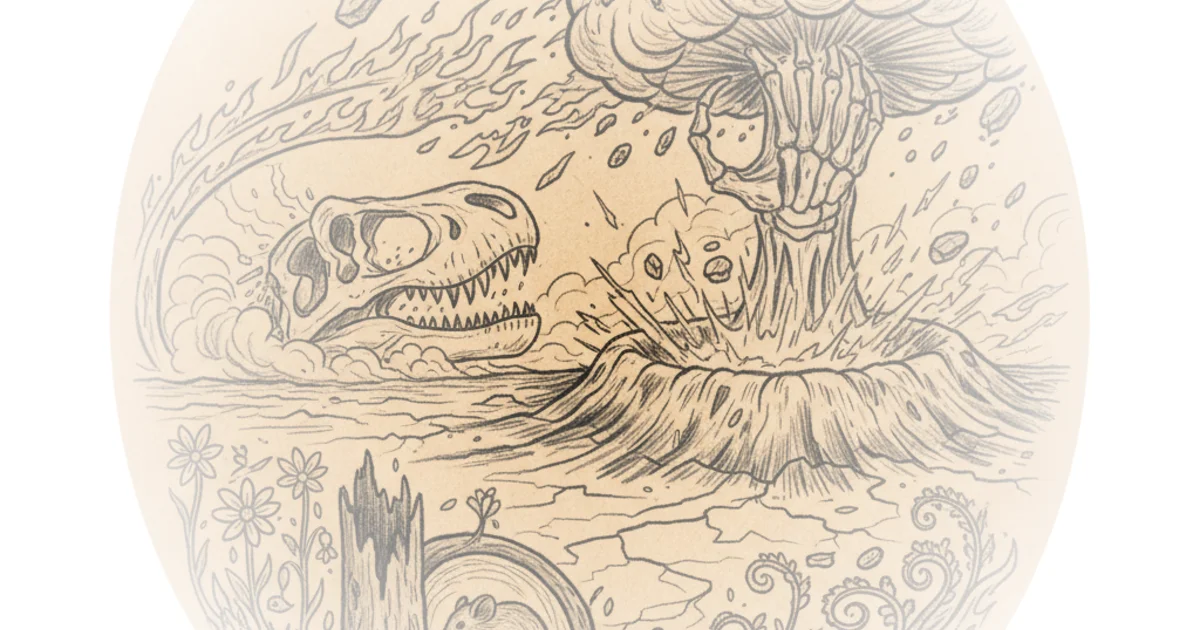
Seventy-five percent of all life on Earth died. All non-avian dinosaurs perished. The giant winged pterosaurs disappeared. Marine monsters like Mosasaurus vanished. A diverse world full of incredible beasts came to an end.
But life survived. And we are here.
The question is: who was our ancestor when the dinosaurs died?
What Makes Us primates
To find our super ancient ancestors, we need to understand what makes us who we are — what traits define humans as primates.
Humans are primates. We're in the order of primates. Our closest relatives are chimpanzees and gorillas. More distantly, we're related to lemurs.
What unites all primates? Several distinctive features define this group — features shared by humans, chimpanzees, capuchin monkeys, and tarsiers alike.
Andrew Summers studies the early origins of primates. He points to one defining trait: forward-facing eyes. Primates have larger-than-average brains, with a skull shaped specifically for these large organs.
The other feature that defines our face is called the post-orbital bar. Our eye socket is fully encased in bone — no gap around it. In many other mammals, it's an opening.
When we look at dentition, primate teeth are generally not super derived. We don't have scissor-like teeth that carnivorous animals have. We don't have tall hip teeth like horses or other grazers. We have low-crowned, broad-based, bulbous posterior teeth — suited for consuming varied foods.
In postranial features, we have diverging thumbs and big toes. Although humans evolved to walk upright, our toe is not diverged anymore — but you can see it in early hominin fossils. We had a diverged big toe. We have fleshy pads on our hands and feet for grabbing. And crucially, we have nails — flattened distal flanges where the last bones in our fingers and toes are flat rather than curved like a dog's claw or cat's claw.
These traits didn't evolve independently. They represent shared ancestry. When paleontologists examine the great diversity of hundreds of primate species alive today and in the fossil record, they see these features across all of them — forward-facing eyes, grasping hands, diverging toes. This suggests primates were clambering up and down trees. We were up in the trees somewhere.
So when do we start to see these features appear?
The Burning World
The earliest true primates appear around 56 million years ago during a period called the PETM — the Paleocene-Eocene Thermal Maximum. This was a remarkably warm time in Earth's history. The polar regions were almost certainly free of ice. Instead, the Arctic was home to subtropical swamps and palm trees, with crocodiles lurking in waters as far north as Saskatchewan.
The earliest ancestors of horses appear in the fossil record for this period — they were just the size of cats. Some animals were small, but others were huge. In South America, giant terror birds hunted for prey. It was almost the return of the dinosaurs.
For marine life, it seems to have been a challenging time.
The PETM was one of the most rapid periods of global warming in all of Earth's history. The warming was probably caused by the release of methane from the ocean floor — various hypotheses exist. This warming may have taken place over just a few thousand to tens of thousands of years.
During this PETM, we see the first true primates appear in the fossil record. One fossil is called Arbus from China. This poor little guy curled over was absolutely tiny — less than one ounce. The feet were preserved, and the flat bones suggest this animal had nails and was a primate like us.
We have another interesting primate specimen called Cantus. Another really interesting one where we have a few fossils is called Talhardina. It has some adaptations for climbing but also a true orbital bar suggesting it was a primate just like us. This specimen from China has been found as far south as Mississippi — quite a widespread early primate across the northern hemisphere during the PETM.
But there's a problem when thinking about the hunt for these early primates. The earliest ancestors of humans — Cantius, Talhardina, Arbus — are already quite derived. Paleontologists believe Tile Hardina and Arcibus were probably already on the side of the family tree that became tarsiers. They were dry-nosed primates like us. Canas is probably an early wet-nosed primate. This means these can't really have been the first primate.
Finding primates further back in time than the PETM is difficult for a couple of reasons. First, all these different features didn't necessarily evolve all at once. You might find fossils that have some features of primates but some features that primates don't have — figuring out their relationship to later species is really tricky.
The second problem is size. We were tiny — absolutely tiny. Look at the scale bar for some of these early primates. We're talking millimeters here compared to a man's fingers. Small creatures like squirrels and whatnot. Tiny animals make it hard for them to become fossils. Fossilization is a rare process. An animal has to be buried quickly but gently, then survive until our time period — incredibly difficult.
But before the PETM, one group of animals we see with primate-like traits are the plesiaforms. Plesiaforms actually means near adapforms — Adapoforms were an early family of primates. So they're near primates basically.
The plesapoforms are our closest cousins — about as close to primates as you could be without being true primates. Today, they're not really seen as their own separate family. They're more of a series of successive species with some actually being very closely related to primates, some being a little less closely related, and so on.
The plesiaforms don't have all the features associated with true primates. They don't have particularly large brains. They don't have true orbital bars. They have claws. Some are even really strange. One has adaptations to be kind of a primate-like woodpecker — this is called chairomyoides. A plesiadapiform but with enormous front teeth almost maybe like a beaver.
Even though there are some weird and wonderful plesiadapaforms, they do show some similarities to primates. They definitely have adaptations for climbing. One specific specimen called Carpems Simpsoni seems to have had a divergent big toe with a nail on the end — classic primate stuff.
Bottom Line
The story of our ancestors is the story of survival against all odds. When an asteroid wiped out the dinosaurs, it created conditions for mammals — and eventually primates — to thrive. The earliest primates appeared around 56 million years ago during the PETM, but they were already quite derived, meaning we need to look even further back in time.
The biggest challenge is that these creatures were tiny — making fossilization rare and discovery difficult. Yet despite these obstacles, paleontologists have traced our lineage through clever adaptations: forward-facing eyes, grasping hands, diverging toes, and flat nails.
What remains uncertain is exactly how far back the primate family tree truly goes — and what our most ancient ancestors looked like before they took to the trees.