Devin Stone, the legal mind behind LegalEagle, does something rare: he proves that the most accurate legal analysis often comes from the most absurd fictional scenarios. By partnering with Brennan Lee Mulligan, a master of improvisational storytelling, Stone dissects why courtroom comedy works so well, revealing that the gap between legal reality and pop culture perception is wider—and funnier—than anyone admits.
The Architecture of Absurdity
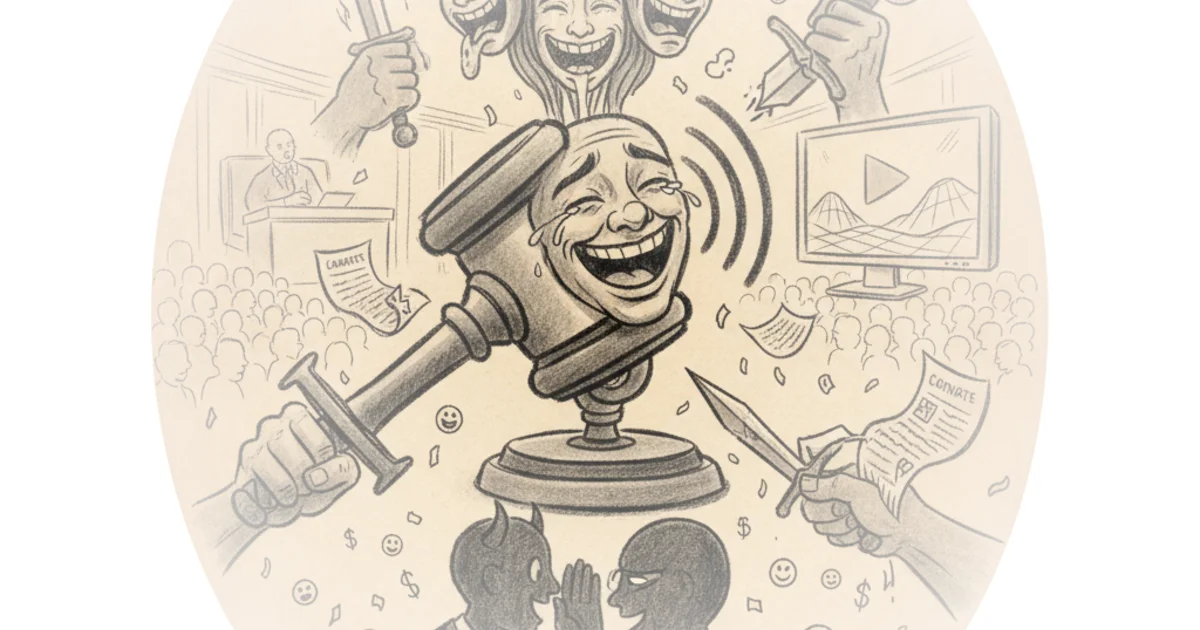
Stone's central thesis is that the rigid formality of a courtroom creates the perfect vacuum for comedy to explode. He notes that "courtroom scenes are such fertile ground for comedy" precisely because comedians thrive on disrupting expectations. When a defendant interrupts a lawyer to admit, "I killed him," the humor lands because it shatters the solemnity of the legal process. Stone argues that this disruption is not just a gag; it highlights how fragile the illusion of order in a trial really is.
The collaboration with Mulligan allows Stone to explore this through a character who represents pure innocence on trial for murder: Kermit the Frog. Stone observes, "If Kermit didn't do it, who did it? Well, who's the most violent muppet? It's Miss Piggy." This line is more than a joke; it is a practical demonstration of how defense attorneys construct reasonable doubt by shifting the narrative to the most plausible alternative, regardless of how outlandish it seems. Stone points out that the humor works because "there is so much truth in it," acknowledging the decades-long, physically aggressive dynamic between the two characters.
"You want to basically talk at roughly like a fourth grade level and it doesn't change the persuasiveness at all."
Stone's analysis of a fictional lawyer's closing argument reveals a critical insight into jury psychology. He critiques the use of complex vocabulary like "specious," noting that while legally precise, such words often alienate jurors who are looking for a human connection rather than a vocabulary test. The argument that lawyers should simplify their language to a fourth-grade reading level is a powerful reminder that the law is a persuasion game, not an academic exercise. Critics might argue that oversimplification risks losing nuance, but Stone's point stands: if the jury doesn't understand the argument, the law doesn't matter.
The Reality of Interrogation
The conversation shifts from the absurdity of fictional trials to the terrifying reality of police interrogations. Stone dismantles the myth that the "good cop, bad cop" routine is obsolete, explaining that the dynamic remains effective because of the sheer psychological pressure on the suspect. "If you find yourself in an interrogation room or in handcuffs, it is a terrifying experience," Stone writes. "They might be dying for a cup of water."
He highlights a disturbing legal reality that often shocks the public: police are allowed to lie to suspects to extract confessions. Stone calls this "bonkers," noting that the legal system permits deception as a standard tool of investigation. This is a stark contrast to the clean, truth-seeking image of law enforcement often portrayed in media. The humor in the "Tide Pod CEO" skit, which Stone praises for its "fake corporate authenticity," serves as a foil to this grim reality, showing how difficult it is to communicate danger when the message is delivered with inauthentic flair.
The Philosophy of Force
Perhaps the most intellectually dense moment comes when Stone and Mulligan discuss a character who defines law as "threats made by the dominant socioeconomic ethnic group." Stone validates this radical statement by connecting it to legal theory, noting that "all of that is in some way backed by force from the government." He explains that even mundane infractions like parking tickets are ultimately enforced by the threat of state violence. This reframes the law not as a set of moral rules, but as a system of power dynamics.
Stone's ability to pivot from a D&D campaign about a halfling anarchist to a serious discussion of political philosophy demonstrates his unique talent for making high-level theory accessible. He acknowledges that while the character's view is extreme, it contains a "clinical" truth about the nature of statutes: they are commands backed by the threat of punishment. This section elevates the entire piece from a simple comedy review to a genuine exploration of legal theory.
"The point Bud Cubby is making in this clip is that like you're saying all this stuff takes root in the state. I mean even the term enforce the word force is right there right."
Bottom Line
Stone's coverage succeeds because it refuses to treat legal analysis as a dry academic pursuit, instead using humor to expose the mechanics of the justice system. The strongest part of the argument is the demonstration that legal accuracy and comedic timing are not mutually exclusive; in fact, they often rely on the same understanding of human behavior. The biggest vulnerability is the reliance on the audience's familiarity with niche pop culture references, which may alienate those outside the specific fandoms. However, for anyone willing to listen, the piece offers a rare glimpse into how the law actually works when stripped of its pretense.