Sabine Hossenfelder dismantles our most intuitive sense of reality: the belief that the past is gone and the future is unwritten. By weaving together Einstein's special relativity with a rigorous examination of 'now,' she argues that time is not a flowing river but a static, four-dimensional landscape where every moment exists simultaneously. For the busy mind seeking to understand the architecture of the universe, this is not just a physics lesson; it is a fundamental challenge to how we perceive existence itself.
The Illusion of the Universal Now
Hossenfelder begins by confronting the human perception of time as a universal parameter, a shared clock ticking identically for everyone. She notes that while we feel time passing with a special moment called 'now,' physics tells a different story. The author traces the shift from this intuitive view to Hermann Minkowski's insight that time is a dimension, not just a parameter. "Maxwell's equations of electrodynamics make much more sense if one treats time as a dimension not as a parameter," Hossenfelder writes. This reframing is crucial because it suggests that the distinction between space and time is merely a matter of perspective, much like rotating a ball in space.
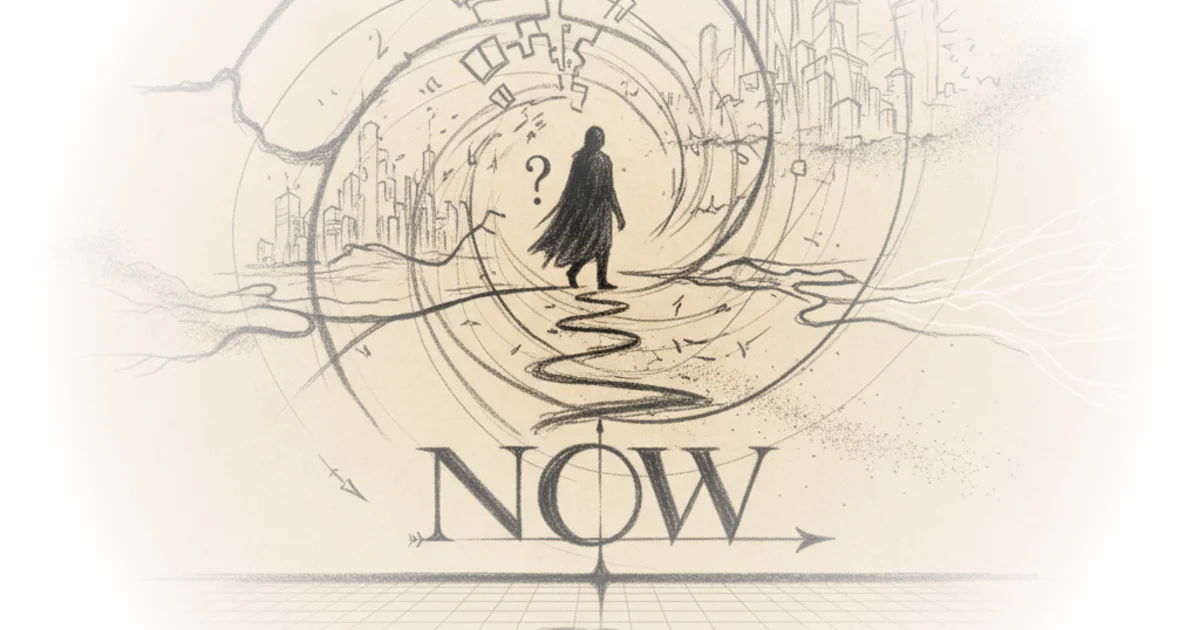
The argument gains traction when Hossenfelder introduces the concept of the 'space-time diagram.' She explains that while we can move freely in space, our motion in time is restricted to a forward direction, yet the labeling of time becomes relative once it is treated as a dimension. "Once you have made time into a dimension the labels on it don't mean much," she observes. This is a bold claim that strips 'now' of its absolute authority. The effectiveness of this framing lies in its simplicity; by using the analogy of coordinate systems, she makes a counter-intuitive physical reality accessible without sacrificing rigor.
The notion of now depends on the observer. Your now is not the same as my now.
The Relativity of Simultaneity
The core of Hossenfelder's analysis rests on Einstein's thought experiment involving mirrors and photons. She details how two observers in relative motion cannot agree on what constitutes 'simultaneous' events. If an observer named Alice flies past in a spaceship, her definition of 'now' diverges from a stationary observer's. Hossenfelder clarifies that this is not a measurement error but a fundamental property of the universe. "You're both right or to put it differently the notion of now depends on the observer," she asserts. This leads to the conclusion that there is no single, universal 'now' that slices through the cosmos.
Critics might argue that this relativistic view is so abstract it has no bearing on human experience, where causality seems rigid. However, Hossenfelder anticipates this by noting that these mismatches are negligible at everyday speeds, only becoming significant near the speed of light. Yet, the philosophical implication remains: if 'now' is observer-dependent, then the reality of events cannot be anchored to a single moment in time. The author's choice to use a fictional character like Alice to illustrate this point humanizes the complex math, making the 'relativity of simultaneity' feel less like a theorem and more like a lived paradox.
The Block Universe and the Existence of the Past
Hossenfelder takes the argument to its logical extreme, proposing the 'block universe' theory. If every observer has a valid 'now,' and those 'nows' overlap and intersect across different velocities, then all events must exist simultaneously. "All times exist in the same way this is called the block universe it's just there it doesn't come into being it doesn't change it just sits there," she writes. This is the piece's most provocative claim: the past is not gone, and the future is not yet to come; they are all equally real, frozen in a four-dimensional structure.
She addresses potential counterarguments from quantum mechanics, noting that while the wave function collapse appears instantaneous, it cannot be used to define a universal simultaneity. "Quantum mechanics doesn't change anything about the block universe because it's still compatible with special relativity," Hossenfelder explains. This is a strong defense against the idea that indeterminism saves the 'flow' of time. However, she acknowledges the discomfort this causes: "If you find that somewhat hard to accept there is another possibility... but unfortunately it has nothing to do with pizza if it had any observable consequences that would contradict the fourth assumption." Her dry humor here serves to underscore the stubbornness of the physics; the universe does not care if the block universe model feels unnatural to us.
Bottom Line
Hossenfelder's strongest contribution is her ability to translate the abstract geometry of special relativity into a coherent narrative about the nature of existence, forcing the reader to confront the possibility that the past is as real as the present. The argument's vulnerability lies in its reliance on the 'block universe' interpretation, which, while mathematically consistent, remains philosophically contested by those who argue that quantum indeterminism implies a genuine, unfolding future. Readers should watch for how this static view of time intersects with emerging theories in quantum gravity, which may yet challenge the rigidity of the block.
All times exist in the same way this is called the block universe it's just there it doesn't come into being it doesn't change it just sits there.