Andreas Matthias dismantles two of our oldest justifications for eating meat by revealing them as convenient fictions rather than moral truths. Drawing on his own years tending livestock in the Romanian mountains, he argues that the romantic image of the benevolent shepherd is a psychological shield we use to ignore the brutal economics of animal agriculture. In an era where industrial farming has severed the connection between consumer and slaughter, this philosophical autopsy forces us to confront whether our food choices are acts of necessity or unexamined cruelty.
The Myth of the Benevolent Shepherd
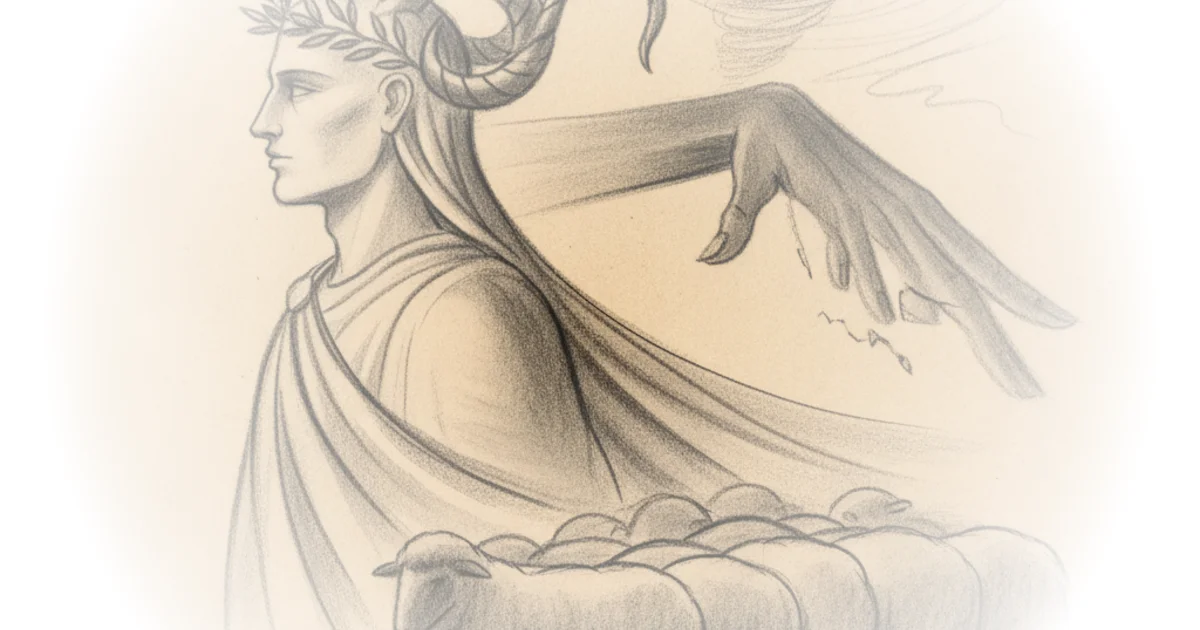
Matthias begins by revisiting Plato's Republic, specifically the debate between Socrates and Thrasymachus regarding the nature of ruling. While Socrates insists that a true ruler, like a shepherd, must act solely for the good of the herd, Matthias rejects this idealism based on lived experience. He writes, "As a former shepherd, I find this unconvincing... obtaining meat, cheese, wool or other types of compensation is the goal of animal agriculture and it is intimately connected with every aspect of the practice." This grounding in reality strips away the philosophical abstraction; the author argues that shepherding has never been charity, but a transaction where the well-being of the animal serves the economic interests of the owner.
The piece effectively uses the fictional world of Severance to illustrate why separating work from profit is impossible in agriculture. Matthias notes, "We don't live in the world of Severance, where two realia can easily be detached." He suggests that the myth of the selfless caretaker persists not because it is true, but because the alternative—that we are raising beings solely to kill and eat them—is emotionally intolerable for many. This framing is powerful because it shifts the blame from individual farmers to a systemic need for rationalization.
"The same people who wouldn't shut up about the virtues of shepherding were also the cheapest ones when it came to actually paying for the services of shepherds."
Critics might argue that this view ignores small-scale, regenerative farming where animal welfare is a genuine priority alongside profit. However, Matthias anticipates this by distinguishing between traditional practices and modern industrial scale, yet he maintains that even in traditional settings, "the well-being of the sheep is ultimately serving the interests of their owners." The argument holds weight because it refuses to let economic incentives masquerade as moral virtue.
The Illusion of Consent
The commentary then pivots to what Matthias calls the "myth of animal consent," a pervasive narrative that domestication was a mutually beneficial evolutionary deal between humans and animals. He cites Jonathan Safran Foer's Eating Animals to expose this trope: "Basically, humans struck a deal with the animals we have named chickens, cows, pigs, and so forth... your labor will be harnessed, your milk and eggs taken, and, at times, you will be killed and eaten." Matthias points out that this story has deep historical roots, from ancient Greek oracles interpreting a nod as consent to slaughter, to Yakut traditions claiming bears willingly offer themselves.
Matthias argues that modern science is often misused to reinforce this fantasy, framing domestication as "an evolutionary, rather than a political, development." He sharply distinguishes between true symbiosis and the reality of farming: "Domestication is an imposition; symbiosis means cooperation." To illustrate genuine mutual benefit, he references the honeyguide bird, which leads humans to beehives so both can feast—a stark contrast to the forced breeding and castration inherent in livestock management.
"If this idea convinces us to buy animal products from supermarkets or fast-food restaurants, then we are simply deluding ourselves."
This section is particularly biting because it exposes how the language of evolution is weaponized to absolve humans of moral responsibility. Matthias writes, "It uses 'evolution' as a way to diminish the moral responsibilities of humans... why would we want to live in a culture where the majority of people think we've evolved to inflict unspeakable acts of violence upon countless billions of animals annually when this is clearly a choice that we make mostly because we like the taste of meat and cheese?" The argument challenges the reader to stop hiding behind biological determinism.
True Superiority: Moral Agency vs. Cruelty
In his conclusion, Matthias addresses the concept of human superiority, noting that while major religions from Hinduism to Islam agree on a hierarchy where humans rule animals, they also emphasize profound moral duties toward them. He contrasts this with the modern "might makes right" mentality derived from simplistic evolutionary theory. Matthias asserts that true human distinction lies not in our capacity for violence, but in our ability to choose otherwise: "Let us embrace an area where we are truly 'superior', and that is the fact that we are the only ones in the natural world that can be moral."
He suggests that veganism or highly labor-intensive humane farming represents a continuation of these ancient ideals of compassion, whereas mass consumption is a betrayal of them. The piece ends with a reminder of responsibility, echoing a contemporary maxim: "with great power comes great responsibility." This reframing turns the debate from one of dietary preference to one of ethical consistency.
"The more financially cheap animal products are, the more they are morally expensive."
Bottom Line
Matthias's most compelling contribution is his refusal to let economic convenience masquerade as moral necessity, forcing a direct confrontation with the reality that modern meat consumption relies on myths rather than mutual benefit. While one might argue that traditional husbandry retains elements of care absent in industrial farming, the author successfully demonstrates that even those practices are rooted in exploitation, not symbiosis. The reader is left with a clear imperative: if we claim moral superiority over other species, our food systems must reflect that responsibility, not just our appetite.