Cory Doctorow does not merely connect two disparate 2013 events; he fuses them into a single, terrifying explanation for our current political fragility. By linking Thomas Piketty's economic data on wealth accumulation with Edward Snowden's revelations on state surveillance, Doctorow argues that the modern state is not spying to protect us, but to buy time for an illegitimate oligarchy. This is a provocative thesis that reframes the digital surveillance state not as a security apparatus, but as the most efficient tool ever invented for preserving inequality.
The Economics of Insecurity
Doctorow begins by anchoring his argument in the stark reality of capital flows. He highlights Thomas Piketty's finding that "returns to capital exceed the rate of growth over the long term," a dynamic he describes as "explosive" rather than innocuous. The author uses this formula, r > g, to demonstrate a perverse inversion of meritocracy: the market rewards those who simply own things far more than those who create value.
To illustrate this, Doctorow contrasts Bill Gates, the architect of Microsoft, with Liliane Bettencourt, the heiress to L'Oreal. He notes that during Gates's active years as an entrepreneur, Bettencourt "did precisely nothing of value" yet accumulated more wealth. The author writes, "Bettencourt, a person who owned things, did better than Gates, a person who did things." This comparison is not just a critique of wealth; it is a critique of the system's inability to distinguish between productive contribution and passive accumulation.
The danger arises when these "winners of the orifice lottery"—those who inherit vast fortunes without earning them—begin to believe their wealth is a sign of "special, heritable virtue." Doctorow argues that these billionaire dilettantes inevitably become "weapons of mass destruction," using their unearned power to dismantle public institutions. He points to Gates's role in blocking AIDS drug production in South Africa and dismantling public schools as evidence of how "ideological projects have been a catastrophe." The author suggests that when the ruling class is composed of people who have never built anything but inherited everything, their decisions lack democratic legitimacy and often inflict massive collateral damage.
Billionaire dilettantes are weapons of mass destruction, and their special projects have a wide blast radius and inflict a lot of collateral damage.
Critics might argue that this framing overlooks the genuine philanthropic efforts of some wealthy individuals, yet Doctorow's focus remains on the structural power these figures wield to reshape society against the public interest. The argument gains weight when he connects this economic instability to the need for repression.
The Productivity of Oppression
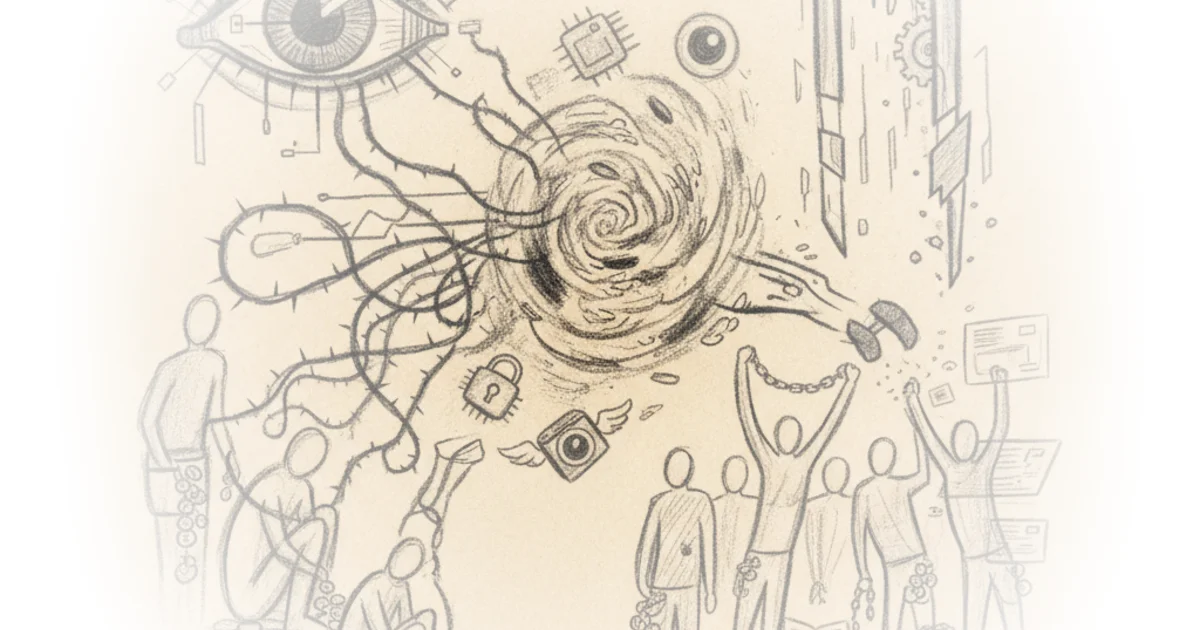
The piece's most striking insight is its re-evaluation of surveillance. Doctorow posits that the digital revolution has achieved a productivity dividend in spying that economists only dream of in other sectors. He draws a chilling parallel to the Stasi, the secret police of East Germany. In the GDR, it took roughly one spy to watch eighty neighbors, a ratio that required massive human resources and ultimately failed when the Berlin Wall fell in 1989.
In contrast, Doctorow notes that the NSA's digitized apparatus allowed a single spy to monitor over a thousand people by 2013. He writes, "computers had made it possible for a spy to keep tabs on more than a thousand people." This efficiency, he argues, is not a triumph of security but a mechanism to sustain a level of inequality that would otherwise be politically unsustainable. The state does not spy because the system is secure; it spies because the system is so unjust that the beneficiaries fear a popular uprising.
Doctorow suggests that the administration's reliance on surveillance is a direct response to the instability created by oligarchic rule. He observes that when leaders lack democratic legitimacy, they must rely on force. "The more he steals, the more he destroys... the more he needs spy cameras, internet surveillance, vehicle tracking, and facial recognition," Doctorow writes, describing a cycle where corruption fuels the demand for repression, which in turn enables further corruption. This creates a "self-licking ice-cream cone" of authoritarianism.
The Cost of the Guillotine
The author concludes by warning that this dynamic is accelerating. He references the dismantling of the administrative state by private interests, noting how specific agencies tracking disease outbreaks were cut, leading to real-world suffering. Doctorow argues that the current trajectory leads inevitably toward violence. He paraphrases Piketty's central warning: "the cheapest way to stop people from building a guillotine on your lawn is to build hospitals and schools; this is cheaper than paying for guards and prisons to lock up would-be guillotine builders."
By choosing surveillance over redistribution, the ruling class is betting that technology can suppress the inevitable backlash of inequality forever. Doctorow implies this is a losing bet. The surveillance state is a symptom of a deeper rot, a desperate attempt to maintain order in a society where the rules of the market have been rigged to favor the idle rich over the productive poor.
The market's most lavish rewards do not go to its most productive participants, but rather, to those participants who have the good fortune to emerge from the luckiest of orifices.
Bottom Line
Doctorow's synthesis of Piketty and Snowden offers a compelling, if grim, explanation for the rise of authoritarian surveillance: it is the price tag of maintaining an oligarchy that has lost its social license to rule. The argument's greatest strength is its refusal to treat surveillance as an isolated privacy issue, instead exposing it as a structural necessity for an unjust economic order. However, the piece leans heavily on a deterministic view of history, potentially underestimating the capacity for democratic resilience and reform without resorting to revolutionary violence. Readers should watch for how this tension between technological repression and social instability plays out in the coming decade, particularly as AI further lowers the cost of monitoring the populace.