Adam Tooze exposes a terrifying disconnect: while the world teeters on the brink of an energy crisis and war, the US stock market is hitting record highs. This isn't just optimism; it is a structural delusion where the financial elite have become desensitized to the very real risks of conflict in the Middle East and the fragility of an economy propped up by accounting tricks. For the busy professional trying to navigate 2026, understanding this cognitive dissonance is not academic—it is essential for survival.
The Architecture of Denial
Tooze begins by painting a stark picture of the current moment. We are facing a historic disruption to energy supplies, with Brent crude hovering near $100 and genuine fears about diesel and jet fuel shortages. Yet, the S&P 500 is reaching new records. The administration's narrative is one of reassurance: the Strait of Hormuz is a "passing storm," and the AI boom is real. But Tooze argues this is a dangerous illusion. He points to the "TACO trade"—the belief that the executive branch will always "chickens out" of a crisis—as a source of false security. This reliance on political unpredictability rather than strategic planning is a fragile foundation.
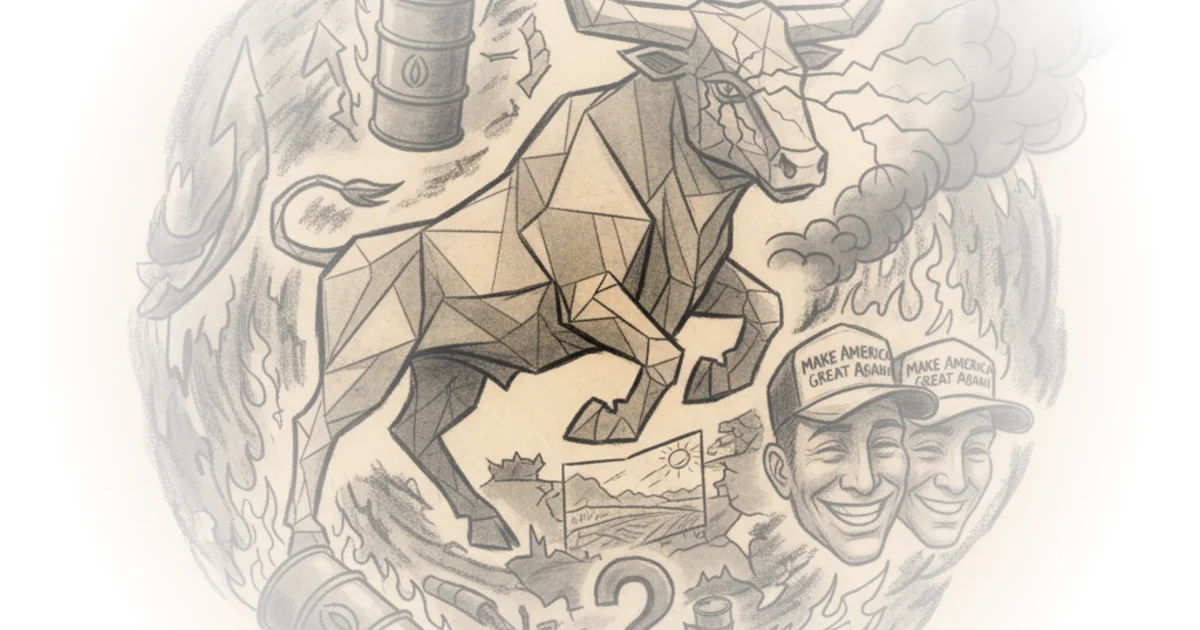
The author draws a sharp parallel to the recent Milken Institute conference, where the mood was one of "blissful ignorance." Despite the war with Iran driving up petrol prices and dividing the Federal Reserve, financiers were "gliding between Spago dinners" and parties at billionaires' homes. Tooze captures the chilling apathy of the room with a quote from a high-powered banker: "Does anyone really care if the Strait of Hormuz is open?" This question is not just rhetorical; it reveals a profound detachment from the geopolitical reality that threatens the global supply chain. The elite are not just ignoring the war; they are actively desensitized to it.
"They might not like a lot of what's happening in Washington, but at the end of the day, everyone's focused on their own investment portfolios, especially here."
This sentiment, voiced by Ted Koenig of Monroe Capital, underscores a K-shaped economy where the wealthy are insulated from the chaos. Tooze notes that while the US market basks in AI-fueled optimism, Europe remains cautiously skeptical. The US is effectively living in a bubble, believing that the conflict thousands of miles away will not touch them. But as the article reminds us, the US is an active participant in this war, and the cost of that participation is being deferred, not erased.
The AI House of Cards
The core of Tooze's argument lies in the mechanics of the current stock market boom. It is not a broad-based recovery; it is a narrow, self-feeding loop driven by a handful of tech giants. He cites a UBS analysis showing that only 42 stocks are driving the bulk of the S&P 500's returns, a stark contrast to the typical 100. The market is up 12% since March, but this growth is entirely dependent on the AI narrative.
Tooze dissects the financials of these hyperscalers—Alphabet, Amazon, Microsoft, Meta—and reveals a disturbing truth: their earnings are being propped up by the inflated valuations of their own private investments. He writes, "Alphabet booked $37.7bn of 'other income' in just the first three months of the year, accounting for over half the company's net income." This is not organic growth; it is a circular economy where money flows from the cloud business to AI startups, which then inflate the value of the parent company's stakes, which in turn boosts the parent company's earnings. As Goldman Sachs analysts noted, nearly 60% of the income for Alphabet and Amazon in Q1 2026 came from these equity stakes.
"The hyperscalers' earnings growth this quarter was boosted by an unusually large contribution from equity stakes in private companies... This represents the group's largest collective share of earnings attributable to 'other income' in at least a decade."
This creates a feedback loop where the AI companies, funded by their cloud sponsors, sign huge computing deals with those same sponsors. OpenAI and Anthropic now make up about half of the entire cloud computing order books for the major players. Tooze argues that this is not a sustainable boom; it is a "black box" of self-referential valuation. If the music stops, the dance ends. The risk is that the entire retirement system has been levered to the performance of Nvidia and its peers, as private equity boss Marc Rowan quips.
Critics might argue that this valuation is justified by the transformative potential of AI. However, Tooze counters that even on narrow self-interest, a boom sustained by only a handful of stocks ought to be worrying. The polarization is set to intensify, with AI making a few rich while the majority face unprecedented adjustment shocks. The graph of the moment, first published by the Dallas Fed, shows the US economy either spiraling to infinity or collapsing to extinction. There is no middle ground.
The Moral Hazard of the 'Bliss Trade'
The final piece of the puzzle is the policy response. Tooze introduces the concept of the "Bliss trade," a term coined by Gita Gopinath. The markets don't believe everything is well; they believe that if things go wrong, the government will bail them out. This moral hazard has become structural. Since 2020, fiscal policy has reacted to every crisis with "big lasting state support," from the pandemic to the Ukraine war and now the Middle East conflict.
This has led to a dangerous buildup of risk. Global public debt is projected to reach 100% of GDP by 2029. The urge to rush to the rescue, regardless of merit, was evident in the administration's attempts to bail out Spirit Airlines. Tooze notes that while the bailout didn't go through, the intent was clear: "I'd love to be able to save an airline." This mindset suggests that in a real crisis, government support would be excessive, further inflating the bubble.
"The Bliss trade is reflected in the divergence between the prices of stocks and government bonds. While equity markets have held up surprisingly well, government bonds have suffered even as long-run inflation expectations have stayed mostly anchored."
This divergence is a warning sign. Term premia on 10-year US treasury yields are now close to 100 basis points higher than before the pandemic, driving up the interest rate bill. The IMF predicts that in a severe scenario, the Iran conflict could cause global growth to fall to 2% and global debt to rise past 120% of GDP. The scope for fiscal largesse is limited, yet the market remains sanguine. Tooze warns that if investors wake up to the reality of the world, the consequences could be severe. The bond vigilantes may be in abeyance, but they are not gone.
Bottom Line
Tooze's analysis is a masterclass in connecting the dots between geopolitical chaos, financial engineering, and policy failure. The strongest part of his argument is the exposure of the circular logic behind the AI boom, revealing it as a fragile house of cards rather than a robust economic engine. His biggest vulnerability, however, is the assumption that the market will eventually "wake up"; history shows that bubbles can persist far longer than fundamentals suggest. The reader must watch for the moment when the bond market stops ignoring the debt and the energy crisis, for that is when the cognitive dissonance will finally break.
"It is as though we were living through the Cuban missile crisis and no one even notices. Is it not time to wake up?"
The stakes are not just financial; they are existential. The current path leads to either a Mars-like leap forward or a collapse to the stone age. There is no middle ground, and the time for denial is over.