This piece cuts through the myth of inevitable technological triumph to reveal a stark reality: the United States, despite leading the world in nuclear physics, was the last of the major powers to deploy commercial nuclear power. The author, drawing heavily on Richard Rhodes' historical account, argues that this delay wasn't a failure of engineering, but a deliberate consequence of national security priorities that treated electricity as a secondary concern to the bomb. For a reader trying to understand why energy transitions often stall despite clear scientific advantages, this distinction between technical capability and political will is essential.
The Priority of the Bomb
The narrative begins by grounding the reader in the immediate post-war reality, where the atom was viewed almost exclusively as a weapon. The author notes that while the first man-made reactor went critical in 1942, it took fifteen years before the U.S. generated nuclear electricity in any quantity. "Fifteen years would pass before nuclear electricity was generated in any quantity in the United States," the text observes, a delay that seems "rapid development or surprising delay, depending upon one's perspective." This framing is crucial; it forces the reader to abandon the linear assumption that scientific discovery automatically leads to commercial application.
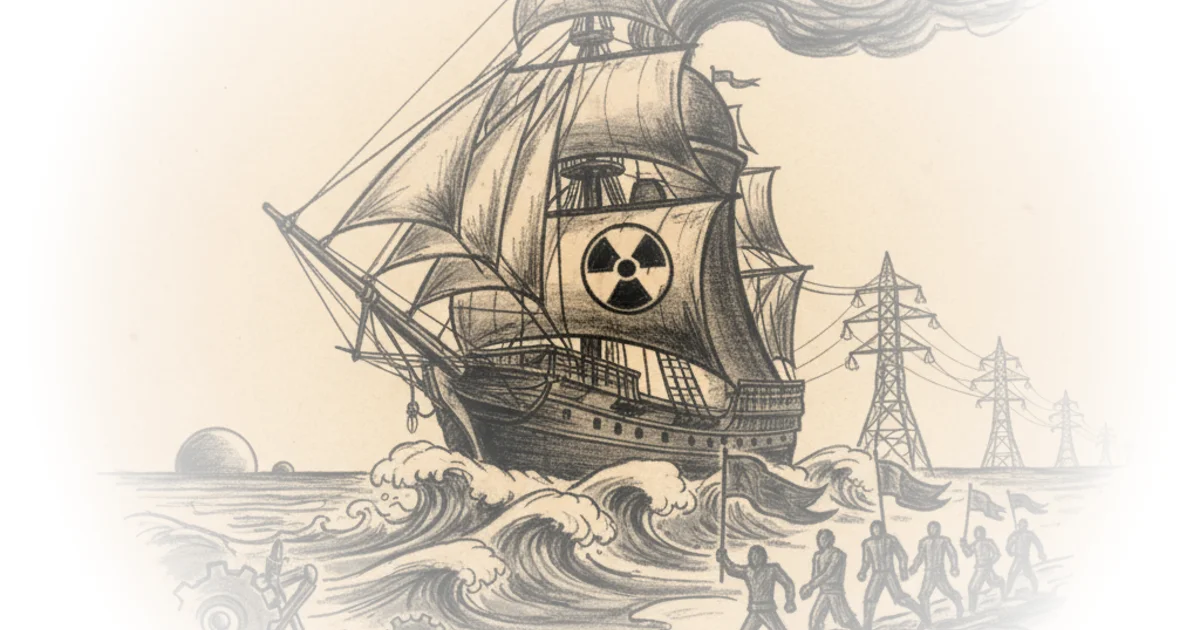
The article effectively dismantles the idea that the U.S. was slow because it lacked the know-how. Instead, it highlights how the "Tolman Committee" in 1944 explicitly advised against commercial power, finding that "the development of fission piles solely for the production of power for ordinary commercial use does not appear economically sound nor advisable from the point of view of preserving national resources." Here, "national resources" was a euphemism for fissile material needed for the arsenal. The author's point lands hard: the government wasn't ignoring power generation; it was actively hoarding fuel for the Cold War. Critics might argue that the economic calculations of the 1940s were too conservative, but the author correctly identifies that the scarcity of enriched uranium made the choice a zero-sum game between a submarine engine and a lightbulb.
"As a result of this cold war and this armaments race, the American atomic energy program has been largely a weapons program carried on in secrecy and with the utmost urgency."
This quote from Gordon Dean, chairman of the Atomic Energy Commission, encapsulates the era's mindset. The author uses this to explain why the U.S. lagged behind Great Britain and the Soviet Union in commercial deployment. The "balance of terror" hadn't just struck a political chord; it physically diverted the raw materials and engineering talent away from the grid. The argument is strengthened by the detail that in 1953, atomic facilities making weaponry consumed 2.5 percent of the entire national electricity supply—a staggering inefficiency driven by fear.
The Architecture of Secrecy
The commentary then shifts to the legal and institutional barriers erected to protect the technology. The author describes the Atomic Energy Act of 1946 as creating "the most totalitarian governmental commission in the history of the country." This is a bold claim, but the text backs it up with the act's provision that all atomic discoveries were "born secret" and that "no one might build or operate a reactor except under government contract." By monopolizing the technology, the government ensured that the private sector could not innovate or compete until the state decided to release the reins.
The author contrasts the U.S. approach with international peers. While Canada and Britain pursued natural uranium and heavy water or graphite, the U.S. doubled down on enriched uranium and light water, a choice driven by the Navy's needs rather than grid efficiency. "The United States ultimately chose enriched uranium and light — ordinary — water, and in this way also, power initially would compete with weapons for the existing uranium supply," the text explains. This technical detail is vital; it shows how the specific engineering path chosen for military vessels (submarines) dictated the commercial path for decades. The author suggests that this military-first design philosophy created a system where civilian power was always an afterthought, a "thing to send home" to satisfy restless congressmen rather than a primary national goal.
The Rickover Factor
The narrative culminates in the rise of Admiral Hyman Rickover, the singular force who bridged the gap between military necessity and civilian power. The author portrays Rickover not just as an engineer, but as a relentless political operator who "operating out of his own hip pocket" managed to force the Atomic Energy Commission to fund a submarine reactor. The text notes that Rickover was "largely responsible for the submarines that" defined the nuclear standoff, implying that his influence was the catalyst that eventually allowed the technology to spin off into the commercial sector.
The author's coverage of Rickover is nuanced, avoiding hagiography while acknowledging his unique ability to navigate the "uneasy nuclear standoff." By focusing on Rickover's ability to bypass bureaucratic inertia, the article illustrates how institutional change often requires a singular, disruptive individual. The text quotes Oppenheimer's 1957 reflection on the era: "There are overtones in this development that have been absent in power developments in other respects not wholly beyond comparison, such as the diesel engine and the gas turbine: overtones of pride and terror, of mystery and hope." This quote serves as a perfect thematic anchor, reminding the reader that nuclear power was never just about kilowatts; it was about the psychological weight of the atom.
"There are overtones in this development that have been absent in power developments in other respects not wholly beyond comparison, such as the diesel engine and the gas turbine: overtones of pride and terror, of mystery and hope."
A counterargument worth considering is whether the author gives too much credit to Rickover and the Navy, potentially downplaying the role of broader industrial lobbying or the eventual economic inevitability of nuclear power. However, the text's focus on the specific bottleneck of fuel scarcity and legal monopoly makes a strong case that without Rickover's specific intervention, the timeline for commercial power might have been even longer.
Bottom Line
The strongest part of this argument is its refusal to treat the delay in U.S. nuclear power as a technical failure, instead exposing it as a calculated strategic sacrifice for weapons production. The piece's biggest vulnerability is its heavy reliance on historical narrative, which, while compelling, offers limited insight into how these institutional dynamics might play out in future energy transitions. Readers should watch for how current energy policies are similarly shaped by security concerns rather than pure economic efficiency, a pattern this history suggests is likely to repeat.