The Problems with Causality: Rethinking Beyond Good and Evil"}{Nietzsche Rejects the Isolated Philosopher
In chapters 20 and 21 of Beyond Good and Evil, Nietzsche makes a argument that seems almost anti-intuitive to modern readers: philosophers are not independent minds freely reasoning in space. They are shaped by their culture, history, language, emotions, and upbringing.
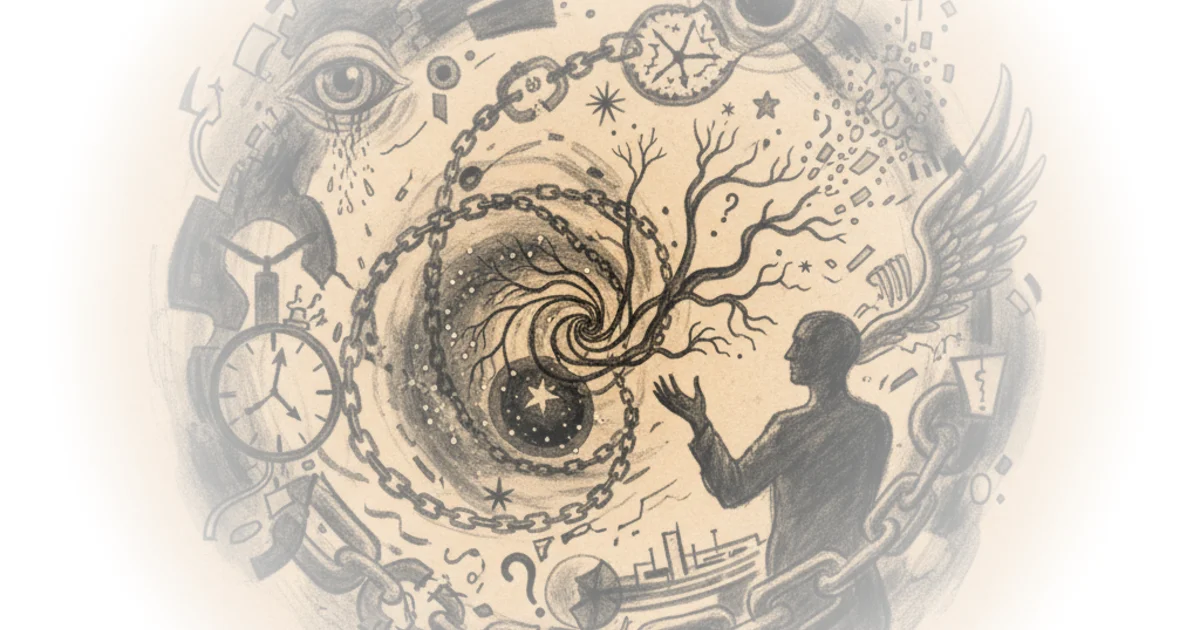
This isn't just metaphor. Nietzsche insists that philosophical ideas don't emerge in isolation. They grow in connection to each other, much like species on a continent belong to a fauna. When new philosophies appear to revolutionize thought, they're actually just coloring within the bounds of what was already possible. The range is set by culture and history.
"Philosophizing is so far a kind of adventurism of the highest order" — the notion that historical traits return, either literally or figuratively.
Nietzsche argues that even groups of philosophers who seem to make radically different arguments are simply reorganizing, remembering, and returning to ancient patterns of thought. They don't discover truth from outside the universe. They rearrange what was already there.
The Grammar of Thought
Why does this matter now? The intellectual climate of Europe was shifting in ways Nietzsche wanted to capture. Philology — the study of language — had just been revolutionized by colonial expansion into India.
European scholars discovered something startling: Indian languages and European languages shared common roots. The word "ignite" appeared in ancient Vedic texts as a fire god, yet lived in European languages thousands of years later with similar meaning. This wasn't coincidence. It was evidence of shared linguistic ancestry — the Indo-European language family.
Nietzsche seized this insight to make a larger point: your grammatical structure shapes how you perceive reality. If your language has underdeveloped concepts of subject and object, you will see the world differently than speakers of other languages.
This is what Nietzsche calls "the spell of certain grammatical functions" — a physiological influence, not merely psychological. Your grammar shapes your mind at a fundamental level. You cannot escape it.
Some Native American languages are verb-focused rather than noun-focused. The world isn't filled with things — it's filled with happenings. This raises questions about whether we can think without subject-object relationships, and how much gets lost in translation between radically different grammatical structures.
The Collapse of Cause and Effect
Nietzsche doesn't stop at language. He attacks the entire debate philosophers consider fundamental: free will versus determinism.
He considers both positions to be mistakes. Free will is a "monstrous conception" that should be put out of your head. But so should its opposite — not-free-will. The entire debate misunderstands causality itself.
Nietzsche calls this "a misuse of cause and effect." He rejects the mechanical philosophy that treats causes as physical things, existing like objects in the world. He's attacking the prevailing notion that cause-and-effect operates like billiard balls colliding — mechanical, deterministic, predictable.
This is part of a systematic dismantling: no free will, no determinism, no abstraction, no foundational assumptions. Just step by step, Nietzsche removes every pillar beneath traditional philosophical thinking.
Counterarguments worth considering:
Some philosophers would push back on the idea that grammar shapes thought so fundamentally. The strongest counterargument suggests we can escape our linguistic conditioning through education and multilingualism — that consciousness isn't trapped by grammar alone."}{Nietzsche's argument is powerful but incomplete. He assumes culture determines philosophy, yet individual genius has always broken through cultural . His case for grammatical determinism relies on examples from linguistics rather than rigorous philosophical . The strongest critique: his own prose demonstrates that language doesn't imprison thought — it enables creativity beyond mere repetition.
The biggest vulnerability: Nietzsche rejects every position without building one. He tears down but never constructs what comes next. Readers looking for positive claims leave empty-handed.