Jeffrey Kaplan reframes the ultimate test of leadership not as technical mastery, but as the radical power of giving reasons. By dissecting the harrowing emergency landing of Qantas Flight 32, he argues that the captain's ability to persuade terrified passengers through logic, rather than vague reassurance, was the true skill that saved lives and sanity.
The Anatomy of a Miracle
Kaplan begins by painting a visceral picture of the crisis: an Airbus A380, the world's largest commercial jet, suffering a catastrophic engine explosion that shredded the wing and punctured fuel tanks. The narrative details how Captain Richard De Crespigny (referred to as Decrepney in the transcript) faced a cockpit screaming with alarms and a wing bent "like a sardine can." Yet, Kaplan's focus quickly shifts from the mechanical failure to the human response. He notes that while the crew possessed immense technical dexterity, their survival hinged on something far less tangible.
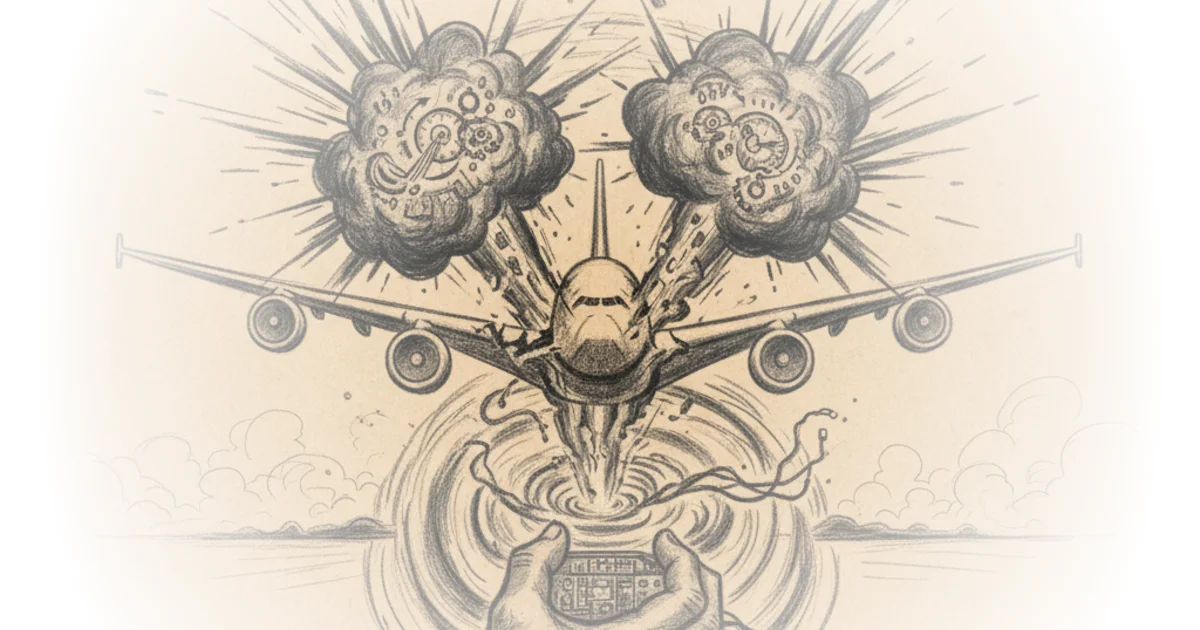
The author writes, "The difference between a good pilot and a great pilot consists in the possession of a whole body of wide ranging fundamental intellectual skills." This is a provocative claim in a field dominated by checklists and automation. Kaplan suggests that the ability to reason under pressure—specifically the capacity to explain why a decision is being made—is what separates a competent operator from a true leader. He argues that De Crespigny's decision to perform "in-flight control checks," a maneuver never taught for commercial airliners, was a triumph of reasoning over rote procedure.
"If you're the boss and you have to order someone to do something, you've already failed."
This insight into leadership is the piece's emotional core. Kaplan illustrates that De Crespigny didn't just command his crew; he persuaded them to accept a dangerous, unorthodox plan by laying out the logical necessity of testing the wing's lift at altitude rather than risking a crash landing. The crew followed not because of rank, but because the captain provided the reasons that made the risk calculable.
The Power of Explanation
The commentary deepens as Kaplan turns to the passengers. He contrasts the captain's transparency with the likely response of a corporate public relations team. While a PR statement might offer a hollow "our priority is safety," De Crespigny provided the gritty details: the fuel leaking ankle-deep, the burning brakes, the risk of broken hips during an evacuation.
Kaplan writes, "A reason is a fact or piece of information revealed at the right time. It's a fact that pilots do engine failure training every 3 months. But if you hear that fact immediately after an engine failure, it's not just a fact. It's also a reason to think that you are safe." This distinction is crucial. The author posits that vague reassurances fail because they ask for trust without earning it, whereas specific facts allow listeners to construct their own sense of safety.
The text highlights a moment where a passenger asked why they had to sit on the runway for two hours in the heat without air conditioning. Instead of a bureaucratic deflection, the captain explained the danger of walking through jet fuel and the risk of fire from hot brakes. Kaplan observes, "If you say the right facts at the right time in the right order, then their mind, the seat of their consciousness and beliefs and desires, you alter it." The result was passengers smiling and defending the airline after a near-disaster.
Critics might argue that this level of transparency is a luxury of a single charismatic leader and that most organizations cannot replicate such honest communication without fear of liability. However, Kaplan's point stands that the absence of reasons creates panic, while their presence creates calm, regardless of the setting.
"If you are good enough at giving reasons, then you can change someone's mind."
The Liberal Arts in the Cockpit
Kaplan concludes by connecting this aviation miracle to the value of a broad education. He suggests that the skills De Crespigny used—persuasion, debate, negotiation, and logical synthesis—are the very skills cultivated by a liberal arts curriculum, not just flight school. He writes, "The story of Captain Richard De Crespigny and Qantas Flight 32 is a story about the immense power of one of those intellectual skills... the absurd immense power of the giving of reasons."
The author challenges the modern obsession with specialized technical training, implying that in a crisis, the ability to think broadly and communicate clearly is the most vital asset. He notes that De Crespigny kept answering questions "until they didn't have any questions left," a feat of patience and intellect that turned a potential riot into a moment of shared relief.
Bottom Line
Kaplan's argument is a compelling reminder that in high-stakes environments, clarity is a form of safety. While the technical execution of the landing was miraculous, the piece's strongest insight is that the captain's ability to explain the why behind every decision was what truly stabilized the situation. The vulnerability of this argument lies in its reliance on a single, exceptional individual; it remains to be seen if this philosophy of radical transparency can be systematized in a world that often prioritizes risk-averse corporate messaging over human connection.