This piece from Compact Magazine does something rare: it rescues a literary figure from the shadow of his own legacy, arguing that Stefan George was not a precursor to Nazism but a complex, hermetic poet whose circle offered a sanctuary for those the regime would later persecute. For the busy reader seeking to understand the intellectual roots of modern Germany beyond the usual political binaries, the article offers a startling re-evaluation of how art, mentorship, and political extremism intersected in the early 20th century.
The Myth of the Nazi Prophet
The article immediately challenges the standard historical narrative that casts George as the "Antichrist in the age of democracy." Instead, Compact Magazine reports that George's life is often misunderstood as a "secret passageway connecting" the end of the 19th century with the "Nazi book burnings of 1933." The piece argues that this linear connection is a distortion. While George was a critic of liberal democracy, describing it as "a cold and disfigured humanity," his vision was not the racist mass movement that eventually triumphed. In fact, the editors note that his work can be cited as a critique of Nazism, and many of his disciples read it this way.
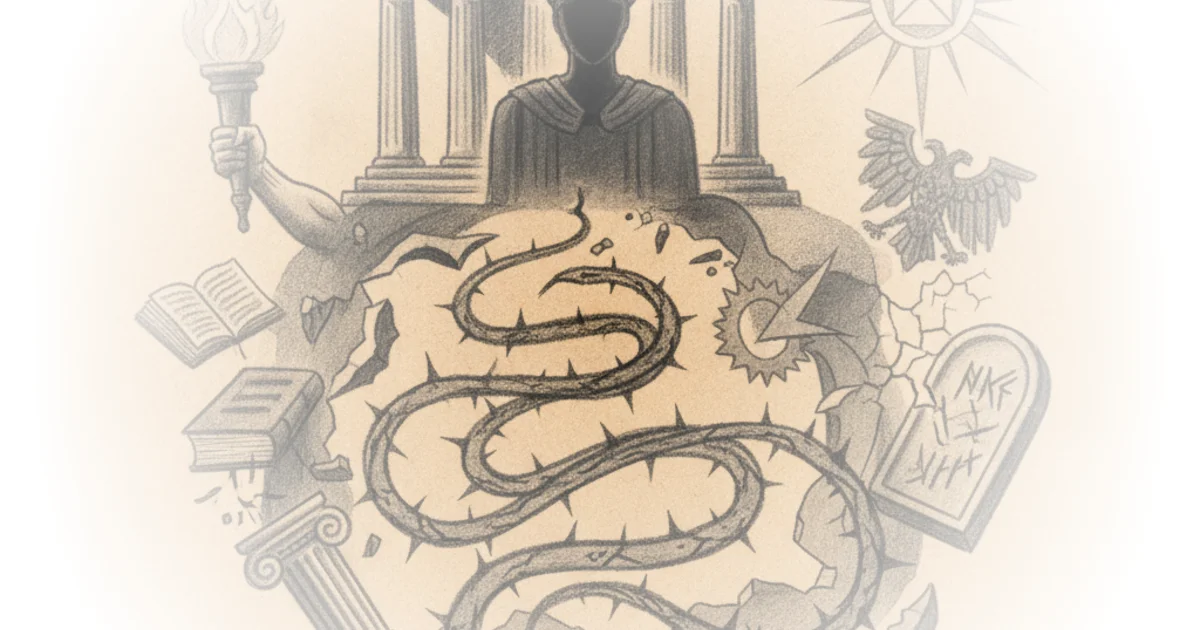
This reframing is crucial. It suggests that the intellectual climate of the time was far more fractured than a simple slide into fascism. The article highlights that the "George Circle" was a sanctuary for Jewish intellectuals and homosexual poets, and that even after the Nazi rise to power, these followers "never forsook the wisdom of their 'Master'." They carried his teachings into exile, nurturing future generations of critics in American universities. This detail complicates the easy label of "cult leader" often applied to George, suggesting a more nuanced relationship between aestheticism and political survival.
"George was not a political theorist; he was the most respected German poet of his time. His name belongs in literary anthologies alongside Rainer Maria Rilke and Thomas Mann."
Critics might note that downplaying George's political influence risks ignoring how his aristocratic ethos and anti-modernist rhetoric provided fertile ground for the very ideologies he may have despised. The swastika, a symbol the Circle used on their book covers as a trademark of approval, is a stark reminder that their "secret kingdom" was not entirely separate from the rising tide of völkisch ideology, even if George himself rejected the Nazi party. The article acknowledges this tension, noting that some followers did remain committed to the regime, but insists the core group remained distinct.
The Architecture of a Secret Germany
The piece delves into the peculiar, almost ritualistic nature of George's world, describing his physical appearance and his unique approach to language as a form of resistance against the "mechanical" and "shadowlike" nature of modern life. Compact Magazine reports that George "omitted articles, replaced semicolons and periods with a two-dot ellipsis," and used lowercase letters for nouns to create a "private language." This hermeticism was not merely eccentric; it was a deliberate attempt to transcend the "instrumental and degraded character of communicative language."
The article draws a fascinating parallel between George and Max Weber. It reveals that Weber's famous concept of "charisma"—the authority of a divinely inspired individual—was first applied in a letter to describe the "utterly absurd" cult George built around a dead teenager. This teenager was Maximilian Kronberger, a Jewish boy George fell in love with at age thirteen. The connection to Kronberger is pivotal; his death from meningitis at sixteen transformed George from a poet into a prophet. The piece notes that George published a memorial album where Kronberger was renamed "Maximin," embodying "almighty youth just as we had dreamed it."
This section is particularly potent because it links the personal tragedy of a specific individual to a broader philosophical crisis. The article references the companion topic of Maximilian Kronberger to ground the abstract concept of "the beautiful life" in a real, tragic human story. It suggests that George's "transvaluation of values" was a desperate attempt to find meaning in a world Weber described as an "iron cage" of specialists without spirit.
"He restored our confidence and filled us with the light of new promises... he showed us things as they are seen by the eyes of the Gods."
The article also touches on the aesthetic dimensions of this movement, describing the "Gesamtkunstwerk" (total work of art) created with graphic artist Melchior Lechter. The publication of The Tapestry of Life in 1900, with its wooden boards and medieval incunabula styling, was a rejection of commercial publishing standards. This attention to detail reinforces the argument that George's movement was about creating a self-contained spiritual reality, one that stood in opposition to the "soullessness of the human race."
The Teacher and the Disciple
In its final analysis, the piece posits that George's legacy is most relevant today not as a political figure, but as a model of mentorship in an era where education is increasingly vocational. The article argues that in a time when "the mind confronts its technological obsolescence," George appears as an "iconoclastic sage." The relationship between George and his disciples, such as Friedrich Gundolf, was based on "Allegiance and Discipleship," a concept that rejected the modern cult of individual autonomy.
Gundolf, described as George's "first and proudest creation," wrote that the righteous man "rejoices in making himself into fuel for a higher flame." This radical submission is presented not as a weakness, but as a form of spiritual strength that modern individualism has lost. The article suggests that the "spiritual kingdom" of the George Circle, impervious to analytical observation, offers a counter-narrative to the bureaucratic and surveilled nature of contemporary academic life.
"The disclosure of these laws and the proclamation of what Wolfskehl called a 'Secret Germany' taking shape, under George's guidance."
However, the piece does not shy away from the darker implications of this dynamic. The "boyishly handsome" selection criterion for followers and the intense, quasi-religious devotion required raise questions about the boundaries of mentorship. The article acknowledges that George has long been regarded as a "megalomaniacal cult leader," and while it seeks to rehabilitate his image, it cannot fully erase the ethical ambiguities of his relationships with young men.
Bottom Line
Compact Magazine's editorial succeeds in disentangling Stefan George from the Nazi narrative that has long overshadowed his literary achievements, presenting him instead as a tragic, complex figure whose circle offered a rare refuge for the marginalized. The strongest part of the argument is the revelation of the George Circle's role as a sanctuary for Jewish and homosexual intellectuals, challenging the assumption that all anti-modernist movements in Germany were inherently antisemitic. However, the piece's biggest vulnerability lies in its tendency to romanticize the "Secret Germany" without fully grappling with how its elitist, anti-democratic ethos inadvertently paved the way for the very authoritarianism it sought to avoid. Readers should watch for how this nuanced view of George's legacy influences current debates on the role of art and mentorship in a technocratic age.