Alberto Romero delivers a jarring prediction for the digital age: the era of fooling human readers with artificial intelligence is ending, not because humans will suddenly become smarter, but because the gatekeepers of the internet are becoming machines. While most commentary focuses on AI as a productivity hack, Romero argues it is an existential threat to personal relevance, positing that in a world saturated with synthetic content, the only way to survive is to build a brand that appeals to the algorithms themselves. This is not a warning about job displacement, but a strategic pivot for anyone who relies on digital visibility to exist.
The Death of the Human Audience
Romero's central thesis rests on a shift in the target audience. He observes that while humans are easily duped by high-volume, low-effort content, the agents that will soon mediate our online interactions are not so easily fooled. "Humans can't tell the difference between your work and your slop... but AIs definitely can," he writes. This distinction is the crux of his argument: the bottleneck of the internet is shifting from discoverability to quality verification. In the past, the challenge was getting found; in the future, the challenge is proving you are worth the computational cost of being read.
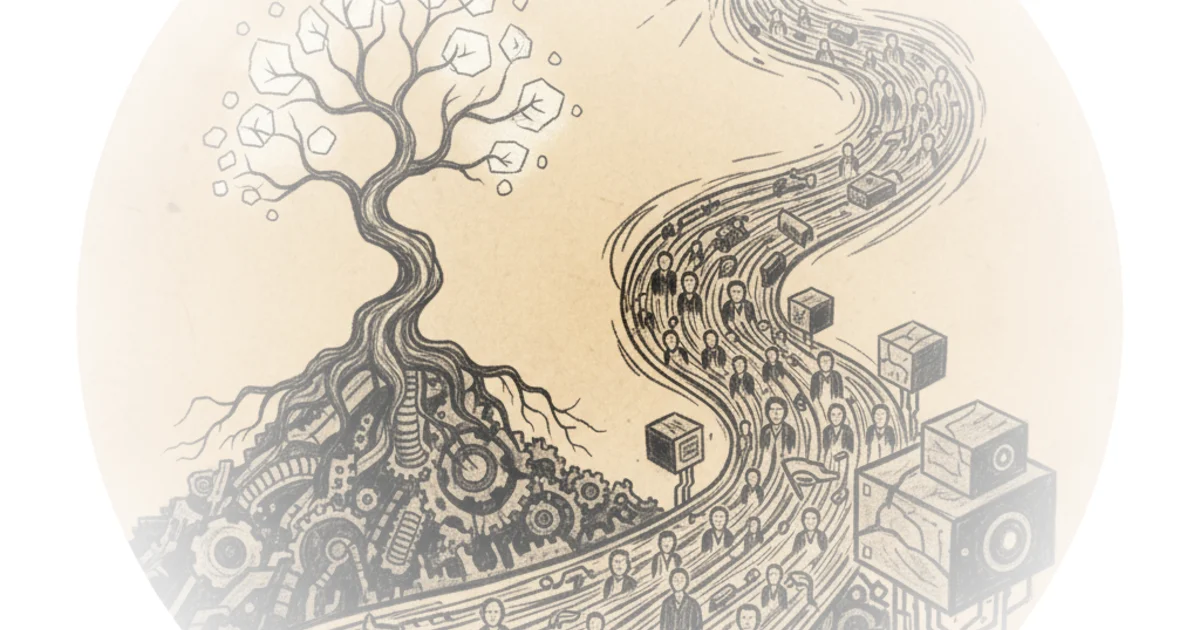
He frames the current reliance on AI as a short-term gain with long-term consequences. "If you do that, you will find yourself deep in brand debt in a few years," Romero warns. This concept of "brand debt" is a powerful reframing of the efficiency trap. It suggests that every time an individual or business outsources their unique voice to a model to save time, they are borrowing against their future credibility. The argument holds weight because it anticipates a future where the "buy side" of the economy also uses agents, creating a feedback loop where only the most distinct, human-originated signals get through the noise.
Critics might argue that Romero underestimates the ability of humans to curate their own feeds or that the "slop" will eventually be so refined that the distinction between human and machine becomes irrelevant. However, the economic logic of the piece suggests otherwise: if the cost of generating content drops to near zero, the value of verification skyrockets.
"In a sea of slop, having a slop-proof suit is a must."
The New Economics of Authenticity
To illustrate the necessity of a conscious personal brand, Romero draws on historical precedents of identity engineering. He points to Steve Jobs, noting how "Apple's brand, the most valuable corporate brand on earth at the time, rode on the back of a personal one," specifically the image of Jobs in his black turtleneck. Similarly, he references Ernest Hemingway, who "built, on purpose, the image of the man who wrote in Paris cafés, boxed, fished, drank, went to wars and bullfights." These examples serve to ground his futuristic argument in the timeless reality that humans have always curated their public selves.
Romero argues that this curation is no longer optional. "To the extent that you have some amount of free will regarding your brand, it is limited to whether you build it consciously or not," he states. The implication is stark: if you do not actively construct your identity, you will be defined by the default settings of the AI tools you use. He suggests that the "Dead Internet Theory"—a concept explored in his companion pieces—is becoming a self-fulfilling prophecy for those who refuse to differentiate. The irony he highlights is that in an age of artificial intelligence, being genuinely human is the ultimate differentiator.
He challenges the reader to consider the future where AI agents act as filters. "The easiest heuristic is, of course, to ignore the slop," he explains, predicting that personal assistants will be programmed to discard anything that lacks a distinct human fingerprint. This shifts the strategy from "how to do things" to "what things to do," a fundamental reordering of priorities for any creator or professional.
The Trap of the "Slop-Proof" Illusion
Romero anticipates the counter-argument that one can simply edit AI output to make it human. He dismisses this as a temporary fix. "One year from now, how effective will your little tricks be against the power of a 2027 AI agent... that has been instructed to detect slop at all costs?" he asks. This forward-looking skepticism is crucial. It suggests that the arms race between generation and detection will favor the detection side, as the cost of running a sophisticated filter becomes negligible compared to the cost of generating content.
He identifies a specific group of thinkers—Andrej Karpathy, Scott Alexander, Gwern, Tyler Cowen, and Paul Graham—as the vanguard of this new reality. These are the "write for the AIs" crowd, individuals who understand that the medium is changing. Romero notes that "the only thing that could save you from being devoured by a shark agent... is a genuine distinction, as seen from an AI perspective." This is a profound insight: the definition of "quality" is being rewritten by the machines that will judge it.
"You are defenseless. Insofar as you depend on AI for everything, you are, essentially, cannon fodder."
The author's tone here is urgent, bordering on alarmist, but the underlying logic is sound. If the primary audience is no longer human, then human-centric metrics of success (like click-through rates or superficial engagement) become obsolete. The new metrics will be about depth, consistency, and the ability to withstand algorithmic scrutiny.
Bottom Line
Romero's most compelling contribution is the reframing of AI not as a tool for efficiency, but as a force that will render undifferentiated content invisible. His argument that "being findable used to be the hard part. Now it's the easy part. Being worth finding is the only thing that matters now" provides a clear, actionable directive for the future. The piece's greatest vulnerability is its assumption that AI agents will uniformly prioritize "humanity" over other metrics like speed or cost, but the economic incentives for filtering low-quality noise make this a highly probable outcome. For the busy professional, the takeaway is clear: the time to invest in a distinct, human-centric brand is before the algorithms decide you are irrelevant.