Brian Albrecht challenges a foundational assumption of modern economics: that the most efficient tax is always the best tax. In a piece that flips the script on standard policy advice, he argues that voters' hatred of "efficient" taxes like property levies isn't ignorance—it's a rational defense mechanism against a state that would otherwise grow without limit. This isn't just a debate about accounting; it's a warning that removing the friction from taxation might remove the brakes on government expansion.
The Efficiency Trap
Albrecht begins by highlighting a stark disconnect between professional consensus and public sentiment. While economists champion taxes on land because the supply is fixed, voters recoil at the idea of paying rent to the government on assets they already own. He notes that "the things voters hate about property taxes are the things economists love about them." This friction is usually dismissed as voter irrationality, but Albrecht suggests this dismissal is a convenient shortcut that ignores the political reality.
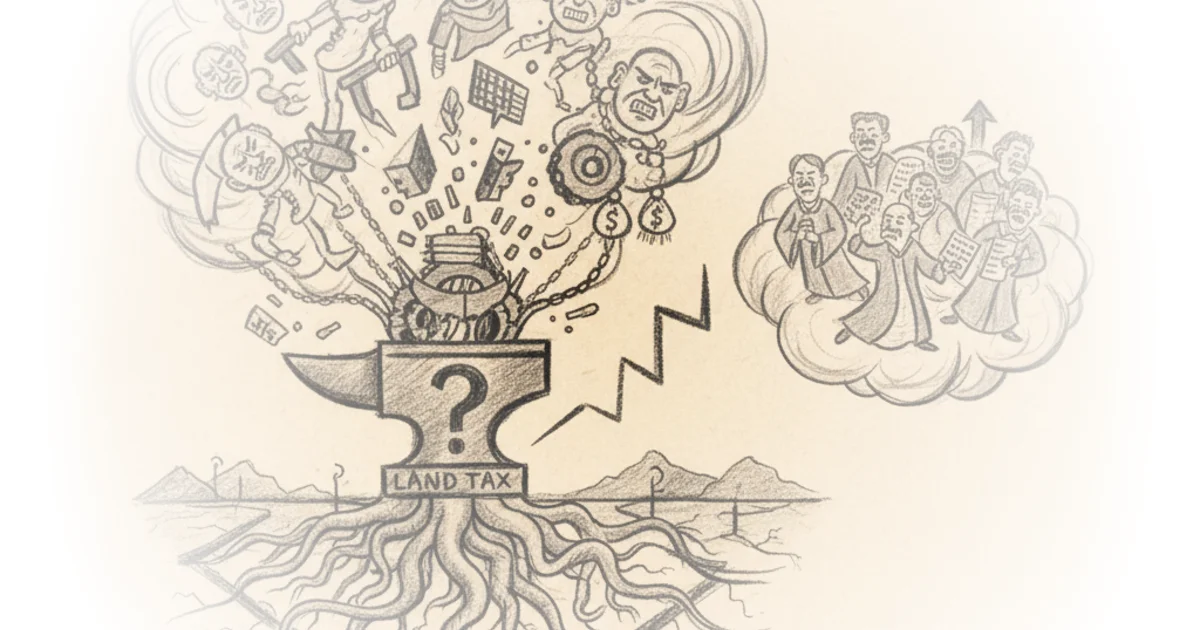
The author reframes the debate by introducing the concept of political economy. He argues that "Tax systems are never optimal, but that's its own kind of market efficiency at work." The core of his argument is that the "inefficiency" of a tax—its ability to cause pain or distortion—serves a vital function. It acts as a signal that mobilizes resistance. If a tax is too smooth and painless, taxpayers sleepwalk into higher rates. As Albrecht writes, "With inefficient taxes, you waste resources on deadweight loss, but you stay vigilant and keep rates low."
This perspective draws on historical attempts to implement pure land value taxes. He references Mike Bird's The Land Trap, which traces how Henry George's 19th-century "Single Tax" movement failed to take root in practice. The failure wasn't just political; it was structural. Real-world property taxes blend land value with capital improvements, creating the very distortions economists try to avoid. Albrecht points out that "If you tax buildings, people build less. If you tax renovations, people renovate less." This capital component creates deadweight loss, yet it is precisely this pain that keeps the tax politically contained.
The deadweight loss of inefficient taxes is the price of keeping Leviathan in check.
The Becker-Mulligan Insight
Albrecht then turns to the Becker-Mulligan model to explain the demand side of this dynamic. The model posits that "inefficient taxes create political resistance that keeps rates low." In a conventional view, a tax with low deadweight loss is superior because it raises revenue without distorting behavior. However, Albrecht argues that this efficiency removes the incentive for taxpayers to fight back.
He illustrates this with a stark trade-off: "An inefficient tax that raises $100 with $20 of deadweight loss costs you $120. An efficient tax that raises $200 with $5 of deadweight loss costs you $205." The rational voter, fearing the unchecked growth of an efficient tax system, may prefer the higher per-dollar cost of an inefficient tax to avoid the total revenue explosion of an efficient one. This logic extends to corporate taxes, which economists despise but voters tolerate. Albrecht notes that "corporate taxes can be partially avoided through transfer pricing, debt financing, and jurisdictional arbitrage," making them painful and politically contentious, which in turn keeps rates lower than they would be otherwise.
Critics might argue that this model romanticizes inefficiency, suggesting that the economic drag of bad taxes outweighs the political benefits of vigilance. While valid, Albrecht's point is that the political cost of an efficient tax is often hidden until it is too late to reverse.
The Friedman Defense
On the supply side, Albrecht applies David Friedman's logic on punishment to taxation. Friedman famously asked why we use prison instead of fines, arguing that fines are economically superior but prison prevents enforcers from becoming profit-driven predators. Albrecht applies this to the tax authority: "Prison protects defendants by making prosecution unprofitable for the state." Similarly, inefficient taxes make enforcement unprofitable for the government.
When a tax is easy to collect and hard to evade, the state has a strong incentive to extract every possible dollar. Albrecht writes, "When enforcement is profitable, the state enforces aggressively. Tax assessors have incentives to value your property at the highest defensible level." In contrast, complex taxes like corporate levies are expensive to audit and easy to game. The IRS knows that "auditing sophisticated corporate returns is expensive and often unsuccessful," so they pull back. This inefficiency acts as a natural cap on state aggression.
The synthesis of these two models suggests that what looks like a policy failure is actually a survival mechanism. Albrecht concludes that "Efficient taxes may be unstable: they either grow until they strangle the economy or provoke a political backlash that replaces them with something more painful." The current mix of taxes, with all their flaws, represents a selection process where the "pain" of the tax keeps the state in check.
Bottom Line
Albrecht's most compelling contribution is the redefinition of "efficiency" to include political sustainability, not just economic output. The argument's greatest strength is its ability to explain why smart voters reject theoretically superior tax policies. However, the model relies heavily on the assumption that voters can accurately gauge the long-term growth of government, a cognitive leap that may not always hold true. The takeaway for any observer of fiscal policy is clear: the friction in our tax system isn't a bug; it's the feature that prevents the state from consuming the entire economy.