Jay Kuo delivers a searing indictment of a reported military order that would shatter the most fundamental rules of armed conflict, framing a potential war crime not as a policy dispute but as a binary legal trap for the Secretary of Defense. The piece's distinctiveness lies in its refusal to let the administration hide behind the fog of war, instead using the administration's own legal manuals and historical precedents to demonstrate that the reported "double-tap" strike on survivors leaves no legal escape route.
The Legal Trap
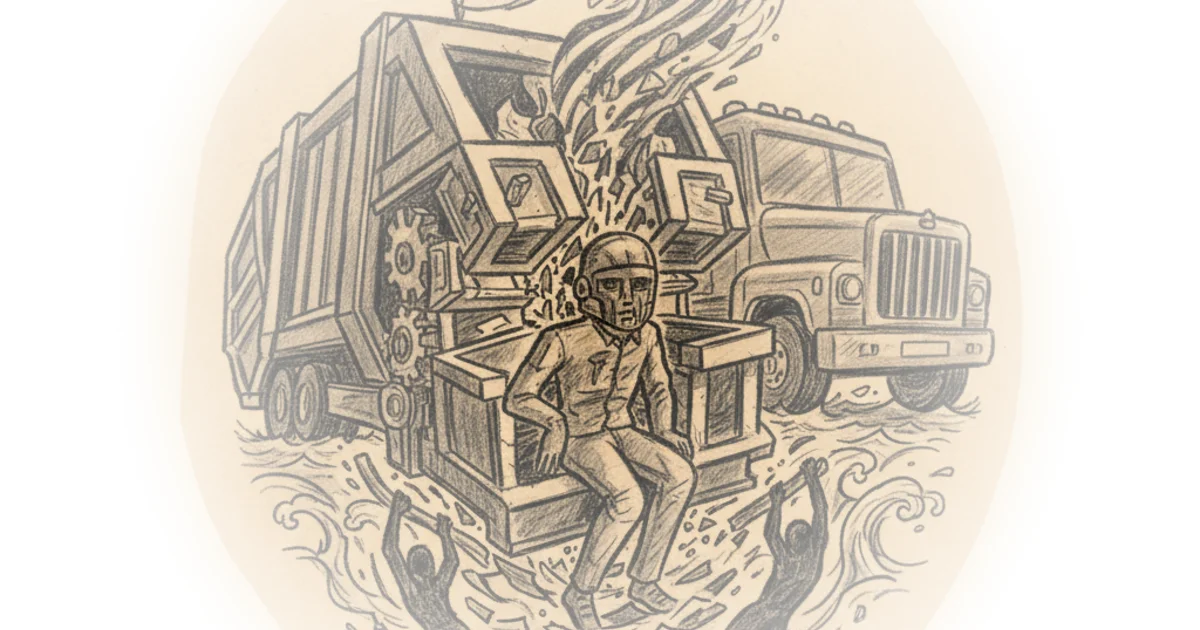
Kuo opens by asserting that the Secretary of Defense has stepped into a "political garbage compactor" following reports that he ordered SEAL Team 6 to "kill them all," including survivors clinging to the wreckage of a drug-smuggling vessel. The author argues that this specific order to fire on defenseless people violates a "bright line" in international law known as the prohibition on "no quarter." This framing is effective because it strips away political rhetoric to focus on a clear, historical standard of conduct that even the most aggressive military doctrines cannot legally override.
"Any way you slice this bread, Hegseth is toast."
The core of Kuo's argument rests on a "choose your poison" dilemma: if the operation is classified as a war, the order constitutes a war crime; if it is not a war, it is murder under U.S. law. He leans heavily on the testimony of a "Former JAG Working Group," which he notes was conveniently pushed out of oversight roles just before the strikes. Kuo writes, "In short, they are war crimes," citing the Department of Defense's own Law of War Manual which explicitly forbids firing upon the shipwrecked. This reliance on the executive branch's own internal legal documents is a powerful rhetorical move, making it nearly impossible for the administration to argue ignorance of the law.
Critics might argue that the classification of the operation as a "non-international armed conflict" is still contested, potentially muddying the war crime charge. However, Kuo anticipates this by pointing out that the alternative—admitting it was not a war—only strengthens the murder charge, leaving the official with no safe harbor.
"It was either a war crime or it was murder. Time to choose your poison, Pete."
Historical Echoes
To ground the severity of the allegation, Kuo reaches back to the Lieber Code of 1863 and the Hague Regulations of 1907, noting that the prohibition against killing those who have surrendered or are disabled is a "foundational principle of modern war." He draws a chilling parallel to the World War II Peleus War Crimes Trial, where German U-boat commanders were executed for ordering survivors to be fired upon while in the water.
"Whoever intentionally inflicts additional wounds on an enemy already wholly disabled, or kills such an enemy... shall suffer death, if duly convicted."
By invoking the Peleus trial, Kuo elevates the current event from a political scandal to a potential historical inflection point. He suggests that the legal principles used to convict Nazi commanders are the exact same ones that now threaten the current Secretary of Defense. This historical context adds necessary gravity, reminding the reader that these are not abstract legal theories but rules born from the bloodiest conflicts in human history.
The Congressional Reckoning
The piece shifts to the political fallout, highlighting a rare moment of bipartisan unity in Congress. Kuo notes that both the House and Senate Armed Services Committees have promised a "full accounting," with subpoenas likely to follow. He highlights the skepticism of military veterans in Congress, such as Rep. Seth Moulton, who called the idea that boat wreckage was a hazard to marine traffic "patently absurd."
"Mark my words: It may take some time, but Americans will be prosecuted for this, either as a war crime or outright murder."
Kuo argues that the administration's attempt to reframe the second strike as a safety measure for other ships is a transparent lie that experienced commanders will see through immediately. The author points out that the Joint Special Operations Command provided a different story to the White House than what was told to Congress, suggesting a deliberate obfuscation. This section effectively highlights the institutional friction: the military chain of command is now at odds with the political leadership that ordered the strike.
"The idea that wreckage from one small boat in a vast ocean is a hazard to marine traffic is patently absurd, and killing survivors is blatantly illegal."
The Erosion of Norms
Kuo does not let the reader forget that the Secretary of Defense has long expressed disdain for the very legal frameworks now being violated. He references a 2024 book by Hegseth titled "More Lethality, Less Lawyers," where the author argued against universal rules of war and suggested treating enemies with the same brutality they display.
"Should we follow the Geneva Conventions? What if we treated the enemy the way they treated us? ... If you do not, we will rip their arms off and feed them to the hogs."
This section is crucial because it connects the specific incident to a broader ideological shift. Kuo argues that Hegseth's past writings and his lobbying for pardons for soldiers convicted of war crimes were not just political posturing but a preview of his operational philosophy. The author suggests that the current crisis is the inevitable result of an official who has spent years arguing that legal oversight is an impediment to victory.
Critics might suggest that past writings do not prove a specific criminal intent in this instance, but Kuo counters by noting that the administration's own legal team has already flagged the order as illegal, making the "I didn't know" defense highly unlikely to hold up in court.
The Bottom Line
Kuo's strongest argument is the inescapable legal dichotomy he constructs: the order was either a war crime or murder, with no middle ground for the executive branch to hide behind. His biggest vulnerability is the reliance on uncorroborated reporting from the Washington Post, though he mitigates this by citing the consensus of legal experts and the administration's own contradictory statements. The reader should watch for the congressional hearings, which Kuo correctly identifies as a potential "mini-Nuremberg" where the truth about the "double-tap" will be tested under oath.
"Trump is now hiding behind what Hegseth supposedly told him. That way if and when the evidence shows otherwise, that Hegseth indeed gave an illegal double-tap kill order, Trump can claim Hegseth lied to him."