In a single column, The Pillar manages to bridge the gap between ancient Roman marble and the sharp edge of modern American canon law, asking whether the Church is losing its nerve or simply practicing a difficult art of discernment. The piece argues that the answer to political scandal isn't always the dramatic hammer of excommunication, but often a more nuanced, pastoral struggle that risks being misread as cowardice.
The Weight of Stone and History
The commentary opens by grounding the reader in the physical reality of the scala sancta in Rome, those marble stairs covered in wood that pilgrims climb on their knees. The Pillar notes that while tradition claims these were brought to Rome by St. Helena in the fourth century, "Tracing each step of the stairs' provenance isn't easy." The article highlights the historical ambiguity: the stairs were moved in 1589 and reinstalled in reverse order so that "workers' feet would not touch them."
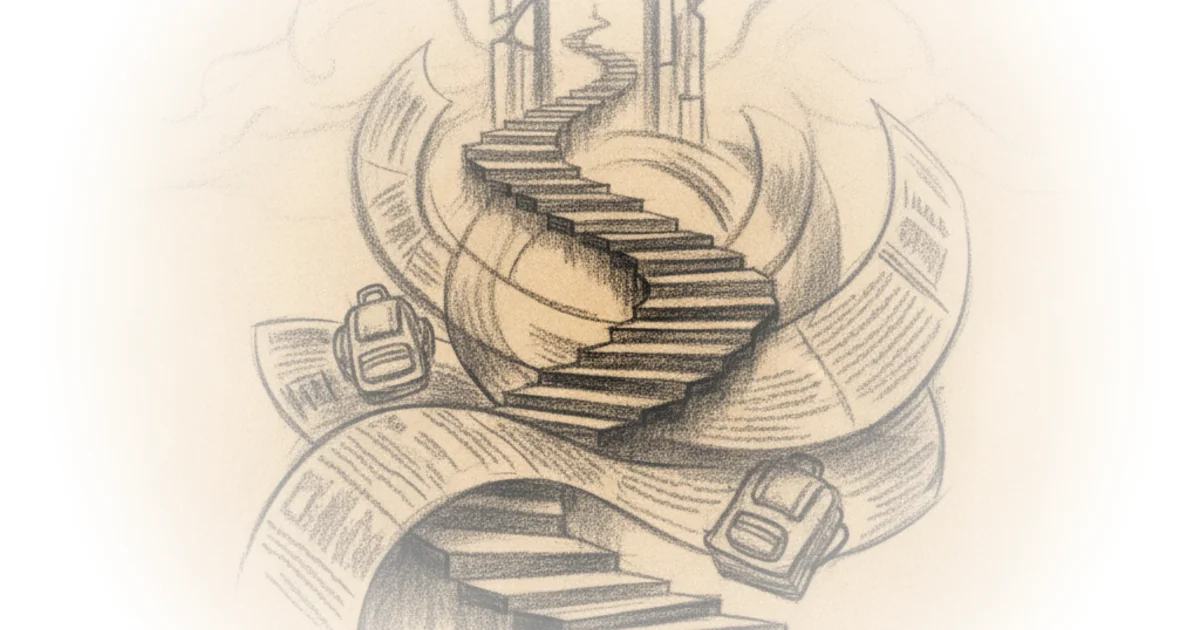
This historical uncertainty is not presented as a failure of faith, but as a feature of it. The piece suggests that the value lies not in the geological origin of the stone, but in the continuity of devotion. "It's enough for me... to remember the centuries of pilgrims taking those stairs as a kind of sacramental," the editors write. This framing is effective because it shifts the focus from forensic proof to spiritual witness. It reminds the reader that faith often operates in the space between historical certainty and lived experience. Critics might argue that such ambiguity undermines the authority of relics, but the piece counters that the "connection to Christ" is found in the act of the climb itself, not the quarry where the marble was cut.
It's enough for me, as with many relics of that era, to remember the centuries of pilgrims taking those stairs as a kind of sacramental, a place which calls to mind that Christ was really a man, who really came into this world.
The Politics of Excommunication
The column pivots sharply from ancient Rome to contemporary Massachusetts, addressing the controversy surrounding Governor Maura Healey's late-term abortion law. The Pillar reports that the advocacy group CatholicVote called for her excommunication, labeling her an "accomplice." However, the editors push back against this demand, arguing that canon law is a precise instrument, not a blunt political weapon. The piece explains that the notion of being an "accomplice" is a "strictly circumscribed thing" that requires a specific canonical crime to be interpreted "strictly."
Instead of the automatic excommunication demanded by activists, the article explores the more complex reality of Canon 1368, which allows a bishop to impose a "just penalty" when a Catholic in public "gravely harms public morals." The editors suggest that while this path is legally available, it is rarely taken. "The point is clear — while the CatholicVote approach doesn't seem to fit with the law's dictates, there are numerous canonical options available to the diocesan bishop," the piece argues. This analysis cuts through the noise of political theater to examine the actual mechanisms of church discipline.
The commentary acknowledges the frustration many feel when bishops appear silent. "It's commonly said... that when bishops don't so choose, it's obviously because of some kind of cowardice," the editors admit. Yet, they reframe this silence not as fear, but as a difficult pastoral calculation. "That's more art than science, and more genuine Christian discernment than either." This is a crucial distinction for busy readers trying to understand why the Church doesn't simply excommunicate every politician who disagrees with its moral teaching. It suggests that the Church is trying to balance the "salvation of the individual" with the "harm done to a community."
For good bishops of conscience, that's more art than science, and more genuine Christian discernment than either.
Institutional Anomalies and Global Persecution
The piece then touches on two jarring institutional developments: the appointment of Umberto Longo, a Freemason, to a Pontifical Committee for Historical Sciences, and the house arrest of Bishop Abelardo Mata in Nicaragua. The Pillar notes the irony of Longo's appointment, given that the Ancient and Accepted Scottish Rite of Freemasonry "can boast among its membership the guys who founded the Ku Klux Klan." The editors ask a pointed question: "whether the Church actually cares anymore what its law and history says about Freemasonry." This highlights a potential disconnect between Vatican appointments and traditional doctrinal boundaries.
Simultaneously, the column draws attention to the human cost of state persecution in Nicaragua, where Bishop Mata was detained after preaching against anti-Catholic policies. The editors note the grim reality of his "interview on a state-controlled TV station," where he claimed to be treated well, adding, "On the other hand, what else would you say during an interview on a regime-controlled TV station?" This section serves as a stark reminder that while Western Catholics debate canonical technicalities, bishops elsewhere are facing literal imprisonment for their faith.
On the other hand, what else would you say during an interview on a regime-controlled TV station?
Liturgical Formation and the Future of Worship
Finally, the commentary addresses Pope Leo XIV's recent emphasis on fidelity to liturgical rubrics. The piece highlights the Pope's letter urging that "through proper education and reverent worship, Catholics will be formed both for the liturgy and by the liturgy." This directive, issued to Cardinal Arthur Roche, signals a potential shift in how the Vatican approaches liturgical reform. The editors note that with Roche nearing retirement, this conference raises questions about the future direction of the Dicastery for Divine Worship.
The analysis suggests that the Church is moving away from the idea of liturgy as a flexible expression of individual preference toward a more formative approach. The goal is to ensure that worship shapes the believer, rather than the believer shaping the worship. This is a significant departure from the trends of the last few decades, suggesting a renewed focus on the objective reality of the liturgy.
Bottom Line
The Pillar's column succeeds by refusing to offer easy answers to complex ecclesial problems, whether they involve the historical ambiguity of a Roman staircase or the political scandal of a Massachusetts governor. Its strongest argument is that the Church's response to moral failure is a matter of pastoral art, not just legal enforcement, a nuance often lost in public debates. However, the piece's biggest vulnerability lies in its potential to be read as an apology for inaction by bishops who may simply be failing to lead. The reader should watch for how the new liturgical directives are implemented, as they may signal a broader shift toward a more disciplined, less flexible Church culture.