Most analyses of China's rise focus on recent trade wars or geopolitical posturing, but Shirvan Neftchi argues that the real story is a fifty-year experiment in turning a fractured agrarian society into the global industrial engine. The piece's most striking claim is that China's success wasn't an anomaly of communism, but a deliberate, brutal adoption of the very East Asian playbook that the West once used to contain it. For busy listeners trying to understand the current economic order, this reframing is essential: it suggests that the world's factory status was not an accident of cheap labor, but a calculated strategy of state-directed mercantilism that the United States inadvertently enabled.
The Cost of Centralization
Neftchi begins by dismantling the romanticized view of China's ascent, grounding it instead in a history of catastrophic failure. He notes that while the Qing Empire once accounted for a third of global GDP, "the industrial revolution took hold in the west... for china it was a disaster." The author details how the subsequent century of foreign incursions and internal rebellion left the state too fragmented to modernize until the communist takeover. Neftchi writes, "Mao being a military man designed an economic policy centered around military conflict," a mindset that led to the disastrous Great Leap Forward. The result was a famine that claimed up to 50 million lives, a stark reminder that ideological rigidity can be as destructive as any foreign invasion.
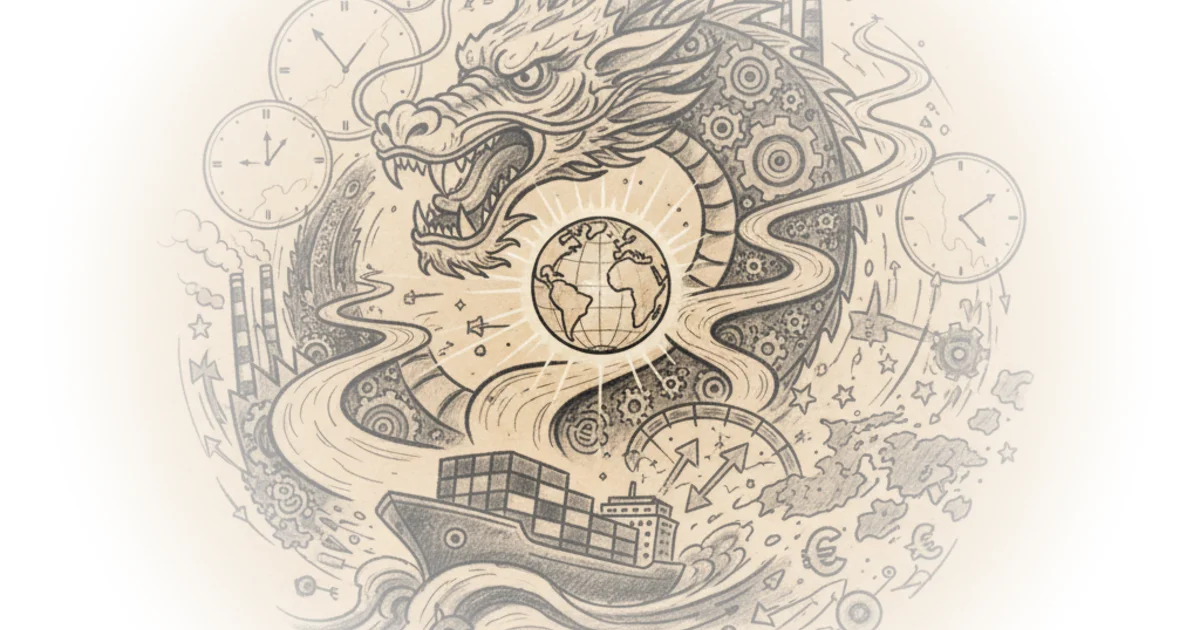
This historical context is vital because it explains why the later pivot was so radical. Neftchi argues that the Maoist era failed because it prioritized heavy industry and self-sufficiency over market realities, creating a system where "agricultural production was lagging" despite massive urbanization. The author's framing here is effective: it treats the famine not just as a tragedy, but as the necessary, albeit horrific, proof that the old model was dead. Critics might argue that Neftchi underplays the role of global isolation in these failures, but the evidence of internal mismanagement is undeniable.
Far from modernizing china mao's reckless policy making had squandered the country's potential
The East Asian Blueprint
The core of Neftchi's argument lies in the comparison between China and its neighbors. He posits that Japan, South Korea, and Taiwan succeeded because they followed a specific three-step pattern: land reform to crush agricultural lobbies, a shift to export-oriented manufacturing, and restrictive financial policies to keep capital domestic. Neftchi explains that "the east asian states came to dominate global manufacturing particularly in consumer electronics," generating the foreign exchange needed for technology transfers. He points out a crucial irony: "America at the time was okay with this trade-off because it needed strong capable allies in asia to counter communist influence."
This section highlights a profound shift in American policy. Neftchi writes, "Washington departed from its free trade principles and allowed its allies to run mercantilist economies." This admission is often glossed over in modern discourse, yet it explains the structural asymmetry that allowed East Asia to rise. The author suggests that the West's strategic need for allies outweighed its commitment to free markets, a pragmatic calculation that ultimately built the very competitors it feared. This is a compelling, if uncomfortable, historical lesson for today's policymakers.
The Deng Xiaoping Pivot
When Deng Xiaoping took power in 1976, Neftchi argues he didn't invent a new system but rather applied the East Asian model to China's unique scale. The author notes, "China's secret weapon was its massive size both territorial and demographic," allowing for local experiments before national rollout. Neftchi describes how breaking up communes in Anhui province led to a surge in food production, with "average farm incomes more than doubled." This success provided the stability needed to pivot toward light industry.
The transition to becoming the "world's factory" was driven by a specific deal with the West. Neftchi writes, "Beijing came up with a tempting concept it permitted export-oriented companies to set up factories in special economic zones along the coast." The combination of "first world infrastructure and third world labor costs" proved irresistible to foreign investors. Neftchi observes that "foreign direct investment increased from zero in 1979 to 40 billion in 1997," fueling a growth rate that defied Western expectations. The author's analysis here is sharp: it identifies that China's rise was not just about cheap goods, but about a state that could deliver infrastructure and security better than any other developing nation.
Being the world's factory meant that it was only a matter of time until china dominated international trade
The Political Paradox
Perhaps the most provocative part of Neftchi's commentary is his analysis of the political system that sustained this growth. He challenges the Western assumption that economic liberalization inevitably leads to political freedom. Instead, Neftchi argues that "unlike western doctrine in china the government is not seen as a hindrance to economic prosperity but a prerequisite to it." The author contends that the Communist Party understood that "market reforms be accompanied by political repression" to maintain the stability required for such rapid transformation.
This framing forces the reader to confront the efficacy of the Chinese model without endorsing its morality. Neftchi writes, "Though unconventional the success of this policy is hard to deny," citing the growth of GDP from $150 billion to $14.3 trillion. A counterargument worth considering is whether this model is sustainable without the political liberalization that usually accompanies such wealth, but Neftchi's point is that the Chinese leadership has no intention of following that Western script. The piece concludes by noting that China's goal has shifted from export-led growth to fostering domestic markets through initiatives like "Made in China 2025."
Bottom Line
Shirvan Neftchi delivers a masterful historical synthesis, stripping away the ideological fog to reveal the cold, pragmatic mechanics of China's rise. The strongest part of the argument is the demonstration that China's success was a deliberate mimicry of the East Asian model, enabled by a Western strategic blindness that prioritized containment over free trade. The biggest vulnerability, however, is the assumption that the current political repression is a permanent feature rather than a transitional phase, a risk that could destabilize the very engine Neftchi describes. As China pivots to domestic consumption, the world must watch whether this state-directed model can survive without the external demand that fueled its initial ascent.