In an era obsessed with the next disruptive software update, Asimov Press makes a startlingly materialist claim: the physical tools of modern biology have barely changed since the 1960s, and that stagnation is not a failure of imagination but a testament to engineering perfection. This is not a nostalgic look backward, but a strategic call to arms for a new generation of scientists and historians to document the "ingenuity and versatility" of the humble pipette, the centrifuge, and the petri dish before they are inevitably swept away by automation.
The Paradox of Stagnation
The piece opens by dismantling the assumption that scientific progress must look like sci-fi. Asimov Press writes, "If you were to revisit photos of Howard Berg's cramped Harvard lab, or Sydney Brenner's Cambridge lab, you'd recognize almost everything you saw." They paint a vivid picture of the modern bench: "glass bottles of reagents, racks of disposable plastic tips, and half-empty boxes of parafilm wrap cluttered the benches." This visual continuity is the hook. The argument suggests that while we celebrate the software layer of science, the hardware layer remains stubbornly analog.
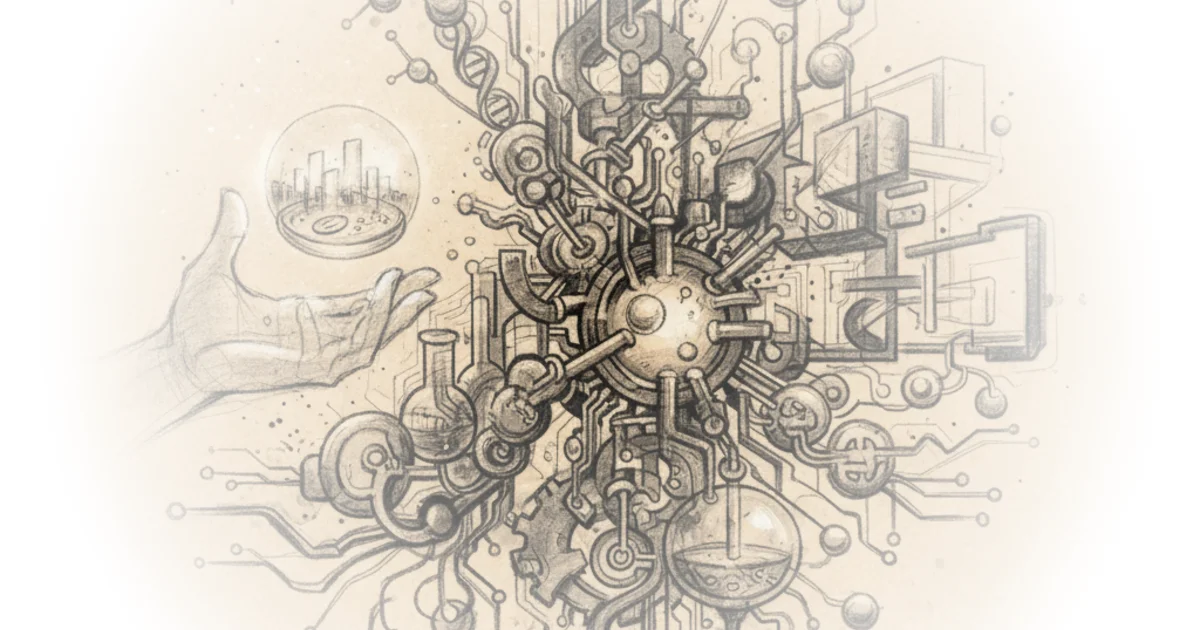
This framing is effective because it forces the reader to reconsider the value of "old" technology. Asimov Press notes, "in many respects, the fact that our scientific devices haven't changed much in the past 50 years also speaks to their tremendous ingenuity and versatility." The commentary here is crucial: we often mistake a lack of change for a lack of innovation, but in the laboratory, stability is a feature, not a bug. The tools work. They are reliable. To replace them with something "new" for the sake of novelty would be a mistake.
The molecular biology laboratory hasn't changed much since the 1960s.
Critics might argue that this focus on physical tools ignores the massive computational shifts happening in the background. However, the authors anticipate this by acknowledging that while AI and computational tools are advancing, the physical interface remains the bottleneck. The project aims to fill a gap in the historical record, positioning itself as an "intellectual companion" to existing histories of chemistry, but with a specific, visual focus on biology.
The Architecture of Discovery
The core of the announcement is a detailed call for contributors to document the hidden history of specific instruments. Asimov Press is not just asking for essays; they are commissioning a forensic investigation into the "why" behind the "what." They ask pointed questions: "Why are these plastic tubes shaped as they are (i.e. Why not square bottoms?), and was Eppendorf the company that first invented them?" and "Who thought up the first flow cytometer, and what did it look like?"
This granular approach elevates the discussion from general history to specific engineering philosophy. The authors highlight the evolution of the PCR machine, noting that early versions were "cobbled together from heating blocks well before programmable thermocyclers arrived." They trace the lineage of the lab coat, questioning the color choice: "Are they white because we associate that color with 'purity' and 'cleanliness,' because they're easier to bleach, or what?" These are not trivial details; they are the design choices that enabled the scientific method to scale.
The piece also touches on the biological tools themselves—the organisms that became the workhorses of research. "Humans domesticated yeast thousands of years ago for bread and beer," Asimov Press reminds us, before noting how scientists later found it "perfect" for eukaryotic research. The history of the E. coli strain BL21, isolated from a Stanford hospital patient, is presented with the same weight as the history of the mass spectrometer. This democratization of history—treating a bacterial strain with the same reverence as a machine—is a bold editorial choice that broadens the definition of what constitutes a "tool."
Scaling the Future
The most urgent part of the proposal looks forward, specifically at the bottleneck of industrial biology. Asimov Press identifies a critical infrastructure gap: "Bioreactors... are also a major limit on our ability to 'scale' biology, and there is a shortage of biomanufacturing capacity in the United States." They are commissioning a long-form essay to explain "why it's so difficult to make more bioreactors."
This is where the piece moves from history to policy. The inability to scale up from the bench to the factory floor is a known problem in the bio-economy, yet it is rarely discussed in terms of the physical engineering challenges of the vessels themselves. By asking "How did engineers first control temperature, pH, and oxygen levels in a sealed vessel?" and then pivoting to the modern shortage, the authors connect the dots between historical innovation and current supply chain fragility.
The final section, "Laboratory of the Future," invites speculative fiction alongside non-fiction. Asimov Press asks, "What should the lab of 2060 look like?" They reference past visions that "never came to pass" and current projects like DynamicLand. This suggests that the path forward isn't just about better machines, but a fundamental rethinking of how humans and tools interact. "Why has the evolution of the laboratory been so slow," they ask, "and what challenges stand in the way?"
We clearly need to update our equipment, especially as AI and computational tools advance.
The tension here is palpable. The authors admit that while the current tools are brilliant, they may not be sufficient for the next century of discovery. The call for "visions of how we could reinvent the laboratory itself" is a challenge to the scientific community to stop assuming the future will look like the past. A counterargument worth considering is that the slow evolution of the lab is due to regulatory inertia and risk aversion, not just a lack of engineering ideas. The piece hints at this but focuses more on the design possibilities.
Bottom Line
Asimov Press has successfully reframed the narrative around scientific infrastructure, arguing that the "stagnation" of the modern lab is actually a story of profound, under-appreciated success. The strongest part of this argument is the insistence that history matters: you cannot design the future of biology without understanding the specific, often accidental, choices that built the present. The biggest vulnerability is the sheer scope of the project; documenting the history of every tool, from the vortex mixer to the HeLa cell line, is a monumental task that risks becoming a catalog rather than a cohesive narrative. However, if executed well, this book could become the definitive guide to the physical world of science, reminding us that before there was code, there was glass, agar, and the human hand.